
This week the smart glasses conversation was, once again, about cameras. Meta's super sensing prototype that records everything, the privacy backlash reshaping how people wear their Ray-Bans, New York banning smart glasses from every courthouse in the state. It is the dominant AR story of 2026, and it is a story about expensive, camera-equipped, AI-driven eyewear trying to convince a wary public that a computer with a camera belongs on your face. Meanwhile, with almost no drama, XREAL shipped a pair of AR glasses in the United States for $299 that has no camera, no AI, and no interest in overlaying the world. It might quietly outsell all of them. And understanding why is the most useful thing you can do to figure out where AR actually stands right now.
Everyone Is Fighting Over $2,000 AI Glasses. XREAL Just Shipped the AR People Actually Buy, for $299.
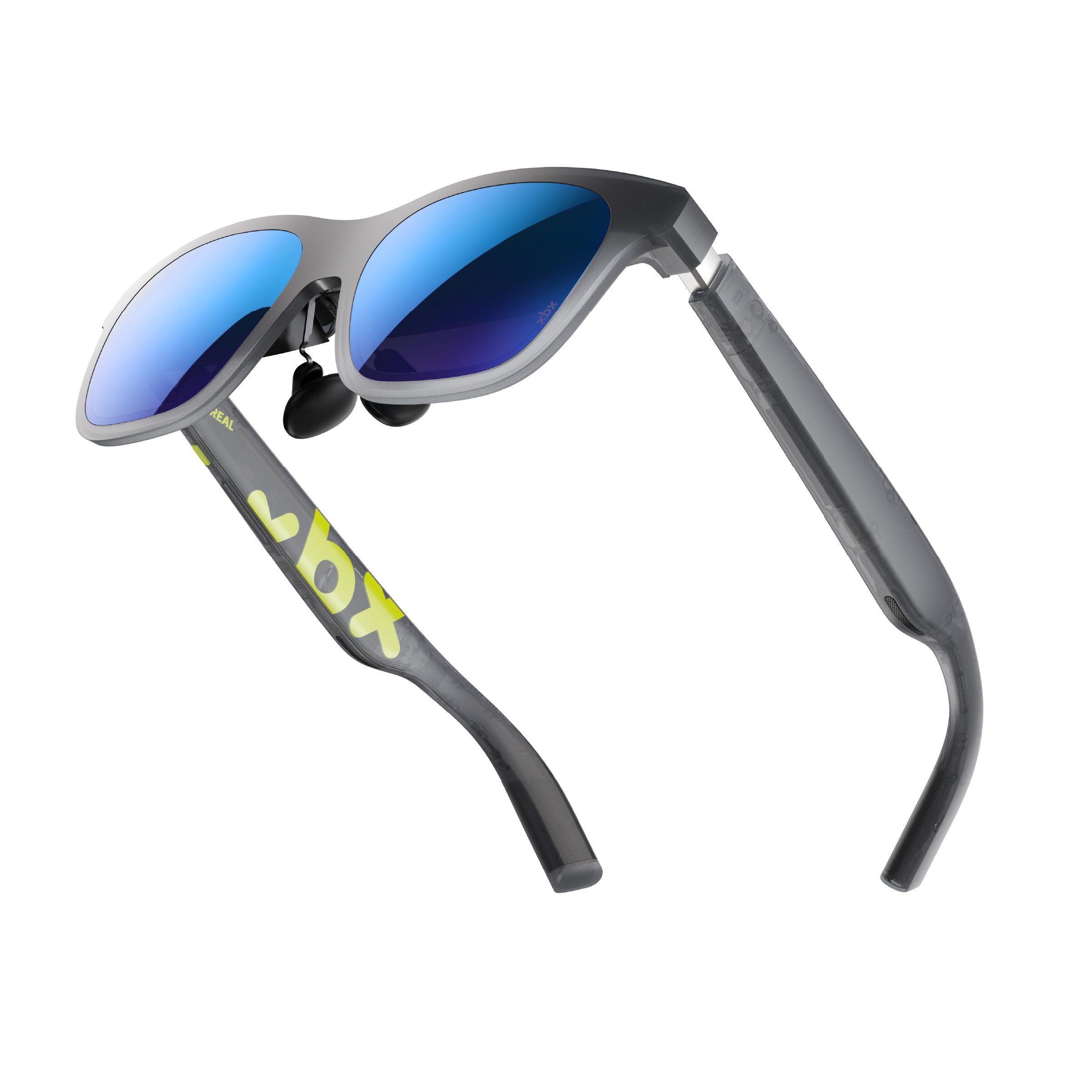
What the a01+ actually is
The X by XREAL a01+, launched this week for $299 through xreal.com, Amazon, Best Buy, B&H, and Micro Center, does exactly one thing, and it does it very well. Put them on, plug them into a phone, a laptop, or a handheld, and you get an enormous private screen floating in front of you, the equivalent of a 147-inch display viewed from a few meters away. The panels are dual 1080p micro-OLEDs running at 120Hz across a 50-degree field of view, with HDR10 and peak brightness around 1,600 nits, driven by an image engine co-developed with Pixelworks and a stabilization system that keeps the picture steady while you move. Reviewers are calling the screen bright, sharp, and genuinely good for both movies and gaming.
They weigh 62 grams, which is barely more than a chunky pair of sunglasses, and there is a specific reason they are that light: there is no camera and no battery inside them. They borrow power from whatever you connect them to. That is not a limitation the marketing is hiding. It is the entire design philosophy, and it is why these work.
Leaving things out is the whole strategy
Look at what XREAL chose not to build. No camera means no privacy problem, no capture LED, no social friction, no reason for anyone around you to be uncomfortable, and no weight or cost from the sensor stack. No battery means nothing heavy sitting on your face and nothing to charge. No onboard AI means no expensive processor and no dependence on an unproven assistant. By subtracting all of the things the rest of the industry is fighting over, XREAL landed at 62 grams and $299, and produced something you can actually use for hours without your neck or your wallet complaining.
Set that against the headline AR products of the year. Snap's Specs arrived at $2,195 as a fully standalone camera-and-AI device, which we covered when XREAL's own higher-end AURA undercut it. Meta's camera glasses triggered a genuine public backlash. Even the privacy-first startups making the anti-camera argument, like the billion-dollar Even Realities, are still building display-in-lens AI eyewear that averages closer to a thousand dollars. XREAL just shrugged and shipped a wearable monitor for the price of a decent pair of headphones.

This is the AR that actually sells
Here is the part the industry keeps underrating. Display glasses solve a problem people already have and already understand. Everyone knows what a big screen is for, and everyone has been stuck watching a movie on a tiny phone on a plane, or wished their handheld had a bigger display, or wanted a private monitor in a cramped space. The a01+ answers that instantly. There is nothing to explain, no behavior to change, no future to believe in. You plug it in and you get a giant screen. That is a product, not a bet.
Compare that to the pitch for AI camera glasses, which asks you to pay a lot of money, accept a camera on your face, trust an AI to be useful, and wait for developers to build experiences that mostly do not exist yet. One of these is a hopeful vision of the future. The other is a thing you can use tonight. XREAL has spent years quietly building this display-glasses category, and it is the single part of the AR market with real, repeat, paying customers, precisely because it is not asking anyone to take a leap of faith. Dropping the price to $299 and putting the glasses on the shelf at Best Buy and Micro Center is how a niche enthusiast gadget becomes something normal people buy.
The connection to where our readers already are
There is a reason this matters to a VR and gaming audience specifically. These glasses are a natural companion to the exact hardware that is surging right now. Connect them to a gaming laptop, a phone, or a handheld like a Steam Deck, and you have a portable big-screen gaming setup with a 120Hz refresh rate, which reviewers found smooth enough to play fast games on. As PC gaming keeps going portable and streaming-first, a lightweight 147-inch screen you can throw in a bag is an obvious pairing. The affordable display-glasses category and the handheld and streaming boom are pulling in the same direction, and the a01+ sits right at that intersection.
The honest limits
Let me be clear about what these are not, because it matters. The a01+ is not true augmented reality in the ambitious sense. It does not anchor objects to your room, it does not understand what you are looking at, it has no camera and no AI, and it needs a tethered device to power it and feed it content. A purist will tell you it is a head-mounted display, not a spatial computer, and they are technically right. The 50-degree field of view is a private cinema screen, not a window onto a digital world layered over reality.
But that honesty is exactly why the product works. It never overpromises, so it never disappoints. It is not trying to be the everything-glasses of 2030. It is trying to be a great screen you can wear, today, for a fair price, and it succeeds.
Why this is the more important launch
The expensive AI-glasses camp, Meta, Snap, Google and Samsung's Android XR partners, is fighting over the future of the form factor, and that fight is genuinely important. But the display-glasses camp is winning the present, and the present is where actual adoption happens. Millions of people are going to have their first experience wearing a screen on their face not through a $2,000 camera device that spooks their friends, but through a $299 pair of glasses that plays their movies and games and asks nothing of them. That first taste is what builds the comfort, the habit, and ultimately the market that the AI-glasses camp needs to eventually sell into.
So when you read another breathless reveal of camera glasses that see everything and cost as much as a laptop, remember what quietly happened this week. The flashiest AR is not the AR that sells. XREAL put a movie theater on your face for $299 and stocked it at Best Buy, and that unglamorous, camera-free, deeply practical little product may end up doing more to put AR glasses on real faces than anything with a keynote behind it.