
There was a time when the pitch for VR training required a leap of faith. Companies would listen to the concept, nod politely, and ask whether the numbers actually worked. That conversation is over. A Forrester Total Economic Impact study commissioned by Meta provides the clearest financial case for enterprise VR training to date, and the numbers are difficult to argue with.
EnterpriseApril 14, 2026
Enterprise VR Training Now Returns 219% ROI. The Business Case Is Over.
By Sam Whitfield
Contributing Writer, VR.org
Advertisement
The headline figure is 219% return on investment over three years. For a composite organization of 10,000 employees with 3,300 trained via VR, the study found $6.1 million in benefits against $1.9 million in costs, producing a net present value of $4.2 million. Payback arrives in under six months.
Where the savings come from
The ROI is not driven by one dramatic cost reduction. It is the accumulation of efficiencies across the training pipeline. User onboarding accelerates by 25%. Task worker training times drop by 75%. Business user training times are cut in half. Those percentages translate directly into hours saved, which translate into payroll dollars not spent on extended training programs.
The per-learner cost tells the story in simpler terms. VR training drops to roughly $115 per person over three years, which is nearly 50% below what traditional instructor-led methods cost. At 375 learners, VR breaks even with classroom training. At 3,000 learners, it is 52% cheaper. At 10,000, it is 64% cheaper. The economics improve at scale, which is exactly the trajectory that makes enterprise procurement teams pay attention.
The adoption numbers
This is no longer an early adopter conversation. According to multiple industry surveys, 91% of enterprises are either actively using or planning to adopt VR and AR training. 75% of Fortune 500 companies are implementing VR in 2026. One in four enterprises is operating VR training at scale. A third of businesses have fully deployed VR and AR and are now expanding their programs.
The market reflects that momentum. The global VR enterprise training market reached $10.96 billion in 2026 and is projected to grow at 44.88% annually, reaching $212.7 billion by 2035. Those are not speculative projections from VR enthusiasts. Those are figures that show up in enterprise budgets and investor presentations.
What real deployments look like
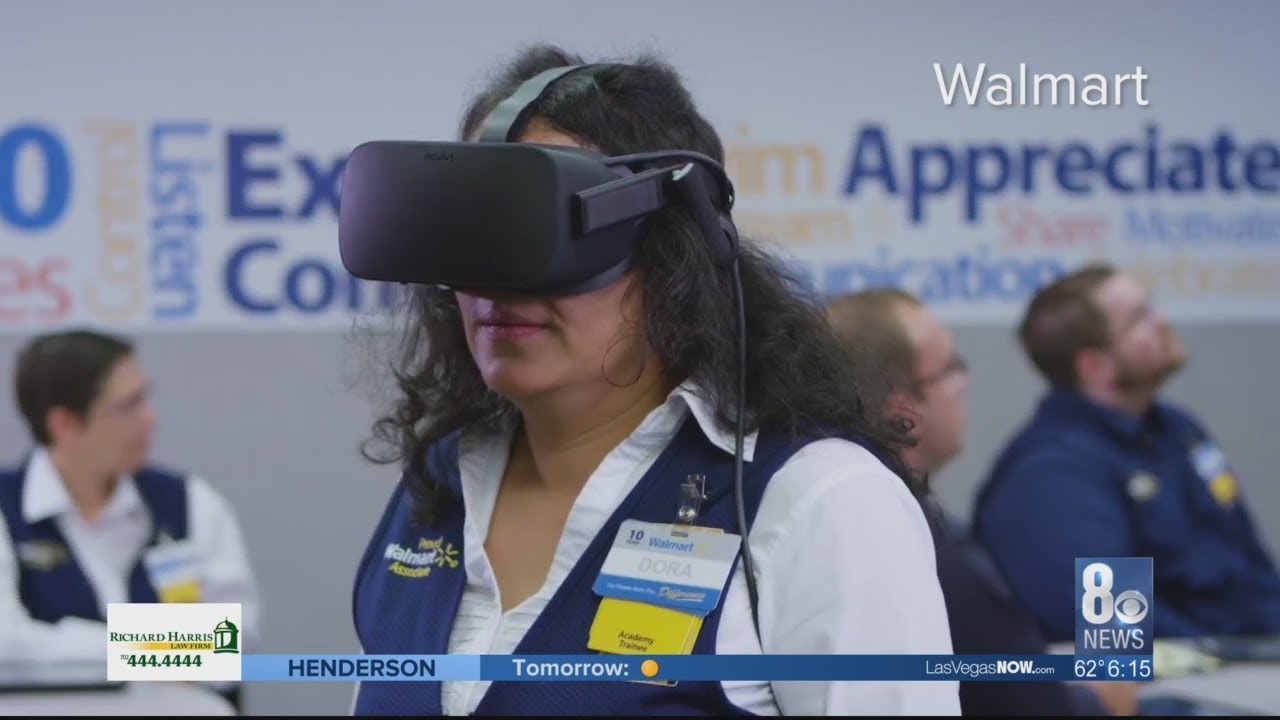
Walmart remains the most frequently cited example, and for good reason. The company has trained over one million employees through VR with results that are hard to dismiss. Pickup Tower training went from 8 hours to 15 minutes, a 96% time reduction. Employee satisfaction scores increased 30%. Test scores improved by 5 to 10%. Content retention rose 70%. Employee retention increased 10%, which at Walmart's scale represents significant savings in turnover costs alone.
Bank of America has put over 50,000 employees through VR training via the Strivr platform. Accenture built the Nth Floor, a virtual campus running on Meta Quest for onboarding and collaboration. In healthcare, VR aseptic training saves up to $23,000 per trainee-trainer pair by reducing the need for physical lab time and instructor presence.
These are not pilot programs. These are production deployments running at enterprise scale with documented, repeatable results.
The science backs it up
PwC research found that VR learners are 3.75 times more emotionally connected to the material, 4 times more focused, and 2.3 times more engaged than classroom learners. Systematic reviews confirm VR exercise and training improves physiological, psychological, and rehabilitative outcomes compared to traditional methods. A mining firm saw a 43% reduction in lost-time injuries after implementing VR safety training. Intel reported 300% ROI on their VR safety program over five years.
The effectiveness data aligns with what the financial data shows. VR training works better, costs less at scale, and produces measurable business outcomes that justify the investment. The hardware cost curve helps too. VR headset prices have decreased roughly 60% since 2016, making enterprise deployment increasingly affordable.
Where this goes next
The remaining barriers are not about whether VR training works. They are about implementation logistics. IT departments need to manage device fleets. Content needs to be created or licensed for specific training scenarios. Change management requires buy-in from training teams accustomed to existing methods.
But those are standard enterprise deployment challenges, not VR-specific problems. Every new enterprise technology goes through the same adoption curve. The difference with VR training in 2026 is that the ROI data is already there. The case studies are already there. The Fortune 500 deployments are already there. The argument is settled. What remains is execution.
Advertisement