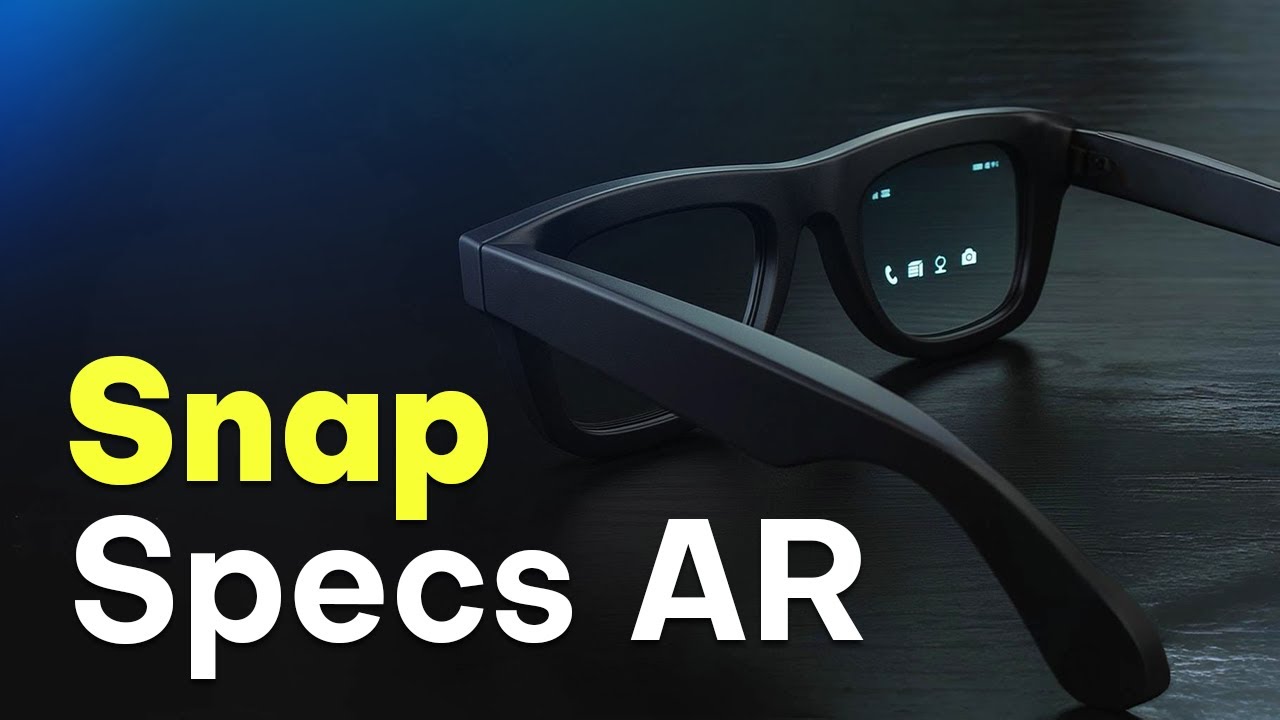
Snap Will Ship True AR Glasses Before Google's HUD. The $2,500 Price Is Not a Mistake.
By Sam Whitfield
Staff Writer, VR.org
Share
Editor's note, September 23, 2026: This article's comparisons with Google and Meta rely on launch details that did not hold up. The correction at the end of this article sets out the record.
Alex Heath's reporting on Wednesday night put a price and a quarter on a product the rest of the smart glasses industry has been politely pretending is years away. Snap Specs ship this fall at roughly $2,500. They are true binocular AR glasses with on-device compute, full-color waveguide displays, and the Specs OS that Snap has been building inside a quietly spun-off subsidiary since April. They will arrive before Google's $799 Android XR Warby Parker frames ship in October, before Meta's next-generation Hypernova lands in Q1 2027, and at a price that says, very clearly, that Snap is not pretending to compete with either company.
Advertisement
Watch the trailer on YouTube →
I want to walk through why the $2,500 number is the most important data point in the smart glasses category this quarter, what it tells you about how Snap reads the market, and what it means for the two competitive analyses I have written over the last week.
What Alex Heath Actually Reported
Heath's piece, published Wednesday evening, names three specific things. The first is the fall 2026 ship window, with September and October as the candidate months. The second is the price, which he describes as "approximately $2,500" with the explicit note that Snap has not finalized on the figure but the band is set. The third is that the product is the consumer Specs build, not a developer kit and not the next-generation Specs that Snap teased at its 2024 Partner Summit. This is the device that two and a half years of Specs Inc engineering work has been pointing at.
Heath has been the most reliable source on Snap's AR program for years. When he says a price band is set, the band is set. The exact number will probably land between $2,400 and $2,600 depending on storage configuration and whether Snap bundles any prescription support out of the gate. The order of magnitude is the data point. Snap is launching a consumer AR product at three times the price of Meta's Ray-Ban Display and roughly the same price as a sixteen-inch MacBook Pro.
What Is Actually Inside the Glasses
Specs as currently built are genuinely a different category of device than what Meta and Google are shipping. The Specs prototype Snap demoed last September weighs 226 grams, runs a Snapdragon AR1 platform with a custom Snap silicon co-processor for the display pipeline, drives two full-color waveguide displays at 37 degrees of field of view per eye, and does all of its compute on the device itself with no paired phone. The audio is open-ear directional. The cameras are stereoscopic for hand tracking and world understanding. Battery life is 45 minutes of active AR use, longer for idle.
Compare any one of those specs against Meta's monocular Ray-Ban Display or Google's projected HUD partners. There is no comparison. Specs are a different product. The Ray-Ban Display is a notification surface stapled to a Ray-Ban. The Android XR launch partners are HUD-style information overlays. Specs are the thing the analyst class has spent five years calling "real AR" and confidently predicting was four to five years out. Snap is putting it on shelves in five months.
Who $2,500 Is Actually For
I want to be very direct about this. $2,500 is not a consumer price for eyewear. The average American spends roughly $250 on a pair of prescription glasses, and the people who spend $700 on Ray-Bans do not typically spend another $1,800 to upgrade them with circuits. The $2,500 SKU is not aimed at the customer who was deciding between a Ray-Ban Meta and a Warby Parker Android XR.
It is aimed at three categories of buyer, in roughly this order. First, AR developers and Snap's existing creator economy. Snap has been paying creators for Specs content since 2023, and at this point there is a small but real ecosystem of Lens developers who want hardware that can run the more ambitious projects they cannot ship to phones. They are paying $2,500 for the dev kit they wish Apple Vision Pro had been. Second, enterprise pilots. The same hospital, manufacturing, and field-services customers who were the original Vision Pro buyer base at $3,499 are exactly the buyer base for a $2,500 product that does the same job in a form factor that does not look like a snorkel. Third, the technology-adjacent enthusiast who buys early-generation hardware to be on it first. That buyer paid $3,499 for Vision Pro, $1,000 for Quest Pro, and $2,500 will not deter them.
None of those buyers overlap with Meta's Ray-Ban Display customer or Google's Warby Parker customer in any meaningful way. That is the entire competitive read on the price.
What Snap Is Actually Doing
Jordan covered the Specs Inc spin-off in early April when Snap's then-AR-lead Scott Myers exited and Snap formed a new subsidiary entirely dedicated to AR glasses. He followed up a week later with the Qualcomm multi-year deal that locked in Snapdragon XR as the silicon platform for consumer Specs. At the end of April, Jordan wrote up the most counterintuitive Snap move of the year, which was that Snap cut 1,000 employees in a 16-percent layoff and protected the Specs Inc headcount, including adding net hiring inside the subsidiary. Spiegel did all of this while activist investor Irenic Capital was publicly arguing that Snap should shut Specs down to stop the $3.5 billion bleed.
Stack those three moves against Heath's reporting and the picture is coherent. Spiegel decided, somewhere between the Myers exit in early April and the layoff in late April, that Snap's path forward was to ship Specs at any price that recovers per-unit margin and to let the rest of the company contract around it. The $2,500 SKU is the price that makes that math work. Snap is not optimizing for unit volume. They are optimizing for the demonstration that Specs Inc can produce a shippable consumer AR product, which buys the subsidiary another funding round and another two years of runway to ship the next-generation Specs at a more aggressive price.
Watch on YouTube →
The Apple Vision Pro Adjacency Nobody Is Talking About
The price point Snap chose is not a Meta price point and is not a Google price point. It is one notch below Apple Vision Pro at $3,499, and roughly twice Quest Pro at the original $1,500. Read that as positioning and Snap's strategic geometry comes into focus. Snap is not trying to take customers from Meta or Google. Snap is trying to take customers from Apple.
Advertisement
That is not as crazy as it sounds. Apple Vision Pro has reportedly sold around 380,000 units to date according to IDC's latest estimate, and the install base is split between developers, enterprise pilots, and the early-adopter consumer cohort. All three of those buyer pools are reachable for a $2,500 consumer AR product that ships before Vision Pro 2, which we now know is at least two years out. If Snap captures even 15 percent of the existing Vision Pro buyer base over the next twelve months, that is roughly 60,000 units at $2,500 plus subscription revenue, which is enough to make Specs Inc cashflow-positive on a per-unit basis for the first time since the program started.
This is also the read that makes sense of Snap's product positioning over the last year. The Specs demos in September emphasized social presence, multiplayer, and creator content. Those are not Ray-Ban Meta use cases. Those are Vision Pro use cases delivered in a 226-gram form factor instead of a 600-gram headset. Snap is making the argument that AR glasses can do most of what Apple's headset does without the comfort tradeoffs.
What This Means for the Meta and Google Reads
I wrote yesterday that the most interesting move in Meta's response to Google's I/O ship date was the price hold on the Ray-Ban Display. Meta did not cut prices because doing so would validate the competitive threat and damage the pricing arc for Hypernova in Q1 2027. The Snap announcement does not change that read, but it adds a third axis. There is now a true-AR product at $2,500, a HUD product at $799, and a notification-surface product at $379. That is not one market with three competitors. That is three different markets that happen to share the word "glasses."
Meta and Google are competing for the same buyer in the same market. Snap is opting out of that fight. The strategic question for both Meta and Google is whether Snap's $2,500 product proves that there is a real consumer appetite for true AR at that price point, which would in turn make their roadmaps look thin. If Snap ships 200,000 units at $2,500 over the next twelve months, every Hypernova specification meeting at Reality Labs gets reopened. If Snap ships 50,000, the read holds and Meta and Google can keep their current product paths.
What Snap Cannot Do
I want to be careful here because it is easy to over-credit a leak. Snap does not have EssilorLuxottica's 18,000-store global retail footprint. Snap does not have Warby Parker's 270 North American stores. Snap will probably sell Specs through snapchat.com and a small number of pop-up retail experiences in major metros, the same channel structure they used for the developer Spectacles SKUs. That is a fundamentally weaker distribution surface than Meta's or Google's, and it caps the addressable market in ways that matter.
Snap also does not have a phone OS to lean on. Meta has Horizon OS. Google has Android. Snap has Snapchat, which is a great social product and is not a platform layer in the sense that matters for hardware adjacency. The Specs OS is Snap's attempt to invent that layer, and it is operating without the gravity of a billion-installed-base operating system pulling apps toward it. Specs will live or die on whether Snap can convince Lens developers and a handful of enterprise vendors to build for the platform in the next twelve months.
And Snap does not have a model. Meta has Llama. Google has Gemini. Apple has Apple Intelligence and the Siri stack. Snap has Snapchat's on-device computer vision pipeline plus partnerships with OpenAI and Anthropic, which is enough to ship a usable consumer AR product but is not enough to compete on the AI-first frame that Google is pushing with Android XR. If the next twelve months of AR glasses are decided by which device has the best AI assistant, Snap is not the winner of that fight.
What to Watch Between Now and the Fall Launch
Four things will tell you how seriously to take the Heath report. The first is whether Snap confirms publicly before the end of June. Spiegel has historically used the Q2 earnings call to set up Specs Inc milestones, and the Q2 call is in mid-July. If the $2,500 price and fall launch window are real, Spiegel will either confirm on that call or step on it with an event of his own before then.
The second is whether the launch partner list grows beyond snapchat.com. Snap reportedly had retail conversations with both Verizon and Best Buy in late 2025. If either partner shows up in pre-launch marketing, the distribution thesis above shifts and Specs become more reachable for the kind of buyer who needs to try a $2,500 product before paying for it.
The third is the Apple WWDC response on June 8. Vision Pro 2 is not at WWDC, but a software-side response to a credible Snap launch might be. Apple has been quiet about visionOS roadmap details since the John Ternus leadership transition, and a public commitment on price, on form factor work, or on a developer program adjustment in early June would tell you Apple read the Heath piece the same way I am reading it.
The fourth is the Meta response. Bosworth posted within six hours of Pichai's keynote last week. The clock starts now on whether he or Mark Zuckerberg posts a similar reaction to the Snap reporting, and the absence of a response is also a data point. If Meta stays silent through the rest of May, the read is that they consider Specs a different market and not a competitive threat. If they post, the read flips and Hypernova becomes a much more interesting conversation.
The Honest Read
Snap is shipping a product Meta is not building and Google is not building. The price says exactly that. Whether $2,500 is the right price for the actual product is a question the market will answer over the next twelve months, and the answer matters less for Specs Inc than it does for the broader AR roadmap at the two larger competitors. If Specs sell, the entire industry's product cycle moves up. If Specs flop, Meta's Hypernova and Google's Android XR HUD path get another twelve months of clear runway.
The thing I keep coming back to is the timing. Spiegel decided to bet the rest of Snap on Specs Inc somewhere between Scott Myers' resignation in early April and the layoff announcement two weeks later. He did it while an activist investor was demanding the opposite. He did it with $3.5 billion of accumulated burn already on the program and no clear path to break-even at the unit level. And the result of that bet is now visible: a $2,500 consumer AR product that ships in five months, before any direct competitor's similar product is ready, in a market that does not currently exist at consumer scale.
That is either the most prescient hardware decision Spiegel has ever made, or the most expensive. The fall launch will tell us which.
Correction, September 23, 2026: Google did not announce a $799 price or an October ship date for Android XR glasses; its May 19 announcement said audio glasses are coming later this fall, with no price. The Q1 2027 timing for Meta's next-generation Ray-Ban Display came from a report we cannot find, and no new Display hardware was announced at Connect on September 23, 2026. The roughly $2,500 Specs figure was a pre-launch report; Snap opened preorders in June at $2,195.