
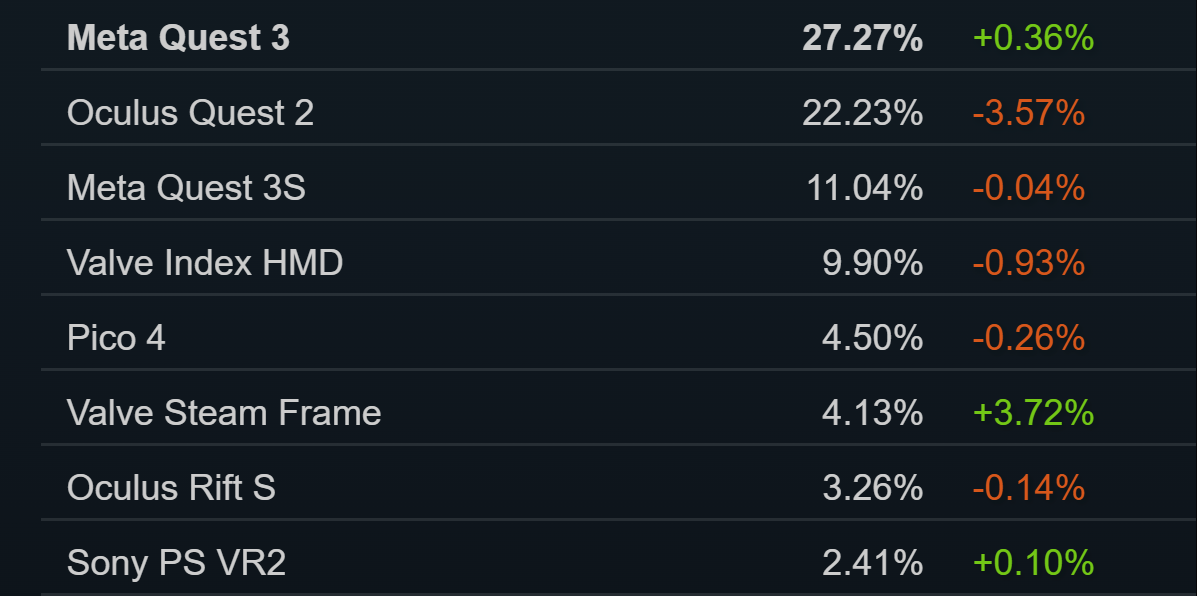
One in 24. That is the Steam Frame's share of VR headsets on Steam for October, its first full month on sale, and Valve is still selling it through a reservation queue.
HardwareNovember 2, 2026
The Queue-Only Steam Frame Is Now 1 in 24 VR Headsets on Steam, but Only a Sixth of October's Jump in VR Users
By Alex Reeves
Staff Writer, VR.org
Advertisement

The number comes from Valve's hardware survey, in which Steam asks users once a month what hardware they have connected, with answers optional and anonymous. The October table puts the Frame at 4.13 percent of connected headsets, up from 0.41 percent in September. September covered 13 days of sales and October covers all 31. It is not a sales figure, and Valve does not publish one.
Access has not changed. Purchase emails began September 18, and Valve said on October 9 that reservation holders will get their order email "by December, or in 2027." The waitlist has no date at all.
Within those limits, the gain is large. At 3.72 points it is about ten times the next-best named headset, Quest 3 at 0.36, and the Frame now ranks sixth among named rows, 0.37 points behind Pico 4. All six HTC rows added together reach 3.83 percent, and the Frame alone beats that.
Where the 0.40 points came from
Another VR line moved too. Steam users with a VR headset rose from 1.35 percent to 1.75, the highest reading since January's 1.77. A new Valve headset and a jump in VR on Steam, in the same month, look connected. Mostly, they are not.
Start with the arithmetic. The Frame's 4.13 percent is a share of that 1.75 percent, so it works out to about 0.07 percent of everyone surveyed, or 1 in 1,400, against 1 in 18,000 in September. That adds about 0.07 points to the total. It is a sixth of the jump.
Who answered appears to matter more. Simplified Chinese users fell 9.41 points in October to 21.98 percent of the survey, after spiking to 31.39 in September, while English rose 4.84 points to 39.04. Valve publishes no VR figure by language, but the two lines run against each other. VR's share has moved in eight of the ten months of 2026 so far, and all eight went the opposite way from Simplified Chinese. February is the extreme case: Simplified Chinese hit 54.60 percent and VR sank to 1.05.
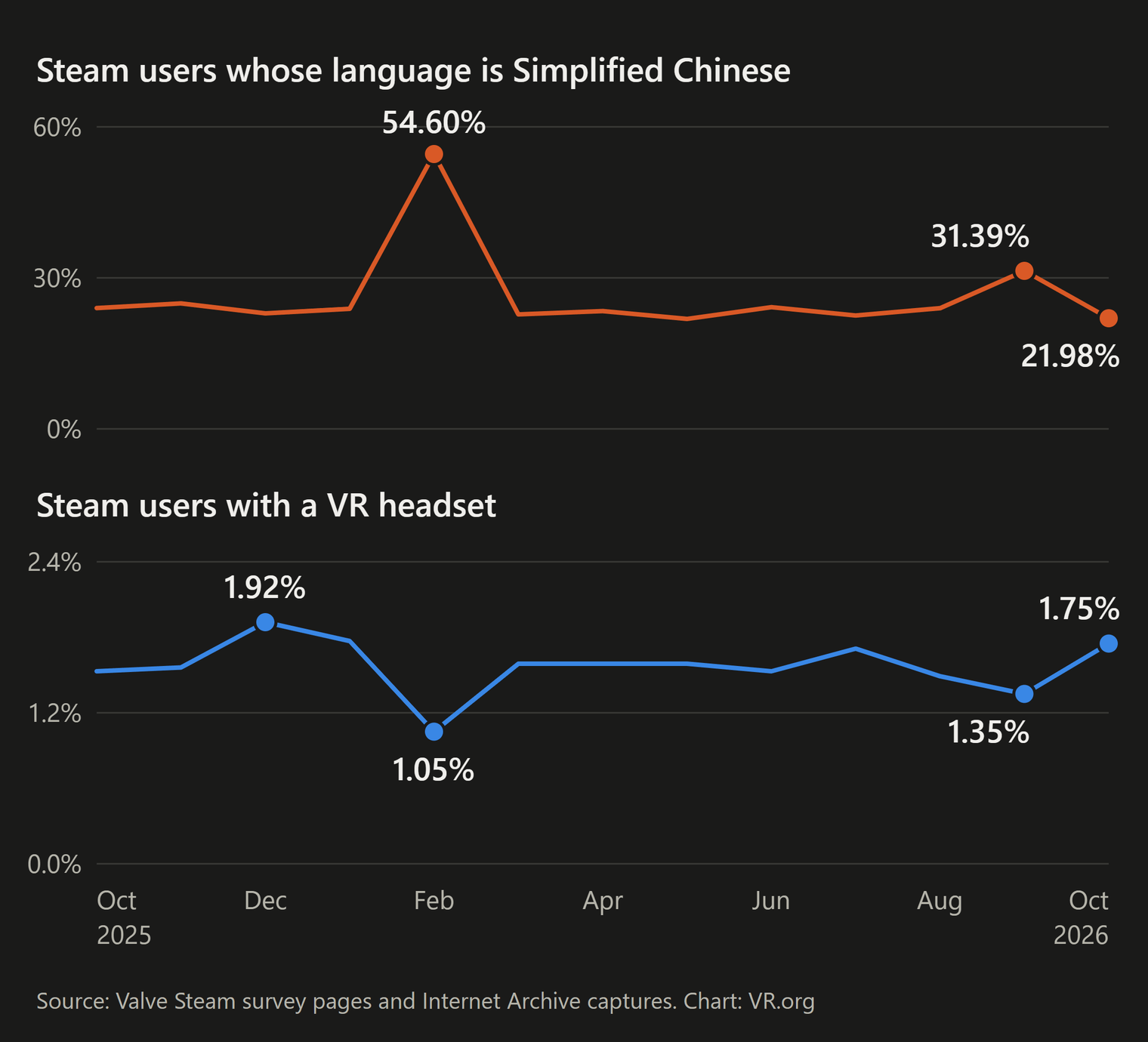
A month with a similar mix makes a cleaner test. July's Simplified Chinese share was 22.52 percent, close to October's, and July's VR share was 1.71 against October's 1.75. That is 0.04 points in three months, less than the Frame adds alone. March and May, also near 22 percent, both read 1.59, so the climb since spring is real and small. Language is only a proxy here, and Valve does not explain the swings.
Quest 2 shows the same effect one row down. It read 22.09 percent in April, 26.97 in August and 22.23 in October, and a six-year-old headset does not gain nearly five points in four months and hand them back in two. This month's 3.57-point drop looks like a loss, yet measured against everyone surveyed Quest 2 went up, from about 0.35 percent to 0.39.
Two rows Valve has not explained
"Other" rose 1.27 points to 2.76 percent, the second-largest gain on the table and bigger than the PS VR2 row. In September, more than half of that bucket's first-published gain turned out to be the Frame, before Valve gave it a line. Valve has not said what sits in it now.
A new row is the second puzzle. Valve's Linux list gained "SteamOS 64 bit" in October, at 0.32 percent of all surveyed users, where September's table had no such line. It sits beside SteamOS Holo at 0.55. The Frame runs SteamOS, and so does the Steam Machine, which shipped June 30. The row is more than four times the Frame's 0.07 percent, so the Frame cannot fill it alone if both rows count the same way. The page does not say what the row measures, or whether a Frame used away from a PC is counted at all.
What it means if you are buying
Quest 3 and Quest 2 together hold 49.50 percent of connected headsets, down from 52.70 in September, and PC VR studios will keep tuning for them first. Nothing here shows VR on Steam growing 30 percent in a month, which is how 1.35 to 1.75 reads on its own.
A reservation still means an email by December or in 2027, and a waitlist spot still means no date. What has changed is the audience a $1,059 buyer joins. One headset in 24 is a row a studio now has to justify skipping, and the games will decide whether that purchase ages well.
Advertisement