
The week could not have been timed better, or worse, depending on whose press release you are reading. On April 27, SightMD announced that Dr. Eric Rosenberg, an ophthalmologist at its Hauppauge, New York surgical facility, had become the first surgeon in the world to perform cataract surgery wearing an Apple Vision Pro. Two days later, MacRumors reported that Apple had effectively given up on the Vision Pro after the M5 refresh failed to move the needle, and that the team was being absorbed into Siri and other groups under Mike Rockwell.
EnterpriseMay 1, 2026
Apple Killed the Vision Pro for Consumers. Surgeons Just Found What It's Actually For.
By Sam Whitfield
Contributing Writer, VR.org
Advertisement
If you are an enterprise XR buyer, the contrast tells you something useful. The consumer story for Vision Pro is over. The enterprise medical story is just getting started, and it has been building quietly for over a year.

The procedure that proved the product
Rosenberg actually completed his first cataract case in October 2025, six months before the public announcement. According to SightMD, he and his team have since performed hundreds of additional procedures using the same setup. That is not a one-off press stunt. That is a working surgical workflow at one of the largest ophthalmology practices in the Northeast, which serves patients across New York, New Jersey, Connecticut, Pennsylvania, and Massachusetts.
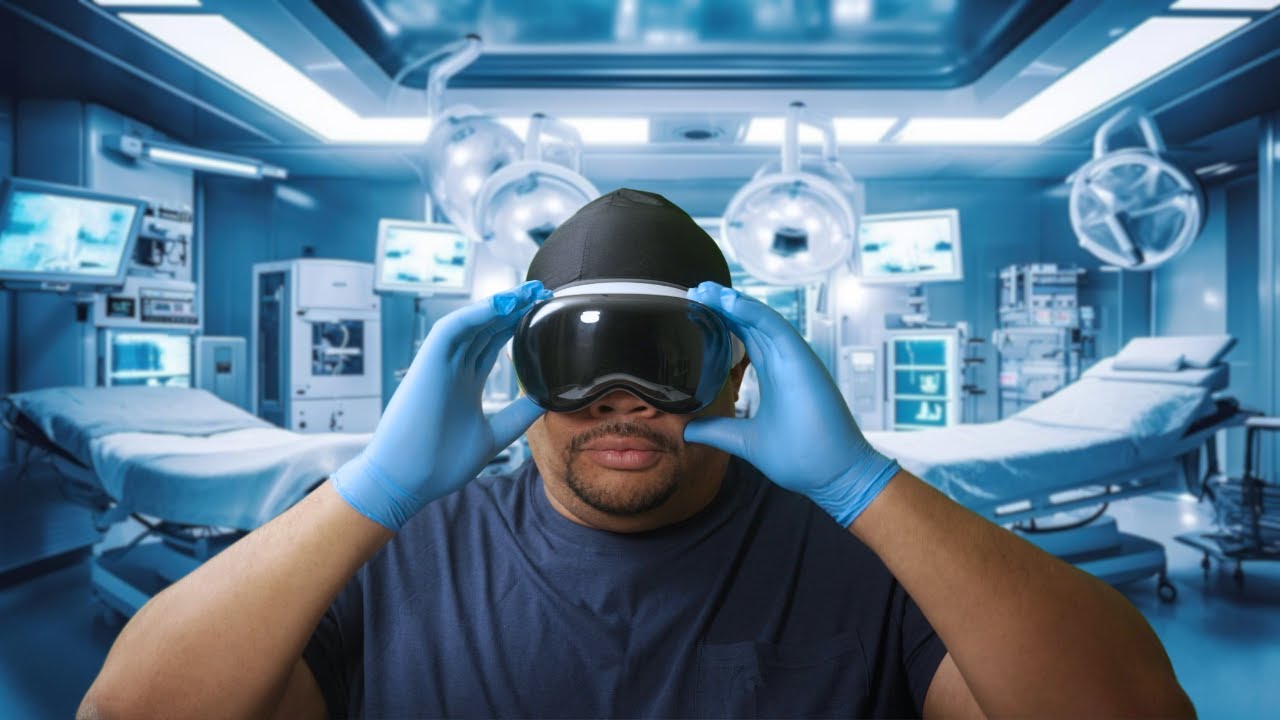
The platform doing the heavy lifting is called ScopeXR, a mixed reality surgical app that Rosenberg co-developed. ScopeXR pulls live feeds from 3D digital surgical microscopes and pipes them straight into the Vision Pro, giving the surgeon a stereoscopic 3D view of the operative field while overlaying preoperative diagnostic data on top. The headset becomes the microscope, the chart, and the second opinion all at once.
The piece that should interest enterprise buyers is the remote collaboration layer. ScopeXR lets a mentor, consultant, or fellow anywhere in the world join a procedure virtually and see exactly what the operating surgeon sees, with secure two-way audio. For a teaching hospital, that is a training multiplier. For a rural practice, that is access to a specialist who would otherwise be a flight away.
The numbers were always pointing here
Vision Pro launched at $3,499 with a clearly stated goal of becoming a mainstream computing device. That goal did not survive contact with reality. Industry trackers reported that Vision Pro sales fell off a cliff in 2025, and IDC's most recent data shows VR and MR headset shipments dropped 42.8 percent over the same period while smaller, lighter, AI-driven smart glasses grew the rest of the XR category by triple digits.
What did keep growing was enterprise demand. IDC and adjacent forecasters now put global enterprise spending on AR and VR at roughly $12 billion for 2026, up close to 20 percent year over year, with a heavy concentration in healthcare, training, and industrial design. The VR enterprise training segment alone is on a path to $212 billion by 2035, growing at a compound annual rate north of 40 percent. Hospitals are buying. Pharma cleanroom programs are buying. Pilot training centers are buying. Consumers, with rare exception, are not.
Advertisement
That is the gap Apple ran into. The Vision Pro hardware was never the problem. The price, the weight, and the lack of a daily-driver use case for ordinary people were the problem. None of those issues apply when the buyer is a surgical group amortizing the headset across hundreds of procedures.
What ScopeXR signals about the next 24 months
The cataract case is not the first time a Vision Pro has been worn in an operating room. Surgeons at UC San Diego have used the headset for more than 20 minimally invasive procedures, and spinal teams in the UK and US have been documenting their workflows since early 2025. What is new with ScopeXR is the productization. There is a vendor, a product name, a co-developer with deep domain credibility, and a deployable workflow with hundreds of cases behind it. That is the threshold a procurement officer needs to write a purchase order.

Expect the playbook to repeat. ScopeXR for ophthalmology will be followed by similar mixed reality apps for orthopedic, neurosurgical, and cardiothoracic workflows, because the technical pattern generalizes. Take a high-resolution medical imaging feed, pipe it into a head-worn display with eye and hand tracking, layer in remote presence, and you have a product the hospital actually wants. The Vision Pro happens to be a very good substrate for that pattern, even if Apple itself does not particularly want to be in the substrate business anymore.
The uncomfortable conclusion for Apple
Apple's strategic pivot to AI-powered smart glasses, codenamed N50 and aiming for a 2027 reveal, makes sense for the consumer roadmap. It does not, however, address the installed base of Vision Pro hardware that is now actively running in operating rooms, simulators, and design studios. If Apple stops investing in the platform, the medical and industrial software vendors who built on it have to ask hard questions about long-term support.
The market answer to that question is already visible. Samsung's Galaxy XR, Pico's Project Swan, and Valve's Steam Frame are all positioning, in different ways, to capture the high-end mixed reality buyer. None of them have the polish or the developer mindshare Apple built up, but enterprise buyers care about reliability and roadmap, not brand cachet. If Apple cannot offer either, somebody else will.
Which leaves the rest of us with a strange new headline to absorb. The most expensive, most-mocked headset of the decade did not become the productivity revolution Apple sold. It became, of all things, a quietly successful surgical tool. That is a smaller market than Tim Cook wanted, but it is also the market that was telling Apple the truth all along. The pity is that the company seems to have stopped listening right as the customers showed up.
Advertisement