
Atlas is World Labs' world model, and a world model is a model that takes photographs or a text prompt and builds a scene that stays consistent in 3D, so it can render new views, a video, or a splat you can walk through. It was introduced on September 1. As of the release post World Labs dated November 12, you can drive it yourself with a project API key, and the four apps built on top of it are open to anyone who signs in.
SoftwareNovember 16, 2026
World Labs Put Six Atlas Endpoints Behind an API Key, and One of Them Turns Splats Into Meshes
By Nina Castillo
Staff Writer, VR.org
Advertisement
The apps are Viewfinder, which reconstructs a scene from photos or generated images and lets you fly a camera path through it; Chisel, which lets you graybox a scene and watch every camera view update as you push the blocks around; Relight, which relights and reworks a splat scene; and Splats to Mesh, which does what its name says.
Six endpoints, and the rest is plumbing
The interesting part is the API reference, because it is short enough to read in one sitting. Six task endpoints do the actual work: atlasGenerate, atlasChisel, atlasTextToImage, images2PosedRGBD, posedImages2Splats and splats2Mesh, each a POST to /api/v2/tasks: plus the name. Everything else in the reference is scaffolding around them: a health check, an assets collection for uploading and reading files, and an operations collection, with webhooks as a field you can set on any task.
The shape of a job is the same every time. You create a project key, configure the client or sign in from your terminal with the World Labs CLI, POST your task, and get back an operation rather than a result. From there you either poll /api/v2/operations/{operation} or call :wait, which holds the connection up to a server-side cap, then fetch the output through the assets endpoints. There is a :cancel if you fire off something expensive by accident and a :trace that hands back the exact request you sent beside its result, for reproducing a run.
splats2Mesh is the one VR people should open first
A Gaussian splat is a scene stored as a few million soft, colored ellipsoids rather than as triangles. It is a gorgeous format for looking at a captured room, it renders fast on a desktop GPU, and as this site argued in July, it is the technique quietly deciding what photoreal VR content looks like. It is also close to useless the moment you want a player to walk into a wall. Splats have no surface, so a physics engine has nothing to collide with, and an engine's lights and shadows do not land on them the way they land on triangles.

splats2Mesh turns the splat into what World Labs calls a mesh "with real geometry," returned as a GLB, which is the thing you can hand to Unity or Godot and expect collision to work. It can also fit upright collider boxes around the mesh and send them back as a second GLB. Put images2PosedRGBD in front to estimate cameras and depth, then run posedImages2Splats, and you have a three-call path from a set of phone photos to something a headset can run. The splat step alone usually takes 15 to 25 minutes.
Advertisement
Meshes from splats are not new. SuGaR did it in late 2023, and KIRI Engine put a one-tap version in its phone app in March 2024. Doing it from your own code has meant wiring COLMAP, a splat trainer and a meshing step together yourself.
Blender is the only named 3D tool
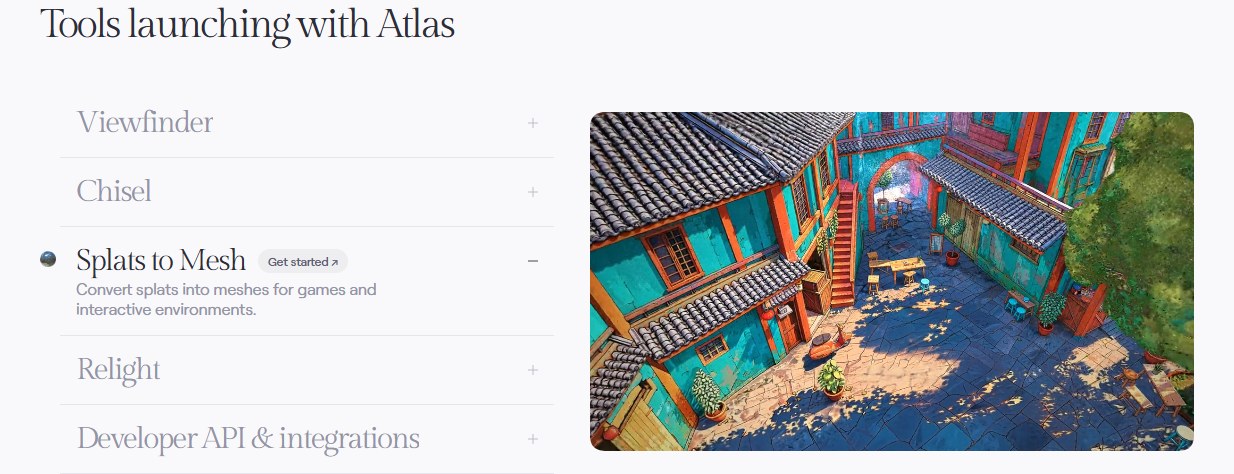
Blender is the only 3D tool the Atlas page names, and the docs add two other integrations: an MCP server for Claude and other agent clients, and Spark.js for rendering splats on the web. No Unity package, no Unreal plugin, no Godot addon. The page lists film, architecture and robotics as its industries, yet it pitches Splats to Mesh "for games and interactive environments," and the GLB it returns is a format Godot imports natively and Unity reads through its glTFast package. Godot users already lean that way; the Blendkit plugin added a prefer-GLTF option for the same reason. What nobody has written yet is an editor plugin that calls those six endpoints from inside an engine. The endpoints are public, so somebody will.
What the docs leave open
The first is a full price list. The billing page sets credits at 1,000 to the dollar, and the splat guide prices a refined posedImages2Splats run at $5, or 50 cents for a draft. The rate card for every other task sits inside the signed-in platform, and the docs warn that it can change. There is no public Atlas pricing page. Check the rate card before you script a batch.
The second is what happens to any of this under AMD. World Labs signed a definitive agreement on September 28 to be acquired in an all-stock deal valued at roughly $8.2 billion, and AMD said Monday morning that the deal has closed, with Fei-Fei Li joining as executive vice president and chief scientist, reporting directly to Lisa Su. AMD says the team will keep advancing foundational model research while working with AMD engineers. Neither release mentions Atlas, or Marble, or the API, by name. If you are about to build a content pipeline on /api/v2, that silence is the part to keep an eye on.
Advertisement