
The entire smart glasses industry is currently fighting over frames, cameras, and fields of view. Meanwhile, a Dubai startup and a Chinese display maker are quietly working on the form factor that could eventually make all of those glasses look bulky: the AR contact lens. XPANCEO and JBD announced they have entered the next phase of their collaboration to co-develop a custom microLED micro-display built specifically to sit inside a smart contact lens, and while this remains firmly frontier technology, the details are worth understanding, because they hint at where this all ultimately goes.
ArJuly 7, 2026
While Everyone Fights Over AR Glasses, Two Companies Are Building the Display for What Comes Next: Contact Lenses.
By Alex Reeves
Staff Writer, VR.org
Advertisement
What they are actually building
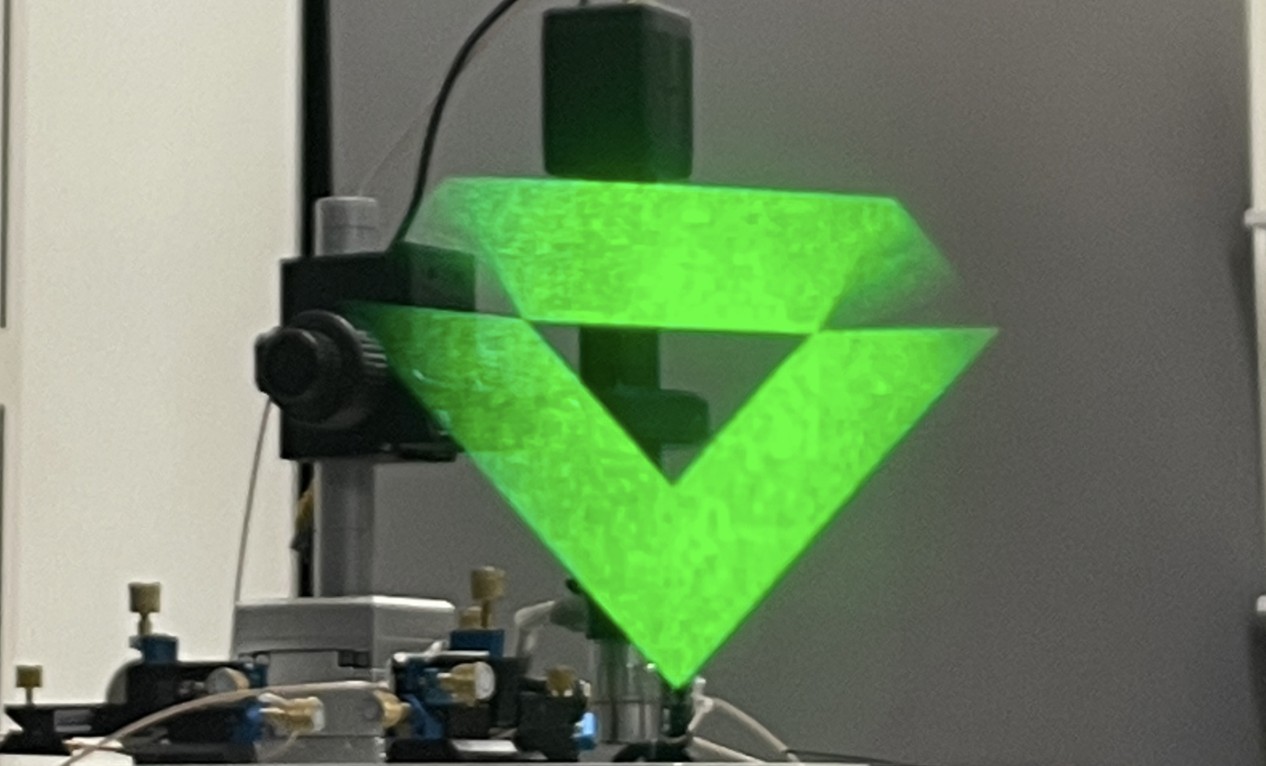
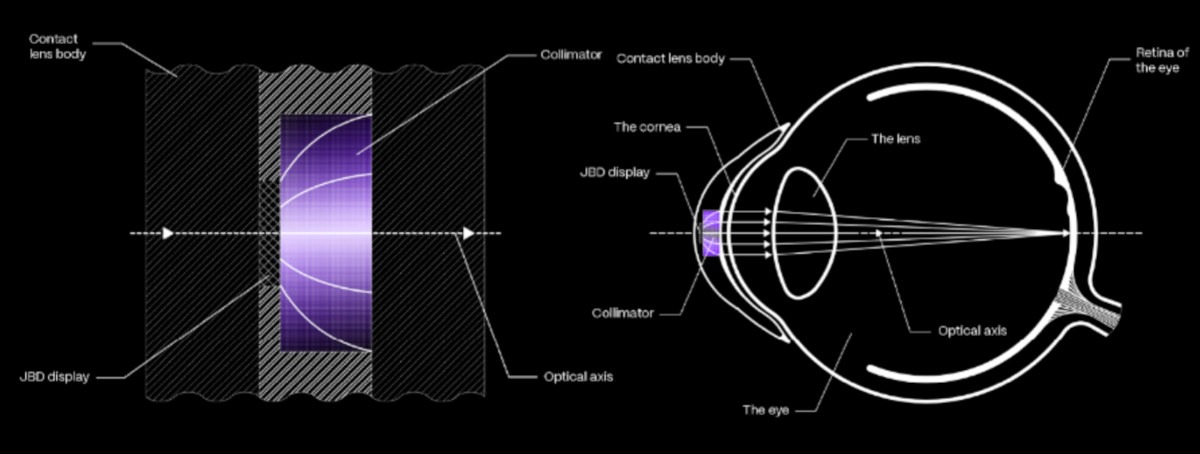
The goal is a display small enough and thin enough to integrate directly into a contact lens you would wear on your eye. That constraint is brutal in a way that is hard to overstate. Every component has to be kept at roughly the thickness of a human hair to remain comfortable and wearable, and the display itself is expected to measure no more than a fraction of a millimeter across. JBD builds microLED microdisplays, some of the smallest and brightest display technology in existence, which is exactly why it is the partner for a job with tolerances this extreme. XPANCEO brings the smart contact lens platform the display has to live inside.
Using JBD's technology, the companies say they have already produced a working prototype with a total lens thickness of under half a millimeter. That is a real object, not a rendering, and for a category that usually trades in concept videos, a physical prototype at that thickness is a meaningful marker.
The specs are genuinely wild
The number that stopped me was the power draw. The display is expected to consume under 10 microwatts, which the companies note is somewhere between 100 and 300 times less than a comparable prospective pair of AR glasses would need. That is not a minor efficiency gain, it is a different universe of power consumption, and it has to be, because there is nowhere to put a battery on a contact lens. Every design decision in this category is dictated by the fact that you are building a computer to float on the surface of a human eye, with no room for the components that make every other device work. Sub-10-microwatt operation is the kind of requirement that sounds impossible until someone quietly hits it.
The part that actually matters
Here is what makes this announcement more than a lab curiosity. This second phase is explicitly focused on scalability and manufacturability, with the stated aim of establishing the first mass-market production run of specialized contact lens microdisplays. That is the tell. Plenty of research teams have shown one-off AR contact lens prototypes over the years. Almost none have shifted their attention to the far less glamorous problem of making the thing repeatably, affordably, and at volume. Moving from can we build one to can we build millions is the transition that separates a science project from a product roadmap, and that is the transition these two are signaling.
The necessary reality check
Now let me be the one to pump the brakes, because this category has earned skepticism. AR contact lenses have been perpetually five years away for a decade, and enormous hurdles remain beyond the display. Powering the lens, transmitting data to it, guaranteeing eye safety, and delivering genuine all-day comfort are each their own mountains to climb, and a display is only one piece of a very hard puzzle. Nobody is buying AR contact lenses this year, or next year, and anyone promising otherwise is selling something. A working display prototype is a milestone, not a product.
But the direction is the point. The entire smart glasses race we cover so closely, the battle between Meta, Google, and Apple and everyone else, is ultimately about shrinking computing until it disappears onto your face. The logical endpoint of that shrinking is not a frame on your nose. It is a display on your eye that no one else can even see. Glasses are a stepping stone. Contact lenses are the destination, and the display has always been the hardest part of getting there. XPANCEO and JBD just moved that hardest part one real step closer, and started worrying about how to build it at scale. That is a long way from a store shelf, but it is exactly the kind of unglamorous progress that eventually changes everything.
Advertisement