
I paid real money to climb into a VR pod sometime in the 1990s, and I could not name the game today if you dangled me over a pit. I remember the helmet. It was heavy, and it was still warm from the last guy.
HardwareOctober 31, 2026
The 8 Creepiest Things VR Hardware Has Ever Done, Ranked, From a Smell Mask to a Headset That Can Kill You
By Evan Marcus
Co-Founder, VR.org
Advertisement

I have argued before that a headset is the best horror machine ever built, but I meant the games. This list is about the hardware, which has spent decades doing deeply unsettling things to the people wearing it and to anyone standing nearby, and almost never on purpose. It is Halloween. I ranked them, mildest first.
First, a word for the founding father. Ivan Sutherland's 1968 head-mounted display tracked your head with "a mechanical arm hanging from the ceiling," which his own paper calls "rather heavy and uncomfortable to use." History named the thing the Sword of Damocles. His paper never does. So the first comfort complaint in VR was filed by the man who built it, and we have been filing them ever since.
8. The wipe-down schedule on a 1990s VR pod
The pods everybody remembers came from W Industries of Leicester, later Virtuality. I cannot swear mine was one of theirs. If it was, that helmet weighed more than six pounds, and the proof comes with a wonderful line from Computer Business Review in 1994, announcing a lighter model: "Strong neck muscles are no longer a pre-requisite."

In 1993, Popular Science found four of these machines in a cordoned-off corner of a sports bar at the Mall of America. Players paid $5 for five minutes of Dactyl Nightmare, in which a pterodactyl "will grab you in its teeth, carry you into the sky, and then hurl you to your death." The writer's review of the hardware: "My head felt like it was trapped inside a pressure cooker."
Neither of those is the creepy part. The creepy part is the 1000CS service manual, which tells arcade staff that "Hourly inspections should be carried out by the operator on the Visette Pads and Lenses," and that "Pads should be cleaned using moist medicated wipes ensuring you cover all areas in contact with the head and face." Hourly. At five minutes a go, that is twelve foreheads between inspections, in a sports bar, at a mall.
7. A mask that promised to smell like zombies
Feelreal raised $140,794 from 561 backers on Kickstarter in 2019, on a $20,000 goal, for a VR mask with scents built in. It promised "over 255 unique aromas," along with a line I have thought about more than any healthy person should: "smell the gunpowder and earthy scent of rotting flesh as you fight off hordes of zombies." PCGamesN listed a Skyrim set ending in "dragon, mountains, and cookie," plus coming attractions that included Baby hair and, a little further down the same list, Zombie.
Then came the December 2019 update, with a sentence that deserves a plaque: "Since Feelreal Mask is technically a vaping device, we had to start a new round of testing and improving the product to get a permission for mass production and sales." Later updates moved on to regulators, then the pandemic, then staff leaving, and the final one, dated November 6, 2020, is the best closing line in this entire genre: "We're here to remind you that the project is still on hold, but still alive."
That was six years ago next week. I could not confirm that a single backer ever got a mask.
Still alive, though.
6. The Virtual Boy instruction booklet
Enough has been said about the Virtual Boy's red screen. Read the paperwork instead. Nintendo's 1995 tabletop headset cost $179.95, and its game manuals open like a threat: "This product MUST NOT be used by children under the age of seven (7) years. Artificial stereo vision displays may not be safe for such children and may cause serious, permanent damage to their vision."

The system instruction booklet then gets personal. It tells you to "Press your face firmly against the eyeshade." It recommends an automatic pause that stops the game after about 30 minutes so you can "give your eyes some rest." It asks you to "listen to the signals your body is giving you," which is the sort of thing a stranger says to you in a dream. And in capitals, on a page about batteries: "FAILURE TO FOLLOW THE FOLLOWING INSTRUCTIONS MAY CAUSE THE BATTERIES TO MAKE 'POPPING' SOUNDS AND LEAK BATTERY ACID RESULTING IN PERSONAL INJURY AND DAMAGE TO YOUR VIRTUAL BOY OR ACCESSORY."
Nintendo brought the Virtual Boy back this year for Switch, and the leaflet for the cardboard model includes this: "Do not press sharp cardboard points or sides against the skin." Thirty-one years, and the threat level has dropped from your retinas to a paper cut.
5. Sega VR, the headset that was too realistic
The great legend. Sega showed a VR headset for the Genesis at Summer CES in Chicago in 1993, and Sega Visions promised it "in time for Christmas this year" for less than $200. Popular Science quoted the company's pitch of "a completely realistic 360-degree game world." It never shipped, and the reason every VR fan can recite is that Sega killed it for being too realistic, because kids might forget where they were and hurt themselves. It is the greatest excuse in the history of consumer electronics, and I have repeated it at parties.

So I went looking for Sega actually saying it, and I could not find it anywhere. The earliest version I can locate that calls it an official Sega line is a 2004 Sega-16 article, a decade after the fact, with no source attached. What the man running Sega of America told Electronic Gaming Monthly in December 1994 was far less fun. Tom Kalinske said the units in Japan's theme parks cost about $5,000 and "The unit shown at CES just didn't deliver the VR experience." Two decades later he told a podcast, "One of the problems was almost everybody got sick."
Advertisement
And Bandit Gangwere, an engineer who worked on the helmet, said this in 2006: "The resolution on the HMD was pretty crappy. There is no way it was realistic enough to fool folks."
That makes "too realistic" the one true ghost story on this list. Everybody knows somebody who heard it, and nobody can produce the body.
4. The legs
At Connect in October 2022, Mark Zuckerberg announced that Meta's avatars were finally getting legs. "Seriously, legs are hard," he said, and a clip showed his avatar standing on a pair. Two days later Meta told UploadVR that "the segment featured animations created from motion capture." The legs in the legs announcement were not the legs. Road to VR's Ben Lang called that "a little deceptive," which was generous.
Legs reached Horizon Worlds in September 2023, and UploadVR's write-up contains the most upsetting sentence in this section: "If you look down however you still won't see your own legs." Everyone else in the room can see them. You look down and there is nothing there. M. Night Shyamalan has made whole movies out of less.
3. The room in Barcelona
February 21, 2016, Samsung's Galaxy S7 launch. The BBC's Rory Cellan-Jones was there: "The first clue was the Gear VR headset placed on each seat as we trooped into the vast hall." Samsung says attendees donned more than 5,000 of them. A voice from the sound system "explained patiently how to put it on." Then, while a room full of people sat sealed inside their headsets watching a video, Mark Zuckerberg came up onto the stage, and not one of them could see him do it.
He posted the photo of that moment himself. You have seen it: the most powerful man in the industry walking past row after row of people with their faces covered. The top Facebook comment, according to Popular Science, was "Damn, It's kind of creepy." Will Oremus at Slate got closest to why it stuck: "What's funny about the photo is that the audience doesn't know he's there. Because they're wearing the headsets!"
That photo came out the same year Raw Data sold me on VR, so I cannot say nobody warned me. It is still the best picture ever taken of this medium's image problem, and the people it is about could not see it being taken.
2. Apple's ghost eyes
Apple introduced EyeSight in 2023 as "an extraordinary innovation that helps users stay connected with those around them." By launch, the line was that "the device looks transparent." It does not look transparent. It looks like somebody projected a soft, slightly wrong version of your eyes onto the front of a ski mask, and those eyes are a software render, not a camera feed. Nilay Patel wrote in The Verge's review, "EyeSight is so weird. So, so weird." He also gave it the name I cannot shake: "the weird ghost eyes on the front."
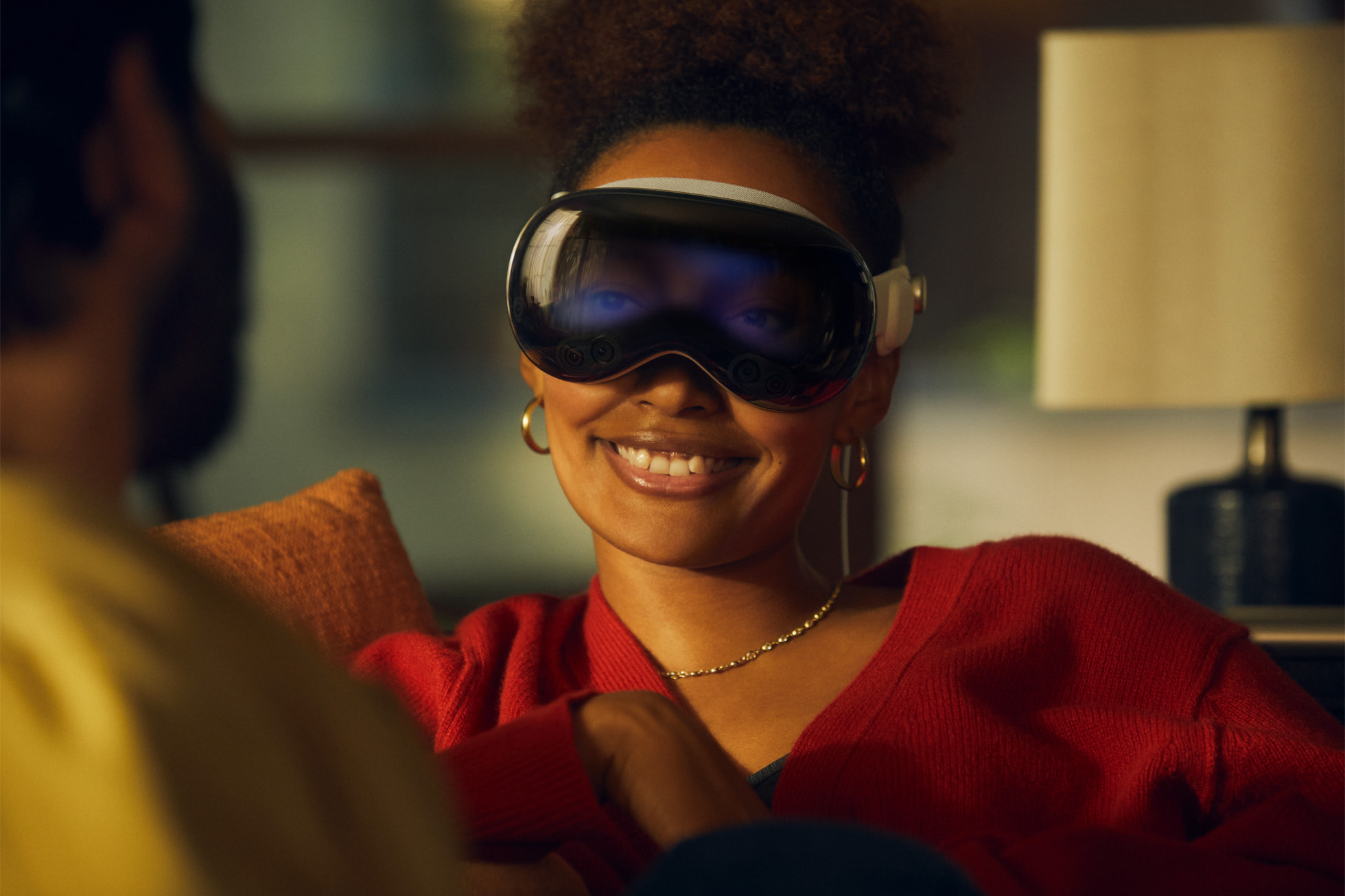
I have worn a Vision Pro, and the strangest thing about EyeSight is that you are the one person in the room who cannot see it. Your family gets the ghost eyes. You get a lovely view of the living room.
Persona, the digital head Apple builds for your calls, was worse. The same Verge review called Personas "uncanny and somewhat terrifying." Joanna Stern tried hers on FaceTime for The Wall Street Journal, and the reviews from home came back unanimous: "You look awful," said her sister. "Frightening," said her dad. Her colleague Jason Gay offered "Botox from hell." Apple shipped it labeled beta, and visionOS 26 rebuilt it with "remarkably accurate hair, lashes, and complexion," so the ghost is at least much better groomed now.
1. The headset that can actually kill you
Nothing else was ever going to take this spot. On November 6, 2022, Oculus founder Palmer Luckey published a blog post titled "If you die in the game, you die in real life." The date was the joke: it is the day the deadly game in the anime Sword Art Online launches. The rest was less of a joke. He had rigged a headset with "three of the explosive charge modules I usually use for a different project," tied to a sensor that watches the screen. (He does not say which project. I am not going to guess.) Then comes the most alarming sentence ever written about a piece of VR hardware: "When an appropriate game-over screen is displayed, the charges fire, instantly destroying the brain of the user."

He told Road to VR that the explosives and the trigger really do work. He also wrote that "there are a huge variety of failures that could occur and kill the user at the wrong time," which is why "I have not worked up the balls to actually use it myself." For now it is, in his words, "just a piece of office art." I would like to meet whoever cleans that office.
And then the beat every horror movie saves for the last ten seconds before the credits: "It is also, as far as I know, the first non-fiction example of a VR device that can actually kill the user. It won't be the last." He signed off, "See you in the metaverse."
Tonight I will strap a computer to my face in a dark room, on purpose, and dig graves in Kick the Bucket VR. My Quest 3 is about a fifth the weight of a 1993 Visette, nobody else's forehead has been near it, and as far as I know it contains no explosives. Ten years I have been doing this, and putting one on still feels a tiny bit like something you should have to sign a form for. I hope that feeling never goes away.
If you want the scares that were meant to be scares, our VR horror guide has them sorted by headset.
Happy Halloween. Listen to the signals your body is giving you.
Advertisement