
A.P. Moller - Maersk announced from Copenhagen on August 7 that it has entered into an agreement to sell Maersk Training, along with its subsidiary Maersk H2S Safety Services, to OpenGate Capital. The press release does not disclose a price. It states that the agreement remains subject to customary closing conditions and regulatory approvals, and that Maersk expects the transaction to complete later in 2026.
EnterpriseAugust 12, 2026
Maersk Is Selling the 48-Year-Old Training Arm Behind Its VR Safety Courses
By Sam Whitfield
Contributing Writer, VR.org
Advertisement
Until it closes, the release says, Maersk Training continues to operate as part of A.P. Moller - Maersk, and employees, customers and partners should expect business as usual.
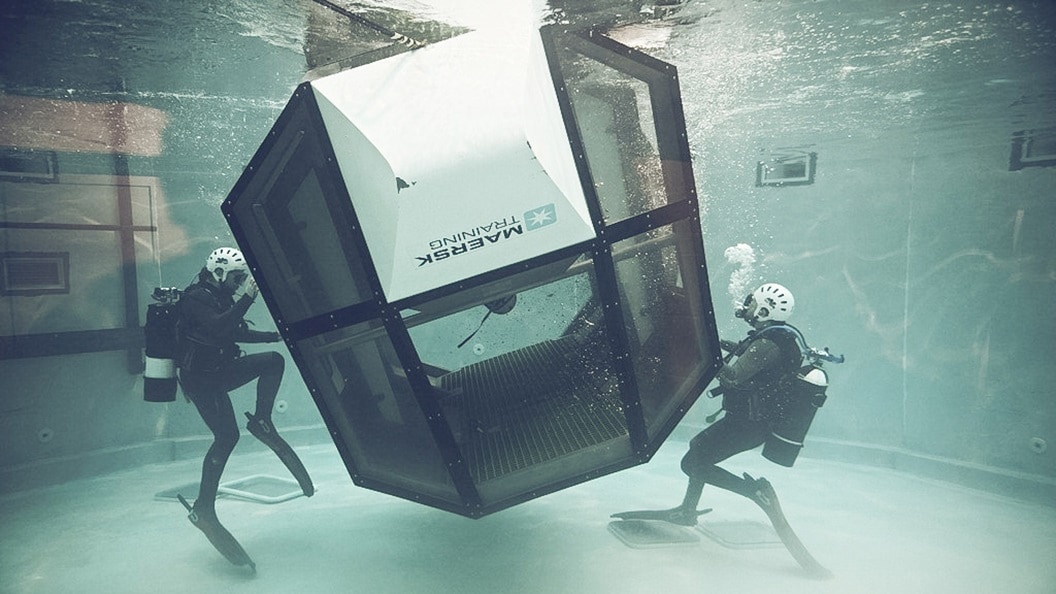
Maersk Training is headquartered in Svendborg, Denmark, and has been running training, competence development and safety services for more than four decades across maritime, offshore energy, renewables and logistics. Maersk H2S Safety Services is the gas side of the business, supplying outsourced hydrogen sulphide monitoring, onsite safety supervision and equipment maintenance to customers working in high-risk environments.
The buyer is a specialist in exactly this kind of transaction. OpenGate Capital, headquartered in New York and Paris, describes itself as a global private equity firm focused on acquiring and operating corporate carve-outs, and says it has executed more than 40 platform acquisitions across Europe and North America since 2005. A carve-out is the sale of a business unit that sits outside its parent's strategic core. The buyer's thesis in these deals is usually that the unit was under-managed inside a larger company, not that it is failing.
Maersk framed it in those terms. "Maersk Training has built a strong business with highly skilled colleagues, trusted customer relationships and a solid foundation for future growth," said Katharina Poehlmann, Head of Strategy at A.P. Moller - Maersk and Chairwoman of Maersk Training, adding that the transaction lets the business develop "under an owner with training, safety and competency solutions as a key focus area." Maersk Training CEO David Skov called it "an important milestone" and said the team was "equally excited about the opportunities this next chapter brings."
Where the XR part actually sits
The Maersk release does not use the words virtual reality anywhere. That is worth stating plainly, because the deal has been picked up in XR trade coverage as the acquisition of a VR safety training provider, and the primary source does not support that characterisation on its own.
What Maersk Training's own published materials do support is narrower and still meaningful. The company runs VR modules in safety behaviour and hazard identification, in CO2 firefighting, and in technical engine training on systems including ME and RTflex, alongside leadership and communication exercises delivered in headset. It built an immersive mooring programme, Maersk Building Capacity, to train ship's officers to read and act on danger signals during a mooring operation, which is one of the most reliably dangerous routine tasks at sea. Its VR work has been delivered in partnership with the Danish XR platform vendor SynergyXR.
So virtual reality is a delivery method inside this business. It is not the business. The business is survival pools, fire grounds, full mission bridge simulators, crane and rig simulators, gas detection equipment and instructors, distributed across training centres in multiple countries. VR is one of several ways that curriculum reaches a learner.

Why an XR vendor should care about a shipping company's divestment
Enterprise XR companies do not generally sell to enterprises. They sell to the training function inside enterprises, and that function is a cost centre with a budget owner. Maersk Training is a large, sophisticated example of that buyer, and it has just changed hands.
Private equity ownership of a training provider tends to produce two pressures at once, and they point in opposite directions for a software vendor. The first is cost discipline, which is unkind to pilot programmes, unproven line items and anything that reads as innovation spend without an attached number. The second is a push toward higher-margin, scalable delivery. That is the strongest commercial argument headset-based training has ever had, since a VR module reaches a client site without booking a seat at a centre in Svendborg or Aberdeen. Which pressure wins depends on the new owner's operating plan, and no part of that plan is public.
Neither Maersk nor OpenGate has said anything about the training technology roadmap. Anyone claiming to know whether this is good or bad for XR training spend is guessing, and the honest read is that it is a variable that was previously fixed.
The wider pattern is more legible. Enterprise XR keeps arriving inside institutions rather than as standalone products, which is the same shape as the Thales Australia agreement with Operator XR in June, and it is why the return-on-investment figures that circulate in this category are so hard to audit. The buyer is rarely purchasing virtual reality. The buyer is purchasing certified competence, and asking who owns the training provider is a more useful question than asking which headset it ships on.
For anyone selling into industrial safety training, the practical consequence is a diligence question to add to the pipeline review: who owns the customer, when did that change, and has the operating plan been written yet. Maersk Training is expected to close under new ownership before the end of the year.
Advertisement