
The original Steam Controller arrived at my apartment in late November 2015. I had pre-ordered it on a whim during the announcement, mostly because I had spent the previous decade evangelizing Steam to anyone who would listen, and this was the official Valve gamepad. Loyalty purchase. I was excited to see what they had cooked up.
GamingMay 2, 2026
I Bought the Original Steam Controller in 2015. Here's Why I'm Setting an Alarm for Monday.
By Evan Marcus
Co-Founder, VR.org
Advertisement
I unboxed it, plugged in the wireless dongle, and stared at it for about ten minutes before I picked it up.
There were no thumbsticks. There was one small analog stick on the left, sized like an afterthought, sitting low under the d-pad position. Where the right stick should have been, Valve had put a circular trackpad. Where the d-pad should have been, another circular trackpad. The face buttons were bunched into a tight cluster on the right side, almost as if they were optional. The whole thing looked like someone had taken an Xbox controller and a laptop touchpad and asked them to have a baby.

I want to be clear about what came next. I tried. I tried for months.
What the original got right (and how often that didn't matter)
Half-Life 2 was beautiful on it, which was not surprising since Valve had built both the game and the controller. Civilization V was a revelation. For the first time in my life I could play a turn-based strategy game from the couch and not feel like I was wrestling the input. The right trackpad became a precision mouse. I drew borders, selected units, navigated tech trees, all without leaning forward. Same story for Crusader Kings II, for XCOM, for any game where the design assumed you would be sitting at a desk with a real mouse in your hand.
The customization was unmatched, even now. Steam Input let you remap anything to anything. The community was constantly publishing profiles for games that had never officially supported the controller. Someone, somewhere, had figured out how to make Dark Souls work. (It still felt bad, but they had figured it out.) The right trackpad could be a touchpad-style aim, a flick stick, a giant relative-mode mouse, a radial menu, all in the same game depending on context. The depth of input remapping was something I have not seen on any controller since.

The problem was that all of that depth required commitment, and most games did not reward commitment. Rocket League with the trackpad? Hopeless. Sekiro? Forget it. Any game that expected a normal controller (which is, you know, every console port ever made) felt like fighting the hardware. The single offset thumbstick was awkwardly placed for traditional movement, and the right trackpad never quite replaced what your thumb had been doing on a stick for fifteen years of muscle memory.
So you ended up with a controller that was extraordinary at a narrow set of things and frustrating at almost everything else. Most of my Steam library lived on the wrong side of that line.
The 2019 fire sale and a quiet death
In late 2019, Valve put the remaining Steam Controller stock on clearance for five dollars apiece. I bought a second one on principle and put it in a desk drawer. People bought them in bulk. The forum I lurked on at the time celebrated like fans at a wake. We all knew it was over. Valve had moved on, the experiment had ended, and the controller that had genuinely tried something different had lost.
Advertisement
For the next several years I would occasionally pull it out for a Civ marathon. The trackpad muscle memory came back fast. So did the limitations. By 2023 my Steam Deck had largely replaced it, since the Deck has trackpads sitting next to its analog sticks and you can use both at once. Which was, in retrospect, Valve quietly admitting that the original Steam Controller's premise had been wrong all along.
The 2026 version is what they should have made the first time
Then in April, Valve announced the new one. I spent about thirty seconds looking at the press photos and understood immediately: they finally got it.
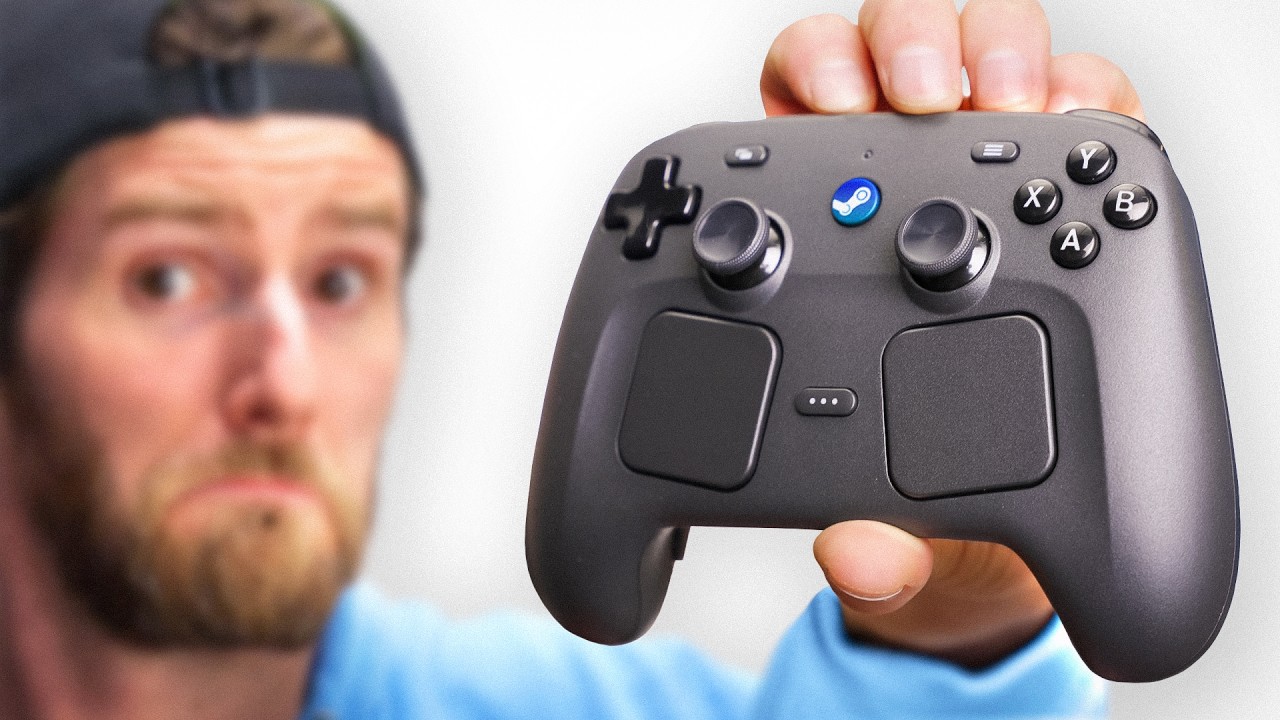
The 2026 Steam Controller has thumbsticks. Real ones. Two of them, sitting where every gamepad in the world puts them, with TMR magnetic sensors that should never drift. Below the sticks, smaller and squarer than before, the two trackpads are still there. They are no longer asking you to abandon what you know. They are asking you to add to it.
That is the lesson. The original was a bet that the gaming world was wrong about controllers. It wasn't. The new one is a bet that gamers will use trackpads if they don't have to give anything up to get them. That is a much better bet, and I think it is the right bet.
I will still use the trackpads for strategy games. I will use them for menu navigation in stuff that wasn't designed for couch play, and probably for inventory management in any game with a complicated map screen. But for everything else, the sticks will be right where I expect them to be. Movement on the left, camera on the right, the way it has been since 1996. One controller, two input philosophies, no compromise.
That alone is worth ninety-nine dollars to me. Add the TMR sticks (which solve the stick drift that has wrecked basically every controller I have owned in the last decade), the four rear paddles, the haptics that survived from the original design, and the eight-millisecond wireless latency, and this is just a great gamepad on its own merits, separate from any nostalgia I might have for the first one.
There is also the VR angle that nobody is really talking about yet. Valve has confirmed the Steam Frame, the upcoming standalone headset, will use the Steam Controller as a primary input device when you are using the Frame in non-VR display mode. You will sit on your couch, put on the Frame, see your Steam library on a virtual screen the size of your living room wall, and play with this controller in your hands. The Grip Sense feature, which activates the gyro based on how tightly you hold the controller, was almost certainly designed with that use case in mind. When the Frame eventually ships, it will arrive in homes where this controller is already familiar, where the button map and the haptic vocabulary are already learned hardware. That kind of platform foundation matters, and Valve is laying it down piece by piece.
May 4, 10 AM Pacific
So here is the plan. Monday at ten in the morning Pacific time I will be at my desk with steam.com loaded in two browser tabs and a credit card pre-filled in my browser. I am not expecting Switch 2 launch levels of chaos. But I do expect this to sell out fast (Valve is selling exclusively through their own store, with no retail partners and no Amazon listing), and I do not want to be sitting around for two months waiting on a restock.
I still have my original Steam Controller in a drawer. Both of them, actually. They are good reminders of what happens when an idea is too far ahead of what the market is willing to accept. The new one looks like the version that finally meets the market where it actually is.
See you in line.
Advertisement