
$1,399. That is what Pimax will charge for Crystal Pro, the wireless PC VR headset it announced in San Jose on October 6. When it ships depends on which Pimax page is open.
HardwareOctober 8, 2026
Pimax Prices Crystal Pro at $1,399 and Gives Three Different Answers on When It Ships
By Alex Reeves
Staff Writer, VR.org
Advertisement
The press release says "Shipping dates for Crystal Pro and the 60G AirLink kit will be announced at a later date." Pimax's launch FAQ says "Shipping is set to start in spring 2027." The store listing says "shipping starts in 2027." One launch, three documents, no agreement on the line a buyer reads first.

The store listing is also the only one of the three that states the reservation term. The $1 deposit is "Non-refundable." It takes $20 off the headset at launch, or $50 off the bundle. Against $1,399, $20 is 1.4 percent. Neither the release nor the FAQ mentions refunds at all.
What $1,399 buys
The box holds the headset, two ringed SLAM controllers, a Wi-Fi 6E adapter and a 16,000mAh battery pack. The pack is not a spare. "No battery is built into the headset," the release says, and the store listing describes the pack as "worn in your pocket." Pimax's own product graphic rates it at 67 Wh. No runtime is given anywhere. No weight either.
The displays are quantum-dot LCD at 2880 by 2880 per eye, behind glass aspheric lenses, with 576 Mini-LED dimming zones per eye and a 110 degree horizontal field of view. Pimax quotes 35 pixels per degree and refresh rates of 72, 90 and 120Hz. Eye tracking runs at 120Hz. Inside-out tracking uses four cameras, and a swappable faceplate adds Lighthouse base stations for anyone who already owns them.
Valve's Steam Frame starts at $1,059 with 2160 by 2160 LCD panels and its own Wi-Fi 6E adapter in the box. Crystal Pro costs $340 more for the higher pixel count, and it is not the same kind of device. The FAQ answers "Is the Crystal Pro a standalone headset?" with "Yes and no." It runs Android and OpenXR mobile titles without a PC, but neither document names the processor doing that work. Road to VR's spec list gives it as a Snapdragon XR2 Gen 1, the chip in the 2020 Quest 2.
The $599 part
Wi-Fi streaming is standard, and it is compressed video. The feature Pimax built its launch around costs extra. The third-generation 60G AirLink kit is $599 on its own, which is the price of a Quest 3. It adds two antennas that slot onto the headset and two Room Antennas placed facing each other across the play space.
What it does is specific. Eye tracking finds where the wearer is looking, and the 60GHz link sends that region "without the video encoding used by Wi-Fi streaming." The rest of the view is, in the FAQ's words, "streamed more efficiently." Pimax claims up to 6 Gbps and under 2 milliseconds of added latency, and calls it the first 60GHz 2x2 MIMO link on a VR headset. Those are the company's figures. Hands-on demos, the first chance for anyone outside Pimax to test them, start in the fourth quarter.
Pimax states the limits itself. The signal "does not pass through walls," so the Room Antennas and the player share a room. The uncompressed region arrives "at up to 90Hz," while the FAQ reserves "their full 120 Hz" for the DisplayPort cable. A five-by-five-meter play area is possible "with the right setup." The Steam Frame also uses eye tracking to decide where its stream spends bits, over the Wi-Fi 6E adapter Valve includes. Pimax's uncompressed version of the idea is the paid tier.
Advertisement
The bundle is $1,899. Bought separately the headset and kit come to $1,998, so the bundle saves $99, and a reservation takes it to $1,849. That is $790 over a 256GB Steam Frame.

Two products with no price
The Ringless VR Controllers are not what ships in the Crystal Pro box. That box holds the ringed pair. The ringless ones drop the tracking ring for infrared LEDs read by the headset cameras, clip together into a gamepad for Windows and Steam, and run up to 40 hours on a 710mAh cell. The FAQ says they also work with Crystal Light, Crystal Super, Dream Air and Dream Air SE.
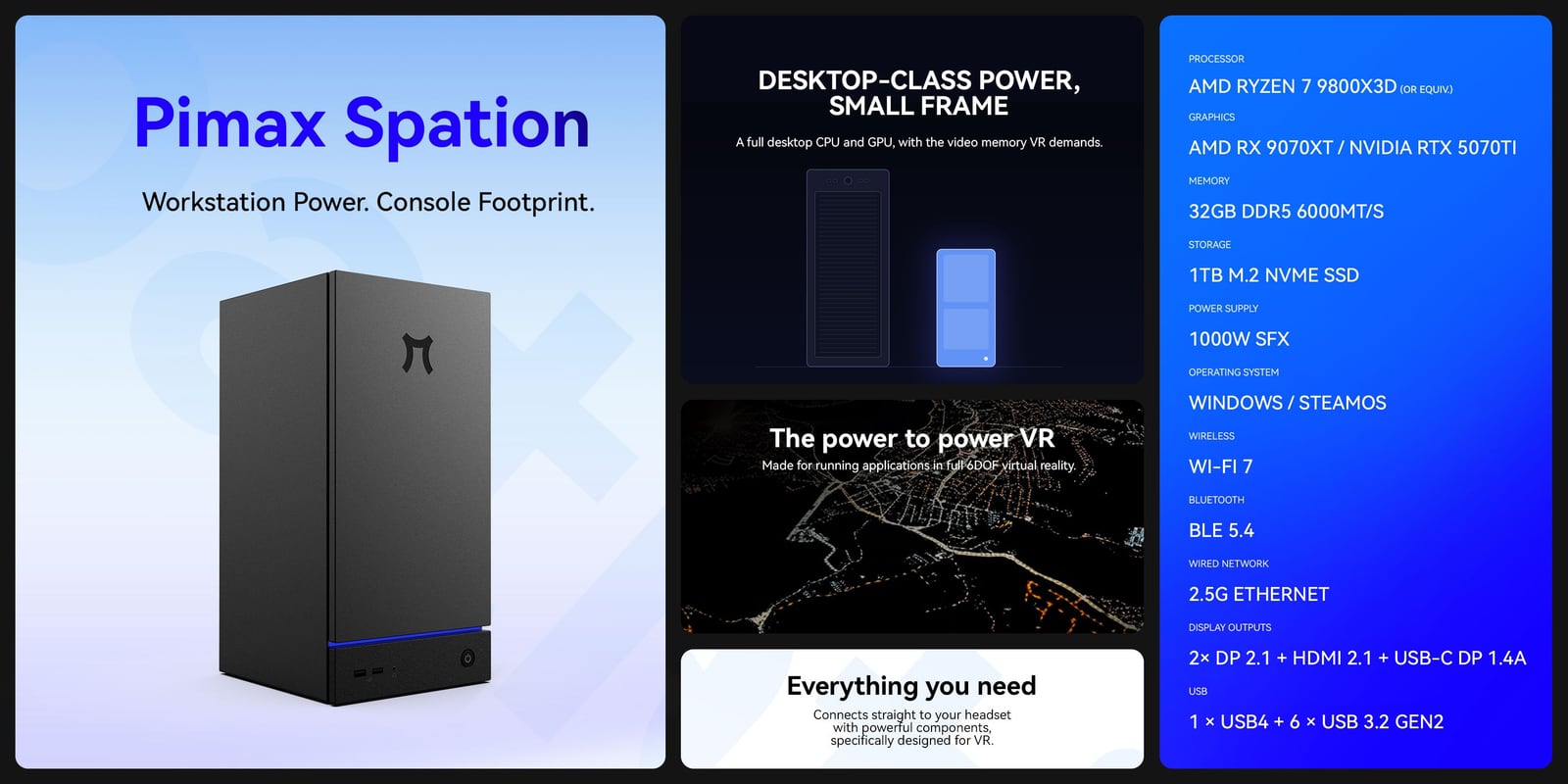
Spation is a small desktop PC: a Ryzen 7 9800X3D "(or equivalent)," an RX 9070 XT or RTX 5070 Ti, 32GB of DDR5-6000, a 1TB SSD and a 1000W SFX power supply. Its store page adds a line the release leaves out: "Operating system not pre-installed."
The documents split here too. The release says the DIY configuration lets customers "supply their own storage memory and GPU." The FAQ says "you bring your own motherboard and GPU." The release invites customers to place a $1 reservation to join the waiting list. The FAQ says "There is no $1 reservation for the Spation."
Both store pages carry "(Price TBD)" in the product title. A storefront still needs a number in the price field, and the listing data for each one holds $99,999.00. Nobody should budget against that.
The dollar and the $599
Pimax announced Dream Air in December 2024. In July of this year it told buyers the preorder backlog would clear by August, about twenty months later. Crystal Pro starts with a quarter for demos and, on the most specific of its three pages, a season for shipping.
For someone with money ready, the reservation is the small question. It costs a dollar that does not come back and is worth $20 or $50 later. The $599 kit is the real one, because it is the only way to get the image Pimax spent its launch describing. That decision can wait for the demos. By every one of Pimax's own accounts, nothing ships before 2027.
Advertisement