
PTC Inc. filed a Form 8-K with the Securities and Exchange Commission on October 5 reporting that it had signed an Agreement and Plan of Merger the previous day with Schneider Electric SE and a Massachusetts subsidiary of Schneider incorporated under the name Grand Slam Merger Sub, Inc. Under the agreement, each PTC share converts into the right to receive $205 in cash, and PTC common stock is delisted from the Nasdaq Global Market and deregistered when the merger closes.
EnterpriseOctober 8, 2026
$22.6 Billion for PTC, and Vuforia Is Not Named in Any of the Paperwork
By Sam Whitfield
Contributing Writer, VR.org
Advertisement

The joint announcement puts the equity value at about $22.6 billion, or 20.1 billion euros, and the implied enterprise value at $23.7 billion. PTC's release describes the $205 price as a 42.3 percent premium to the last closing price before the announcement and 46.1 percent over the preceding 30 trading days on a volume-weighted basis. The same release gives PTC calendar 2025 revenue as 2.4 billion euros at an adjusted EBITA margin of roughly 40 percent, and says revenue and annual recurring revenue are expected to grow about 10 percent a year through 2029. That last pair of figures is the parties' own projection in a document written to sell a transaction, and carries the weight such projections usually do.
Schneider Electric chief executive Olivier Blum called the acquisition "an important step forward in our ambition." PTC president and chief executive Neil Barua described the all-cash structure as "the culmination of the PTC Board's commitment to maximize shareholder value."
What the paperwork names, and what it leaves out
For a company that has been a fixture in enterprise augmented reality for a decade, the notable feature of the announcement is an omission. PTC's release characterizes the business in four categories: computer-aided design, product lifecycle management, application lifecycle management and service lifecycle management. Augmented reality is not among them. Neither is Vuforia, the brand PTC has sold AR software under since it acquired the platform from Qualcomm in 2015.
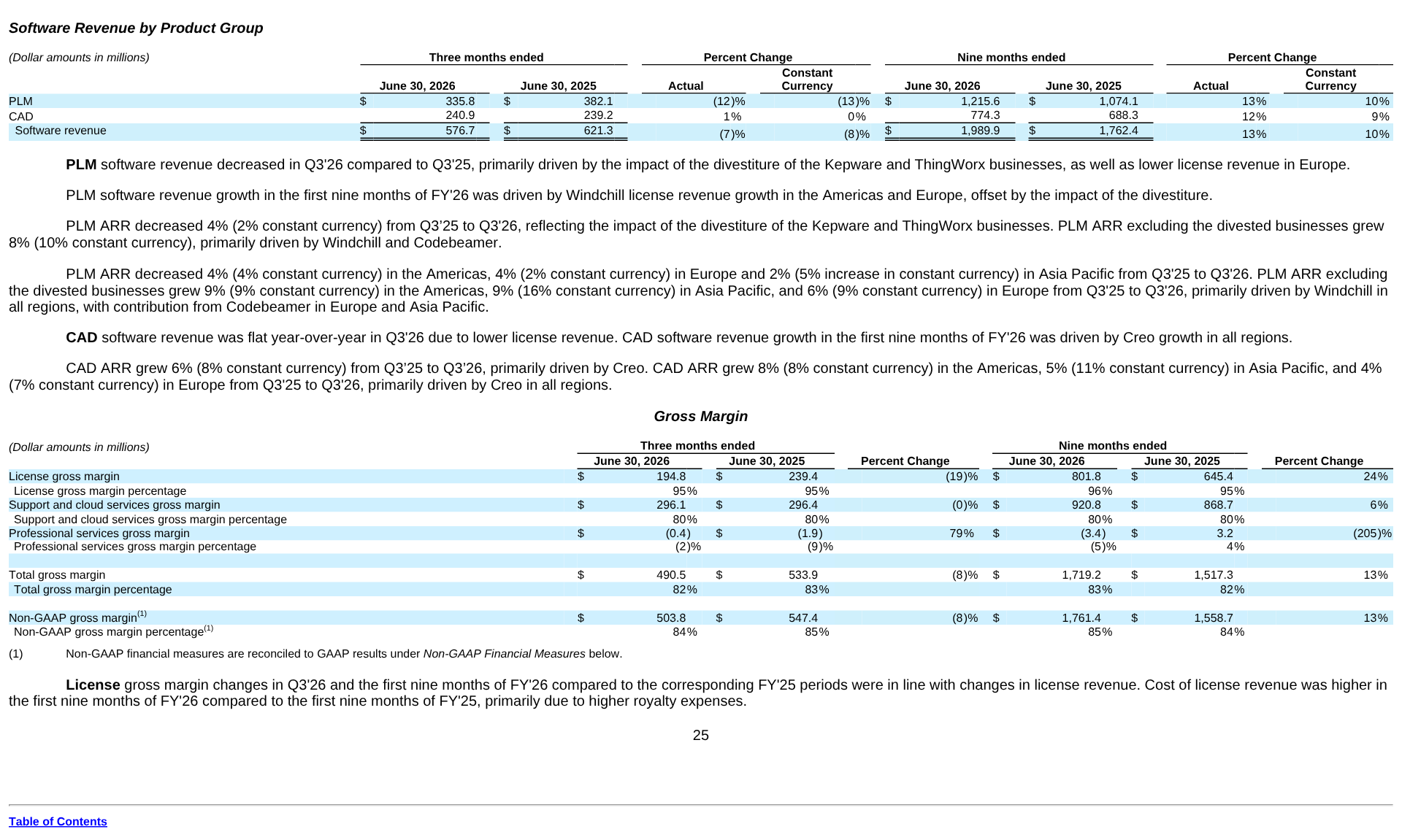
On its own that proves little. A release announcing a $22.6 billion acquisition is not a product catalog, and acquirers routinely name the revenue lines and leave everything else for later. The more informative document is the quarterly report. In the Form 10-Q PTC filed on July 31 for the quarter ended June 30, 2026, the company reports software revenue in exactly two product groups, PLM and CAD, at $335.8 million and $240.9 million for the quarter. There is no AR line and no third group, and the word Vuforia does not appear anywhere in the filing.
Vuforia remains a shipping product line. PTC's own site currently lists four: Vuforia Expert Capture, Vuforia Studio, Vuforia Engine and Vuforia Chalk, none of them carrying a discontinuation notice. What the filings establish is narrower and more useful than a rumor would be. Whatever Vuforia earns, it has never been large enough for PTC to break out, and a buyer paying $23.7 billion in enterprise value did not need to mention it to justify the price.
Advertisement
The ThingWorx precedent
There is a recent and specific reason for customers to read that omission carefully. The same 10-Q records that PTC sold its Kepware and ThingWorx businesses on March 13, 2026, under an asset purchase agreement dated November 5, 2025, to Parrot US Buyer, L.P., an entity controlled by funds affiliated with TPG Global, LLC. Total consideration was $530.8 million, of which $523.3 million was received in cash during the second fiscal quarter, with up to $125 million more contingent on a subsequent sale by the buyer. PTC recognized a gain of $462.6 million and entered a transition services agreement running up to twelve months.
ThingWorx was not incidental to the AR business. It was the industrial IoT platform that fed Vuforia Studio live equipment data, which was the distinction between PTC's AR work instructions and a 3D model displayed on a tablet. PTC kept Vuforia and sold the data layer sitting underneath part of it. Seven months later the company agreed to sell itself. Consolidation of this kind is data rather than an obituary, and the sequence is on the public record in PTC's own filings either way.
A long pendency
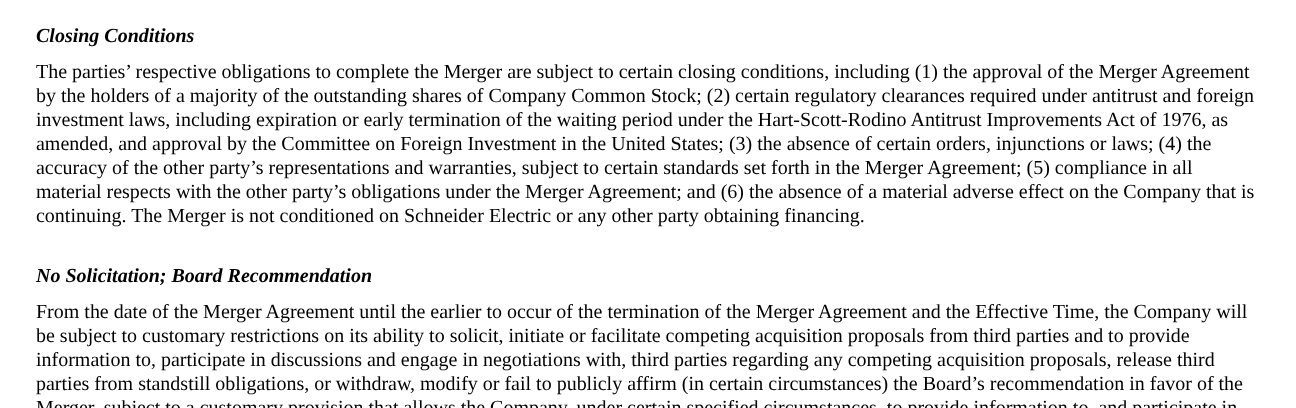
The 8-K sets out closing conditions that make this a slow transaction. Completion requires approval by holders of a majority of PTC's outstanding shares, expiration or early termination of the waiting period under the Hart-Scott-Rodino Antitrust Improvements Act, and approval by the Committee on Foreign Investment in the United States. That last condition applies because Schneider Electric is a French company buying a Boston software vendor whose products sit inside American industrial operations. The merger is not conditioned on Schneider obtaining financing. PTC's announcement anticipates closing by the third quarter of 2027.
Close date aside, the practical question for an organization running Expert Capture on a factory floor or Chalk in a field service group is what happens across roughly a year of pendency. PTC will operate under customary restrictions on strategic transactions during that window, and any roadmap commitment made now is a commitment from a company that will have a different owner before most multi-year enterprise agreements come up for renewal. Nothing in the filings says Vuforia is for sale or scheduled for sunset, and reporting otherwise would be going beyond the documents.
The optimistic reading is available on the same evidence. Schneider Electric sells industrial automation, building management and energy infrastructure, and augmented reality work instructions delivered to a technician standing in front of equipment fit that business more naturally than they ever fit a CAD and PLM vendor. There is a plausible version of this in which Vuforia ends up somewhere better suited to it than where it has been.
Buyers negotiating a renewal before the close should get term length, support commitments and data portability in writing rather than in a roadmap presentation, and should ask directly where Vuforia sits in the combined product plan. This publication has covered what happens when an immersive unit changes hands without that conversation, most recently when Maersk sold the training arm behind its VR safety courses, and has made a habit of asking which parts of an enterprise pitch actually ship. The question is answerable today and will be considerably harder to raise in 2027.
Advertisement