
$399.20. That is what a Valve Index headset costs today, 20 percent off a list price that had not moved since 2019.
HardwareOctober 14, 2026
Valve Stopped Making the Index. The Last Ones Are 20 Percent Off.
By Alex Reeves
Staff Writer, VR.org
Advertisement
Valve's hardware page for the Index carries a new title: "Valve Index Sunset." The notice under it is short. "Valve Index is no longer being produced," it reads. "Remaining Index headsets, controllers, and accessories are still available at the new prices below while supplies last." For people who already own one, Valve adds that nothing changes, and that the headset "is still supported on Steam and SteamVR."
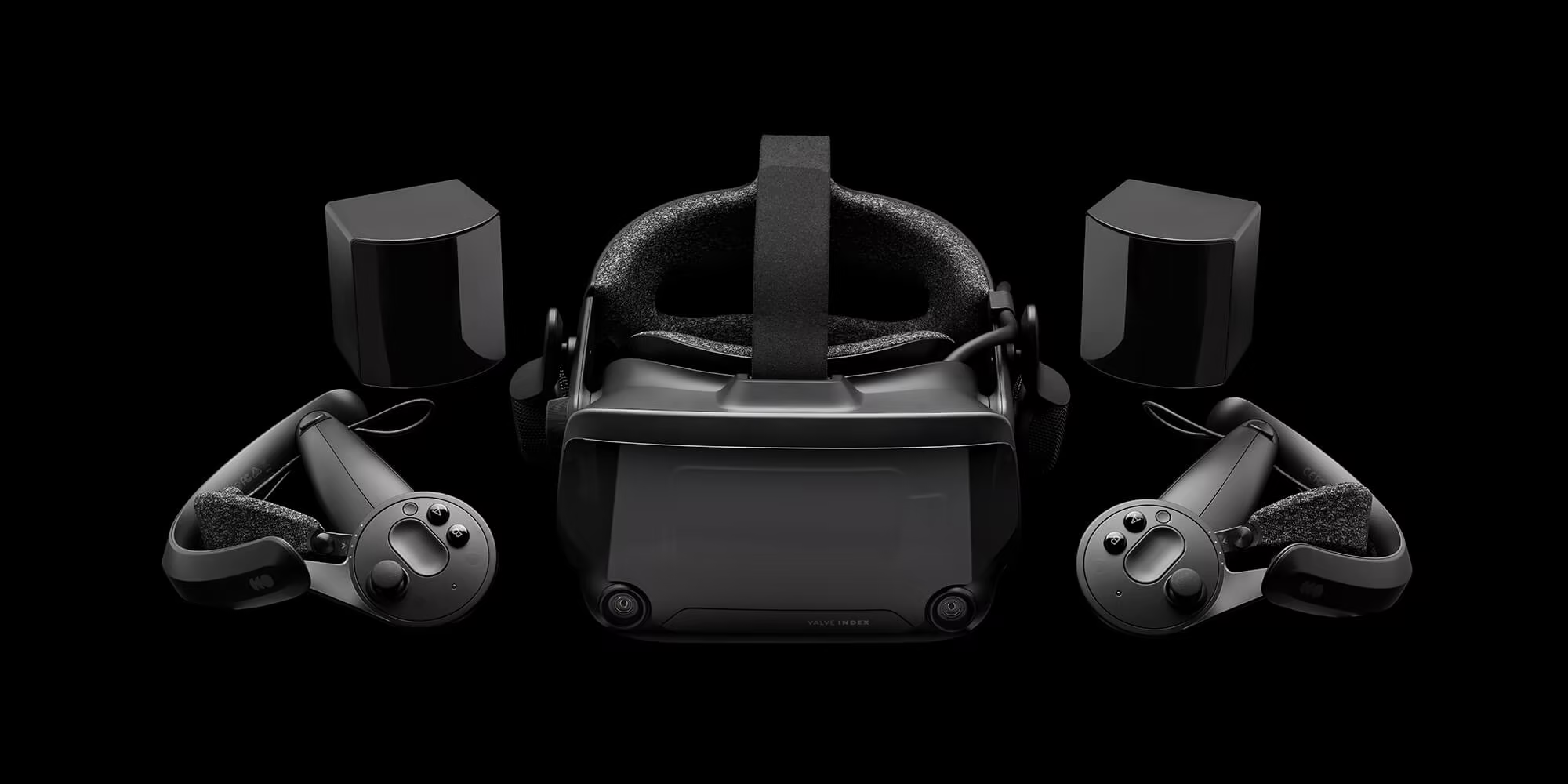
Three items are listed at the new prices. The headset at $399.20. A replacement left controller at $119.20, down from $149. A replacement tether at $103.20, down from $129.
The list is more useful for what is absent. No base stations. No right controller. No full kit.
What $399.20 actually buys
Not a working setup. Index tracks outside in, which means it needs SteamVR base stations mounted above head height in the corners of the room, and it needs a pair of controllers to put hands in the headset. Valve is selling neither. HTC, which still sells the tracking hardware, lists the SteamVR Base Station 2.0 at $229 on its US store, and two of them is the normal room scale configuration for anybody who wants to turn around. Controllers, in the US, are now a used market problem, because the remaining stock Valve is clearing is left hand only. Steam's store API still carries discounted prices for a controller pair and a single base station, $223.20 and $119.20, but both product pages now redirect to the sunset page, which has no button for either.
So price it out from nothing. Headset at $399.20, two base stations at $458, and a pair of controllers from whatever listing somebody else happens to have written that week. That is $857.20 before a single hand is tracked. The 2019 full kit, controllers included, was $999.
Valve will sell you the left controller. The right one is your problem.
The specs it retires on
The spec block on the sunset page is shorter than it used to be. Dual LCDs at 1440 by 1600 per eye, full RGB per pixel. Refresh rates of 80, 90, 120 and 144 Hz. Persistence of 0.330 ms at 144 Hz. Canted, double element lenses that Valve still rates at roughly 20 degrees more field of view than the original HTC Vive. Physical IPD adjustment across 58 to 70 mm. Stereo 960 by 960 global shutter cameras.
They shipped in June 2019 and did not change again. Neither did the $499 list price, through seven years and two Quest generations while every competitor repositioned around it. This week's 20 percent is a clearance markdown, posted Tuesday afternoon.

Fourth place in the survey
Index is not a dead product by usage. September's Steam hardware survey put it at 10.83 percent of the VR headsets it detected, fourth behind the Quest 3 at 26.90 percent, the Quest 2 at 25.80 and the Quest 3S at 11.07. That reading came from the survey Valve added the Steam Frame to. The Index share fell month over month, but a tenth of surveyed SteamVR machines is a large installed base to run out of spare parts for.
The successor is already out and already behind. Steam Frame went on sale in September at $1,059 for the 256GB kit, and Valve said on October 9 that some reservation holders will not get an order email until 2027. Index is being cleared out while the thing replacing it is backordered.
Who should buy
Current owners, on parts. A spare tether at $103.20 and a left controller at $119.20 will not be cheaper, and when this stock is gone Valve has nothing behind it. Buy the spare now or accept the used market later.
Everybody else should think harder. $399.20 is a real discount on a headset whose panels and audio still hold up, but it buys into a tracking system that needs $458 of base stations Valve no longer sells, controllers it will only half supply, and a cable to a PC with a DisplayPort output. The Steam Frame does not use base stations at all. That is the direction Valve is pointing, and the Index price is what the exit looks like.
Advertisement