
Virtuix Holdings' November 24 release covers the Infantry Fireteam Trainer, the four-person system it is building as lead systems integrator to requirements from the Marine Corps Training and Education Command. It ends with a date: the company "plans to bring the IFT system to Quantico, Virginia, in early 2027." That is later than the date the program carried for most of the year. Virtuix's August 5 announcement, which VR.org covered in August, put the system at Quantico in the fourth calendar quarter of 2026. AVRT, which supplies the weapons tracking, repeated that target in its own October 22 announcement: "delivery to Quantico, Virginia expected in Q4 2026."
EnterpriseNovember 26, 2026
Virtuix's Quantico Fireteam Trainer Slips to Early 2027 as Its Cash Falls to $5 Million
By Sam Whitfield
Contributing Writer, VR.org
Advertisement
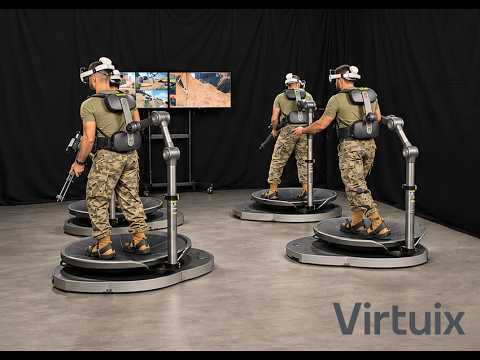
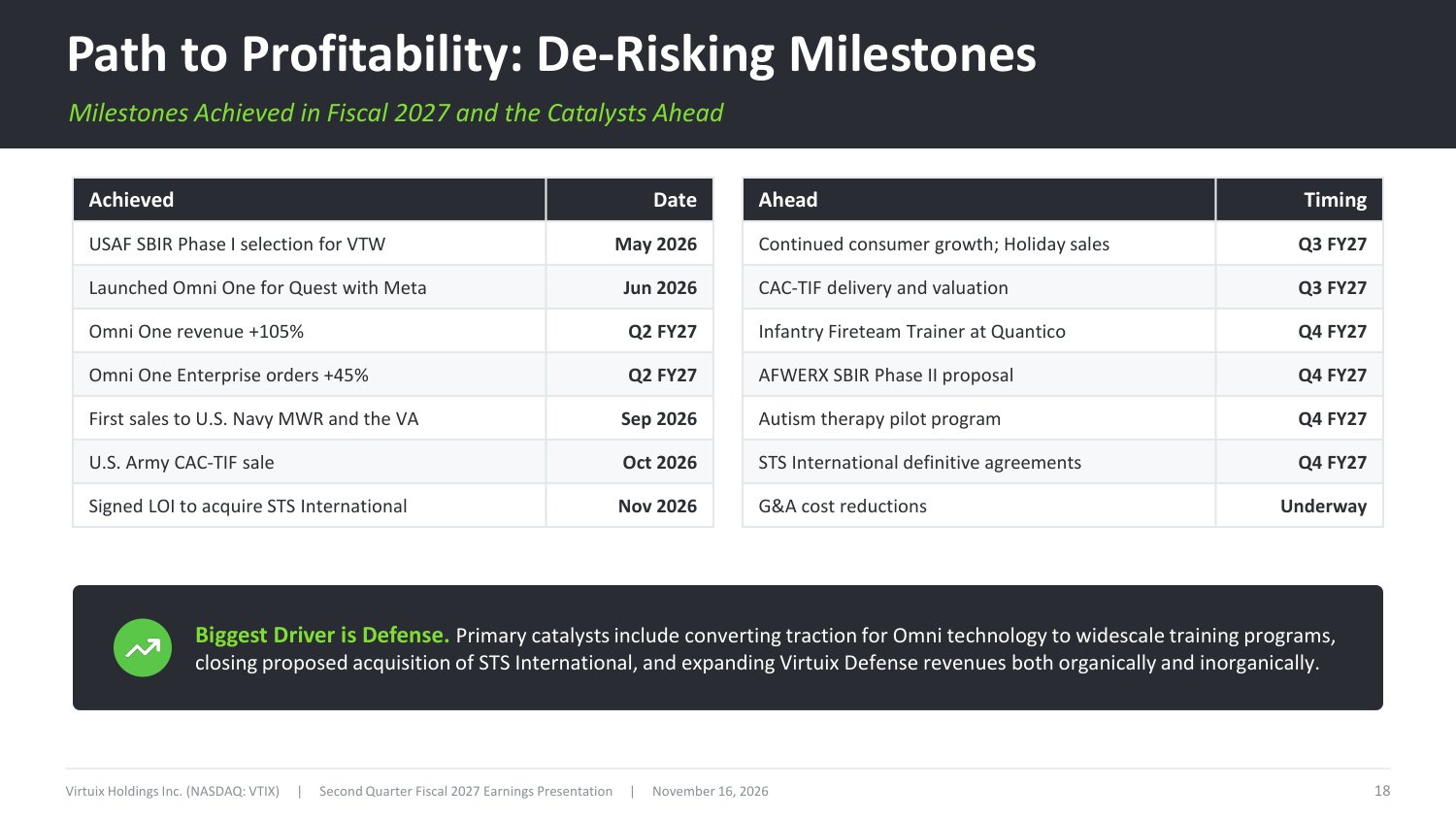
The move was visible in the company's earnings materials eight days earlier. The November 16 earnings presentation lists "Infantry Fireteam Trainer at Quantico" under milestones ahead, with a timing of Q4 FY27. Virtuix's fiscal year ends March 31, so that quarter runs from January to March 2027. The company's investor site now says the same in plain months. On the earnings call, founder and chief executive Jan Goetgeluk described the system as finished and the schedule as the customer's: "The system is ready to be brought to Quantico where we're waiting on a date from TECOM." Nothing in the filings or releases tests that account, and VR.org found no public Marine Corps statement on the schedule. What the record does show is a slip of one quarter in a program whose next step is an operational assessment. That is the Marine Corps deciding whether the trainer works, not a purchase.
One smaller change sits in the November 24 text. The release names AVRT as Virtuix's collaborator and does not mention KBR, the defense contractor that the August announcement, the earnings deck and the earnings call all describe as a partner on the program; KBR appears only in the boilerplate at the end, in a list of organizations Virtuix works with. Nothing Virtuix has filed describes a change in KBR's role, and an omission in a press release is not evidence of one. The release does add a market figure: "approximately 18 Marine Corps installations and more than 90 active-duty U.S. Army combat battalions," presented as places the system could eventually go. That is a count of potential sites, not of orders. The release discloses no contract value for the work at Quantico.
Advertisement
What the 10-Q says about the order claim
In October, VR.org noted that Virtuix's statement that Omni One orders had risen about threefold rested on press releases, and that the 10-Q for the quarter ended September 30 would be the first filed document able to test it. That report arrived on November 16, on its deadline. It supports the claim. The filing states that after the launch of Omni One for Quest in June, "new orders for Omni One systems increased 230%, or by a factor of 3.3X," measured against the number of Omni One unit orders in the same quarter of 2025. Two cautions apply. The figure counts orders rather than revenue, and the filing gives no unit total, so a reader can see the ratio but not the size of the base it was built on.
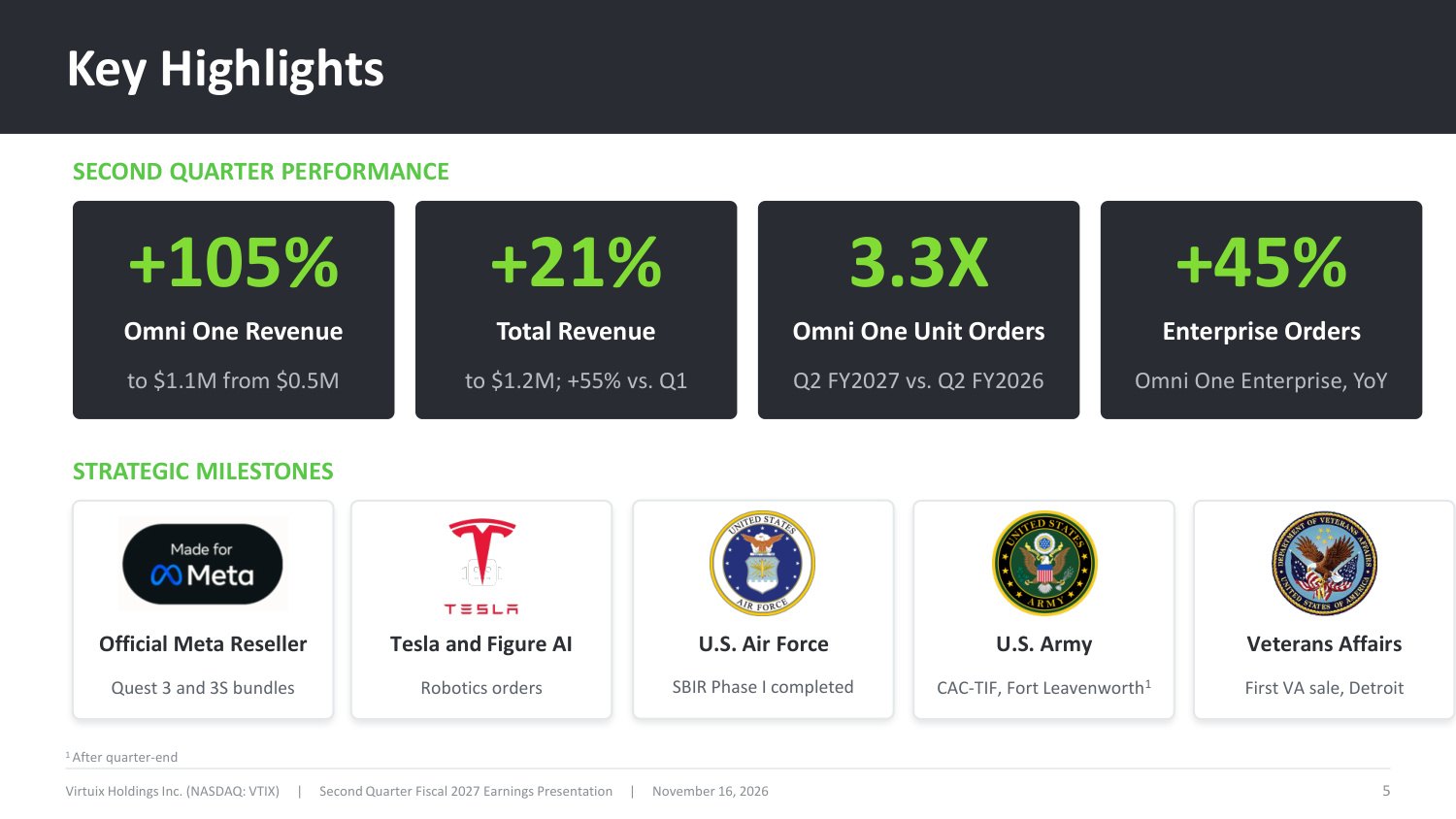
Revenue moved in the same direction, at a smaller scale. Omni One sales for the quarter were $1,110,510, against $542,524 a year earlier, an increase of 105 percent. Total sales rose 21 percent to $1,190,097. The gap between those two rates is Omni Arena, the arcade product, whose sales fell to $21,376 from $335,555. Across the first six months of the fiscal year, total sales were $1,957,397, down 3 percent from a year earlier. Orders of Omni One Enterprise, the line sold to institutions, rose 45 percent, again by count. The quarter's net loss was $6,367,511, against $1,866,696 a year earlier. Cash stood at $4,963,127 on September 30, down from $9,471,288 on March 31. The filing repeats the going-concern language from the previous quarter, that the company's losses and limited working capital "raise substantial doubt" about its ability to continue for a year, and says Virtuix "expects to require additional financing to fund its planned operations over the next 12 months." It also says the company did not meet the conditions to draw further advances under its equity purchase agreement with Streeterville Capital, a facility of up to $50 million signed in August 2025, so no additional funding was available under it as of September 30.
The sentence that matters most for the Marine Corps program survives unchanged from the prior report: "we expect that meaningful sales in the defense sector may not materialize until fiscal year 2028 at the earliest." Fiscal 2028 begins in April 2027, after the new Quantico window closes.
The listing and the acquisition
The stock has continued to fall. In an 8-K filed November 25, Virtuix disclosed a second Nasdaq deficiency notice, received November 23, because its shares "closed below $1.00 per share for 30 consecutive business days from October 12, 2026 to November 20, 2026." It has until May 24, 2027 to regain compliance with that rule, and until March 29, 2027 under the separate market-value notice reported in October. VTIX closed at $0.4174 on November 25, according to Nasdaq's historical data. The 10-Q reports 30,609,775 Class A shares as of November 13. At that price they are worth roughly $12.8 million, or about $14.4 million with the 4,000,000 Class B shares included, against the roughly $41 million this site calculated in August. Both senior officers bought stock in the days after the results: Form 4 filings show Goetgeluk buying 145,000 shares and chief financial officer Thomas McGinnis 140,000 between November 19 and 25, at prices between about $0.37 and $0.41. Open-market buying by executives signals their confidence. It does not measure the company's prospects.
Virtuix's quickest route to defense revenue before fiscal 2028 may be an acquisition. A November 12 8-K disclosed a non-binding letter of intent to acquire STS International, a defense contractor in Arlington, Virginia, for a base price of about $12 million, $8 million in cash and $4 million in stock. STS reported about $40 million in unaudited, cash-basis revenue for the ten months to October 31, many times Virtuix's own. The filing also states that Virtuix "has no committed financing" for the cash portion. That cash portion is about $3 million more than the company held at the end of September.
The next public test comes quickly. Virtuix will hold private meetings at I/ITSEC, the Interservice/Industry Training, Simulation and Education Conference in Orlando, from November 30 to December 3, and Omni One systems will appear on the Mass Virtual and University of Central Florida stands. For a training organization weighing the Fireteam Trainer, the gating event is still the operational assessment at Quantico, now in the first quarter of 2027. Nothing about the system's performance is on the public record yet. The supplier's position is on the record, in its own filings: under $5 million in cash at the end of September, a going-concern warning, two open Nasdaq notices and an acquisition it has not yet funded. Any multi-year commitment should be priced with that in view.
Advertisement