
Virtuix Holdings Inc. announced on August 5 that it has selected AVRT to supply weapons tracking and training content for the U.S. Marine Corps Infantry Fireteam Virtual Trainer, or IFVT. The release, distributed through GlobeNewswire from the company's Austin headquarters, names a delivery target that matters more than the partnership itself: the system is expected at Quantico, Virginia, in the fourth calendar quarter of this year.
EnterpriseAugust 20, 2026
Virtuix Has Until December to Put Four Marines on Treadmills at Quantico
By Sam Whitfield
Contributing Writer, VR.org
Advertisement
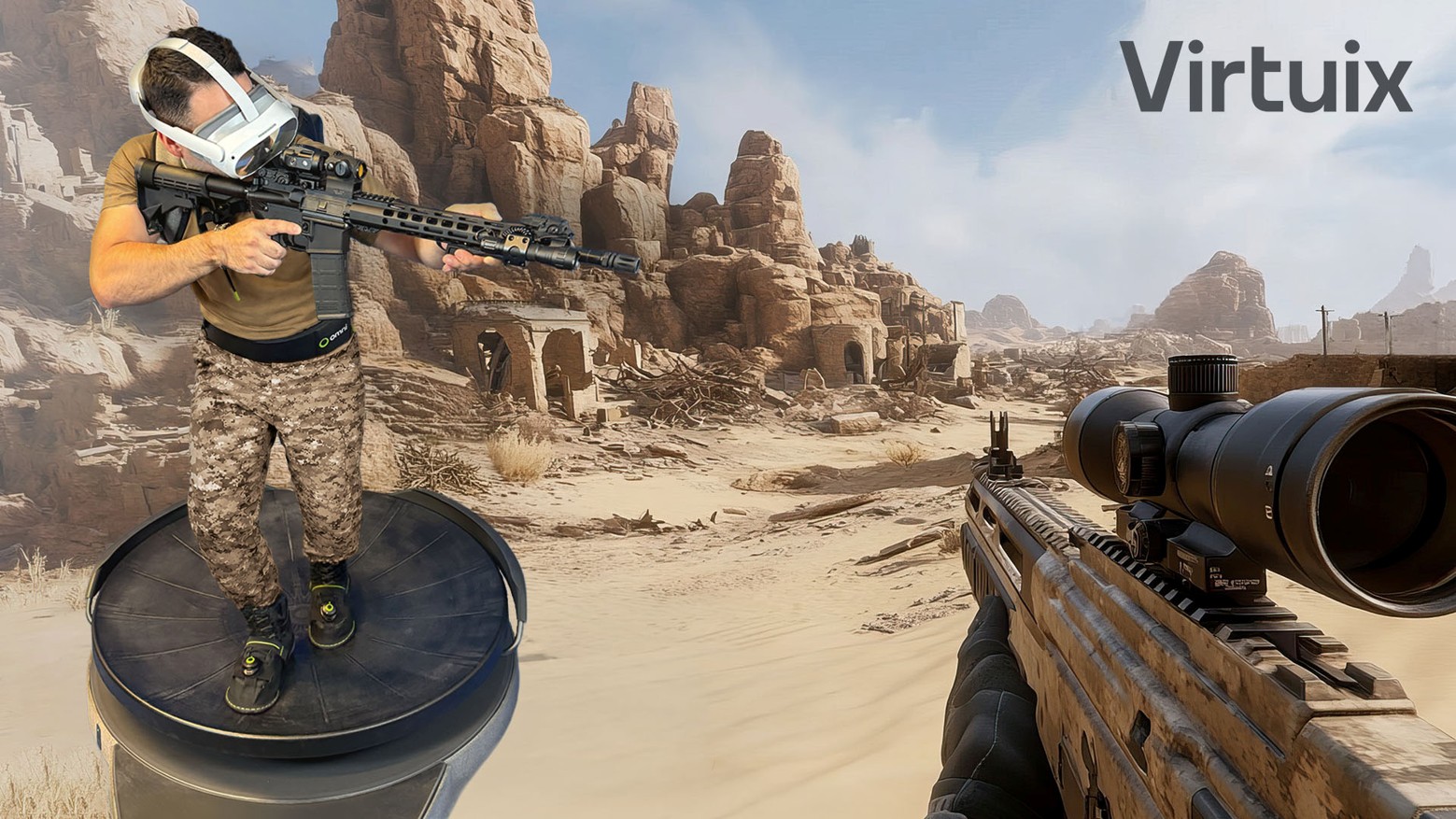
Virtuix is the lead integrator on the program, working through its strategic partner KBR, and the trainer is being built for operational assessment rather than as a fielded program of record. That distinction is worth holding onto. An operational assessment is the Marine Corps deciding whether the thing works, not the Marine Corps buying it at scale. The company's own language allows for both outcomes: if the assessment succeeds, the release says, the project could be expanded and deployed to Marine Corps training centers nationwide.
What the system actually is
Four Marines train simultaneously as a fireteam. Each stands on an Omni One omnidirectional treadmill, wears a Meta Quest headset, and carries a tracked M4 rifle surrogate supplied by AVRT. The design intent is that trainees walk, run, crouch, communicate, identify threats, and engage targets using their own legs, rather than moving the world with a thumbstick or teleporting across it. Instructors monitor the exercise in real time and run after-action reviews from AVRT's instructor tools.
The scenario list Virtuix published covers close-quarters battle, patrol operations, threat identification, tactical decision-making under stress, and mission rehearsal. The stated business case is cost: live-fire exercises carry range time, ammunition, transport, and scheduling burdens that a simulator does not.

"Natural locomotion fundamentally changes how Marines train by allowing them to move exactly as they would in combat instead of relying on joysticks or teleportation," said Jan Goetgeluk, Virtuix founder and chief executive, in the announcement. That is the pitch the entire company rests on, and the Marine Corps assessment is the first serious test of whether a buyer with real training requirements agrees.
Advertisement
How far this is from an SBIR feasibility study
In May, VR.org covered Virtuix winning an Air Force AFWERX Phase I award and noted at the time that a Phase I is a feasibility study, that the dollars are small, and that the company was at the front door rather than inside the building. Three months later the picture has changed in a specific way. Lead integrator on a multi-vendor Marine Corps system with a hardware delivery date is not a feasibility study. It is a program with a schedule, a location, and a customer who will form an opinion in roughly four months.

The August release also lists what Virtuix says it has assembled over the past year: the Air Force SBIR award, a development agreement with the U.S. Navy, system sales to the U.S. Army and the Pennsylvania Air National Guard, a NASA Moon and Mars exploration analog mission, a counter-UAS training partnership with LeadTech, a first enterprise sale to Tesla's Optimus robotics division announced on July 27, and consecutive AWE Auggie Awards. Every item on that list comes from the company rather than from the customers, and none of it carries a disclosed contract value. Readers should weigh it accordingly.
The number nobody published
No dollar figure appears anywhere in the AVRT announcement. That is the most informative absence in it. Public companies disclose contract values when the values are worth disclosing, and Virtuix has been a public company since January 27, when it began trading on the Nasdaq Global Market under VTIX at a listing valuation of roughly $341 million on reported revenue growth of 138 percent for the six months ended September 30, 2025. What that sentence leaves out is everything that has happened since. VTIX closed at $1.25 on August 20, a 52-week low, against a 52-week high of $92.74 set around the listing. The market capitalization behind that price is roughly $41 million, something close to an eighth of what the company was worth when it rang the bell in January. None of that makes the Marine Corps program less real. It does mean public investors have spent seven months repricing the same list of pilots and partnerships this August release recites, and they have landed a long way from where they started. The release carries the standard forward-looking statements caution, including explicit risk language about contract cancellations, modifications, and funding changes in government work.
So the honest read is that this is a real program at an early stage, disclosed without the figure that would let anyone size it. The Marine Corps has been buying immersive training for two decades, and VR.org covered a separate $5.1 million Corps award to a different vendor in July. Defense is where XR money is being validated right now, but it is also a market where a successful prototype and a nationwide deployment are separated by years and by budget cycles that no press release controls.
What a buyer should watch
For anyone evaluating Virtuix as a supplier or as a stock, the milestone to track is not this partnership. It is whether hardware reaches Quantico inside the fourth quarter and what the Marine Corps says after it does. A slipped delivery on a company's flagship defense program is the kind of thing that shows up in a quarterly filing rather than a press release, and a successful assessment is the only thing that converts this list of pilots into recurring revenue. December is the date on the calendar. Everything before it is preparation.
Advertisement