
John Ternus gave his first extended public answer on Apple Vision Pro as chief executive in an interview with Clique, the Canal+ talk show hosted by Mouloud Achour, which the program published to YouTube on September 21. Ternus succeeded Tim Cook on September 1, a transition Apple announced in April, so the interview went up roughly three weeks into the job. Achour put the question plainly, asking whether the headset was a test, a flop, or the first step toward whatever the next computer turns out to be. Ternus accepted none of the three labels. "Vision Pro to me is an amazing device," he said. "It's an absolutely amazing device, but I think of it as like the early days of computers. It is the early days of a long journey. That's how I feel about Vision Pro."
Asked Whether Vision Pro Was a Flop, John Ternus Pointed to the Operating Room
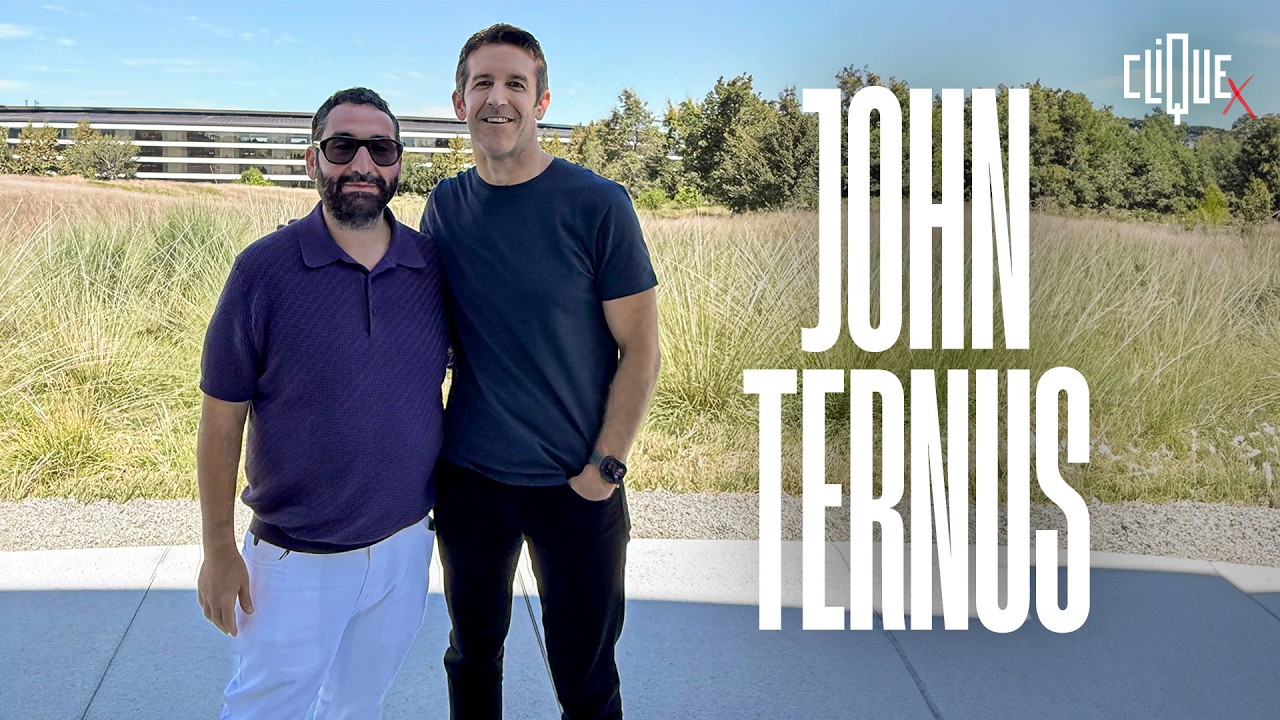
The examples he offered were more specific than executives usually volunteer about a product in this position. There are early adopters "who love it and they're using it and they're enjoying it," Ternus said, and surgeons are starting to use it in surgery "because it's just a fundamentally better tool for them than a monitor that's kind of sitting over here." He added film production, where he said people are using the headset for set development, and closed on trajectory: "we're going to continue to grow and find more and more compelling use cases," and "there's a very bright future." That last sentence never finished. Achour cut in to ask about racing, and Ternus talked about watching Formula 1 in the headset and running the iRacing simulator on it. He did not mention glasses, a new headset, pricing, or a timeline, and he was not asked about any of them.
The one example with a public record
Of the uses Ternus named, surgery is the only one with a verifiable public record, and it is the one VR.org has followed most closely this year. In May, SightMD disclosed that one of its ophthalmologists had performed hundreds of cataract procedures wearing the headset. In August, a peer-reviewed UC San Diego study of 32 endoscopic tear duct operations found that the Vision Pro cases averaged 34.4 minutes against 42.7 for cases run from a conventional monitor, with identical outcomes, a result its authors described as preliminary. And on September 1, Stryker announced the first procedure performed with SportSuite Vision, software authorized through an FDA De Novo grant that created a new device classification for augmented reality displays in orthopedic surgery. Ternus's phrasing tracks the mechanism in the UC San Diego paper closely. Its authors attributed much of the time saved to surgeons no longer turning away from their hands toward a monitor positioned across the room.
That record deserves to be read at its actual size. It amounts to one authorized product covering two hip procedures, one single-institution trial, and one practice's disclosed workflow. It is real evidence that a head-worn display can outperform a monitor in specific procedures, and it now gives a hospital procurement office a product code to write policy against. It is not evidence of volume. The film production claim is harder to assess. Apple has not named the productions or studios Ternus was describing, VR.org has not reported on any, and the claim cannot be checked from outside the company.
What the answer left out
The hardware record since June runs in one direction. On June 3, TF International Securities analyst Ming-Chi Kuo reported that Ternus had personally approved an XR roadmap overhaul that removed every Vision Pro successor and left two pairs of smart glasses standing. On June 25, Apple raised the base price to $3,699 as part of a broader increase tied to memory costs. On August 21, Bloomberg's Mark Gurman reported that Apple had cut roughly 100 jobs from the Vision Products Group, largely shutting down the team building games for the headset and reducing the unit that produces Apple Immersive Video. Apple told employees at the time that Vision Pro and visionOS were not going away, and Gurman reported that a new model remained under consideration for as early as the end of 2028.
Nothing in the Clique interview contradicts any of that. "Continue to grow and find more and more compelling use cases" describes software and customers on the hardware Apple already sells, which is consistent with a roadmap that has no confirmed successor before 2028. The software side, for its part, is visibly active. visionOS 27 shipped on September 14, and Apple posted the second developer beta of visionOS 27.2 on September 21, the same day the interview went up.
The analogy he chose
The comparison Ternus reached for is the part of the answer most worth examining. The Macintosh shipped in January 1984. Desktop publishing, the example he cited, took off a year later, when Apple introduced the LaserWriter printer in January 1985 and Aldus released PageMaker that July, and the category matured on machines that came after the original, the Macintosh II among them. The early days of computers, in other words, were a succession of hardware generations, each widening what the previous one could do. The analogy holds for Vision Pro only if there is a next machine to widen the category, and the most recent reporting on that question describes a consideration rather than a plan.

A fair reading runs in the other direction as well, and it should be stated. Apple does not discuss unannounced products, and no chief executive on a television talk show would be expected to preview a hardware roadmap. An answer confined to current use cases is what Apple's disclosure practice produces whatever is or is not in development. The interview therefore establishes emphasis rather than plans. It shows where Ternus wants the product discussed, and when given the chance, he chose the operating room.
What a buyer should take from it
For a hospital or training organization evaluating Vision Pro, the interview is worth something, though not what a headline might suggest. A new chief executive naming surgery unprompted, in his first weeks, is a reasonable signal about where Apple intends to direct software investment and enterprise support. It is not a hardware commitment, and it does not change the practical guidance VR.org offered in June: buy the current M5 model for what it does today, on a depreciation schedule that assumes it is the hardware you will run through the end of the decade. The more durable asset for surgical buyers may not belong to Apple at all. The FDA classification Stryker obtained is written around a generic head-mounted display rather than Apple's headset, so the regulatory path now exists independently of whatever Apple decides about the next Vision Pro. A procurement committee that plans around that fact, rather than around a chief executive's optimism, is on firmer ground either way.