
I teleport. Whenever a game gives me the choice, I pick it, because smooth thumbstick movement starts to turn my stomach somewhere around the second flight of stairs. I have made my peace with blinking across rooms. It is not glamorous, and it does mean a big part of the VR library was built for somebody else.
GamingNovember 7, 2026
Can Jogging in Place Get a Teleport Player Moving? VR StrideS Thinks So, for $12.99
By Evan Marcus
Co-Founder, VR.org
Advertisement

Sprint Vector was the last time I tried to fight it. Survios built a whole racing game around pumping your arms like a speed skater, and on paper that should have been the answer, because your body is doing the work and your brain has less to argue about. It made me sick. Properly sick, from all that motion.
So VR StrideS had an uphill climb with me before I read a word about it. It came out on Steam on Thursday, November 5, from a developer called gnuj industries, and it costs $12.99, or $11.69 until November 12. It is a PC app that turns jogging on the spot into thumbstick movement in games that already support smooth locomotion. No treadmill, and no trackers strapped to your ankles. Just a headset and the two controllers you already have.
A thumbstick you run with
The trick is less exotic than it sounds. A companion app on your PC reads your headset and controllers 90 times a second. The bounce and rhythm of your head set your speed, and the tilt and motion of the headset and controllers set your direction, so you can look one way and jog another. All of it gets boiled down into the same two-axis signal your left stick sends, then handed to the game through SteamVR or, when SteamVR is off, through an OpenXR layer. The game never finds out. As far as it is concerned, somebody is pushing a stick.
That is why the compatibility list reads the way it does. Half-Life: Alyx works once you set its movement to continuous. Blade & Sorcery, VRChat, BONELAB and BONEWORKS are confirmed, and so are flat games you have converted with UEVR, which is a fun wrinkle if you have been working through our UEVR guide. Skyrim VR, No Man's Sky and Phasmophobia are among the games still in testing, and Phasmophobia is the one I noticed first, since it is the VR game I actually play with friends. Beat Saber is out, because there is no stick movement to drive, and so is anything that only lets you teleport.
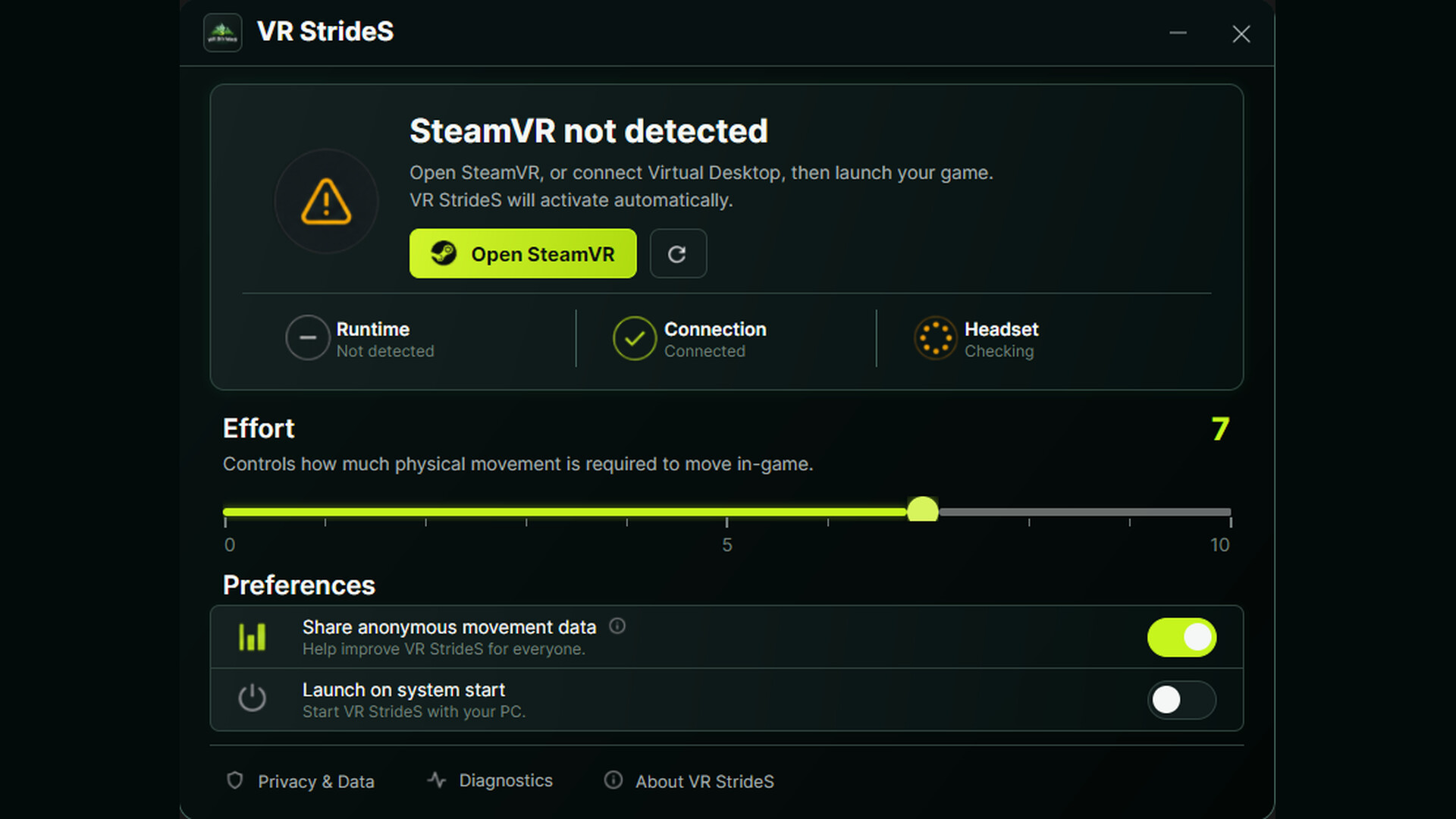
Two dials do most of the work. Effort runs from 0 to 10, with 5 as the default, and sets how hard you have to move to reach a given speed. Turn it down and a light jog gets you to top speed. Freedom of Movement limits which directions you can drift in, from a full circle down to a forward cone, and the developer suggests the narrow cone for people who keep sliding sideways while they learn. It is also straight about one weakness: a very slow walk in place may not register. It wants a jog.
Will my stomach care?
The idea behind every scheme like this is simple enough. Stick sickness is an argument between your eyes, which say you are moving, and your inner ear, which says you are standing still. Give your body real motion and maybe the argument gets quieter.
Advertisement
Maybe. I went looking for evidence and found less than I wanted. The study I kept coming back to is a small one in Scientific Reports, published in July 2025, where 15 people worked through mazes three ways: teleporting with hand tracking, a normal controller stick, and Cybershoes, which you wear sitting down and shuffle your feet to walk. Teleport made people the least sick. The stick landed in the middle. Cybershoes made people the sickest, and the authors blame the same sensory conflict, made worse by sitting still while your legs claim you are walking. They also point out that the Cybershoes runs used a Valve Index while the other two used a Quest 2, so it is one data point, not a verdict.

What it does tell me is that "your body is moving, so you will feel fine" is not a rule. Sprint Vector already taught me that. The difference with StrideS, at least on paper, is that you are standing up and bouncing for real, so your inner ear gets some version of what your eyes are seeing. Is that enough? I do not know. I am not sure anybody does yet.
There is also the headset to think about. My Quest 3, with Meta's Elite Strap on it, starts to bother me in under an hour when I am mostly standing still, and what twenty minutes of jogging does to that number I have no idea. The developer's own advice is to take breaks the way you would in any standing VR game, and to make sure you have the floor space to jog without hitting anything.
$12.99 against $2,595
In June I wrote about Virtuix's Omni One for Quest, a $2,595 treadmill, and said I wanted to believe in it. I still do. But StrideS costs about a two-hundredth of that, runs on hardware I already own, and the worst case is thirteen dollars and a sweaty shirt. That is a much easier bet to make.
It is not a new idea, either. Natural Locomotion has sold the same basic promise on Steam since April 2018 for $9.99. I have not used either one, so I am not going to pretend I know which is better. What StrideS has going for it is focus: Quest 3 is its main tuning target, Quest 3S and Quest Pro are supported, and there is a free tutorial to try before you spend anything.
How to set it up
What you need: a Windows 10 or 11 PC that runs PC VR games, a Quest 3, Quest 3S or Quest Pro, and a way to connect them: Virtual Desktop, Steam Link or ALVR. Quest 2, PS VR2 on its PC adapter, other PC headsets and Meta's own Link and Air Link are still listed as in testing. The app is $12.99, or $11.69 until November 12.
- Try the free tutorial first. There is a standalone VR StrideS Demo on the Quest store and a free VR StrideS Tutorial on Steam. Both teach the motion in their own practice world, and the Quest one does not add jogging to your other Quest games.
- Buy and install VR StrideS on Steam. This is the PC companion app that does the actual work.
- Clear your space and check your boundary. You are going to be jogging for real.
- Connect the headset to your PC. Use Virtual Desktop, Steam Link or ALVR, the three connections the developer lists as supported.
- Start VR StrideS before the game. It finds SteamVR or a native OpenXR runtime on its own when it launches. If it finds nothing, its Diagnostics screen is where to look.
- Switch the game to smooth movement. In Half-Life: Alyx, set movement to continuous.
- Set Effort and Freedom of Movement. Lower Effort if top speed takes too much work, and narrow the cone if you keep drifting sideways.
The developer keeps its compatibility list and FAQ on the VR StrideS site, and it labels that list a sample rather than a whitelist, so check it before you buy with one particular game in mind. The Linux build is still in testing too, after people reported launch and connection problems.
The free tutorial is where I would start, and it costs nothing. If my stomach survives it, the $12.99 version is where I find out whether a teleport player can run through an entire level of something. If it does not, I am out nothing, and I go back to blinking across rooms.
Advertisement