
The cheaper Vision Pro has been dead for a while. What died this week is the part that would have made it buildable.
HardwareJuly 10, 2026
Apple Did Not Just Cancel the Cheap Vision Pro. It Canceled the Display That Made One Possible.
By Sam Whitfield
Contributing Writer, VR.org
Advertisement
South Korea's The Elec reported on Wednesday that Samsung Display is winding down G-VR, the internal name for the glass-substrate micro-OLED panel it had been developing for a lighter, lower-cost Apple headset. The project is set to be formally terminated by September. Apple has already pulled the bulk of its mixed-reality hardware talent onto smart glasses, and the panel program went with them.

If you have been following Apple's Vision retreat, you have seen a lot of headlines that sound like this one and mean slightly different things. Mark Gurman reported the Vision Air was paused in October 2025 and canceled outright in May 2026. Ming-Chi Kuo reported in June that incoming CEO John Ternus had erased every Vision headset from the roadmap. Those were decisions about products. This is a decision about a component, and components are where product decisions become irreversible.
Why the panel was the whole story
The Vision Pro's displays are OLEDoS, which means the organic emitters are deposited directly onto a single-crystal silicon wafer. You are, functionally, printing a display inside a chip fab. The result is spectacular: 3,386 pixels per inch, which is the number that makes text legible on a screen sitting two centimeters from your cornea. It is also the reason the headset costs what it costs. Silicon wafers are small, the panels are cut from them, and yield on a 3,000-plus PPI emissive display is not the kind of thing that improves quickly.
G-VR was the escape hatch. Building micro-OLED on a glass substrate rather than silicon means larger mother panels, more units per sheet, cheaper backplane processing, and a cost curve that behaves like display manufacturing instead of like semiconductor manufacturing. The tradeoff was resolution. The Elec puts G-VR at roughly 1,600 to 1,700 PPI, about half the density of the panel in the current Vision Pro.
Half the pixel density sounds like a downgrade until you consider what it was for. Nobody was going to sell a $3,699 headset in volume. A device at half the density and a fraction of the panel cost, paired with a lighter enclosure, was the only credible route Apple had to a spatial computer that a normal person might buy. Mass production was penciled in for sometime after 2028. That timeline was already generous. Now there is no timeline at all.
The gap is structural now, not scheduling
Here is the part that matters for anyone making a purchasing decision. Apple's headset absence has been reported as a delay for the better part of a year. Gurman said in May that a Vision Pro successor was at least two years out. Delays get resolved. Suppliers get re-engaged, engineers come back, a slipped date becomes a shipped product.
Component cancellations do not work that way. A display program is a multi-year commitment involving process development, capital equipment, and a customer willing to underwrite volume that does not exist yet. When Samsung Display formally closes G-VR in September, the institutional knowledge does not sit in a drawer waiting for Apple to change its mind. It gets reassigned. Restarting means starting.
Advertisement
So the practical read is this. Apple has one headset. It is the M5 Vision Pro, it was refreshed in October 2025, and Apple raised its price to $3,699 last month rather than cutting it. There is no cheaper model coming, and there is now no panel that a cheaper model could have been built around. If your organization has Vision Pro deployments in surgical training, field service, or design review, the device you are standing up today is the device you are standing up for the rest of the decade. Budget the refresh cycle accordingly, because there will not be one.

The category Apple is running toward
The engineers did not evaporate. They moved to glasses, and Apple's display-free AI glasses are still expected in 2027, aimed squarely at the category Meta built with Ray-Ban and has spent three generations refining. A display-free product needs no micro-OLED at all, which explains the sequencing better than any strategic memo would. You do not fund a headset panel roadmap while shipping a product that has no screen.
There is a timing detail worth noting without overreading. G-VR terminates in September. Ternus becomes chief executive on September 1. Whether the calendar alignment is deliberate or incidental, the effect is the same: the incoming CEO takes the job with the headset program's most expensive open commitment already closed out. Executives generally prefer to inherit a clean set of books.
Samsung keeps the technology
The most interesting line in The Elec's report is the one that is not about Apple. Samsung Display is continuing OLEDoS development for its own mixed-reality devices, and industry reporting suggests the company may carry the glass-substrate work forward for its own smart glasses rather than shelve it.
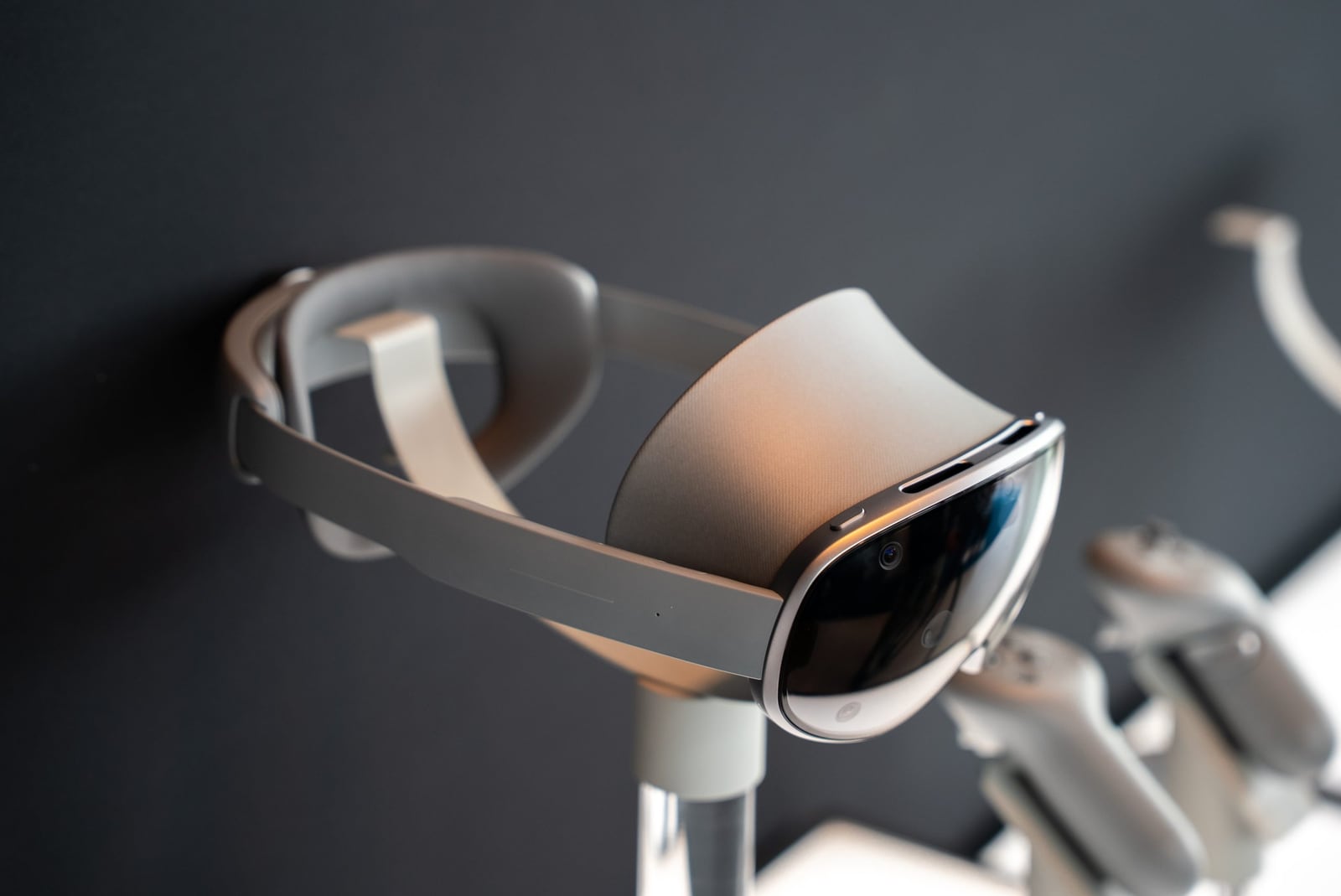
That reframes the story. Apple funded several years of research into how to make high-density micro-OLED cheap. It then walked away, leaving the supplier holding the results and a Galaxy XR line that needs exactly this technology. Samsung showed a 1.4-inch panel at 5,000 PPI and a 1.3-inch RGB OLEDoS rated at 40,000 nits at AWE this year, which is not the portfolio of a company that has lost interest in the category.
Meta, meanwhile, has already signed Seeya and BOE for micro-OLED panels on its next flagship. The supply chain for affordable high-density displays is consolidating around companies that still intend to ship headsets. Apple is not on that list.
The usual caveat
The Elec is a supply-chain outlet with a good record and an imperfect one. Apple has not confirmed anything, Samsung Display has not confirmed anything, and panel programs have been reported dead before and quietly revived. Read this as one more consistent data point in a pattern that now runs from Gurman to Kuo to the fabs, not as a press release.
But the pattern is the point. When the analysts, the reporters, and the component suppliers all describe the same retreat, the disagreement is only about vocabulary. Apple spent six years and an enormous amount of credibility arguing that the headset was the next computing platform. It is now betting the decade on a pair of glasses with no screen in them, and this week the last piece of hardware that could have made the old bet work got a termination date.
Advertisement