
FDA cleared the software behind Meta's new Hearing Enhancement feature on July 13, 2026. The submission is 510(k) number K254044, filed by Meta Platform Technologies, LLC of Burlingame, California, received on December 17, 2025 and found "Substantially Equivalent" after a traditional review. The 510(k) summary calls the device "Hearing assist." Meta's announcement came ten weeks later, at Connect on September 23, and the feature arrived with a price: $149.99 as a one-time payment, or included with a Meta One plan, after a 30-day free trial. Meta's Connect recap lists it as HSA and FSA eligible and "Launching in the US later this year."
ArSeptember 25, 2026
Meta's $149.99 Hearing Aid Unlock Runs on a 510(k) It Cleared in July
By Sam Whitfield
Contributing Writer, VR.org
Advertisement
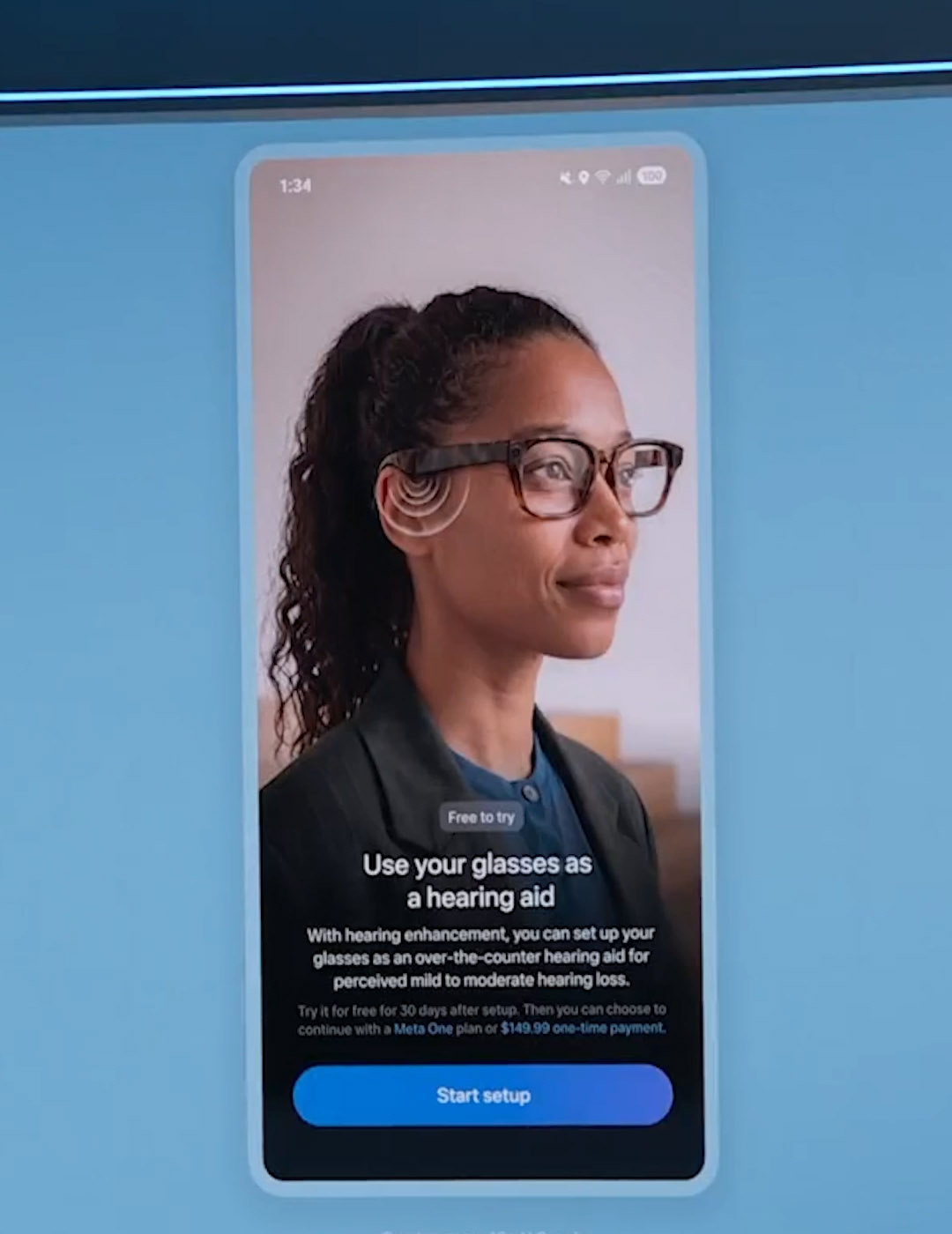
The setup screen Meta showed during the keynote is the plainest description of the product so far: "With hearing enhancement, you can set up your glasses as an over-the-counter hearing aid for perceived mild to moderate hearing loss."
What K254044 covers, and what it does not
The clearance sits under product code SCR, regulation 21 CFR 874.3335, which FDA's classification database defines as software "intended to be used with a compatible wearable hardware platform to compensate for impaired hearing," with customization to the user's hearing needs. It is Class II, reviewed by the Ear, Nose and Throat panel. Because the regulation covers the software rather than the frames, one clearance can in principle travel across a hardware line the company is still adding to, provided each new pair meets the platform requirements described in the filing.
The code is young and nearly empty. openFDA lists five authorizations under it: the De Novo grant that created it, and four 510(k) clearances since. FDA authorized Apple's Hearing Aid Feature through the De Novo pathway on September 12, 2024, in what the agency's announcement called the first over-the-counter hearing aid software, indicated for adults 18 and older with perceived mild to moderate hearing impairment. Luxottica Group S.p.A. cleared the software inside Nuance Audio on January 31, 2025, and Tuned, Ltd. cleared a self-fitting mobile app on September 26, 2025. Meta's was the third 510(k), and it names Apple's feature as its predicate device. Samsung Electronics cleared its own Hearing Aid Feature on July 31, 2026, eighteen days after Meta. openFDA labels its records unvalidated, so the filing details here are the agency's data, checked against the summary FDA publishes for each clearance.
Luxottica's place on that list is the commercially awkward one. Its parent, EssilorLuxottica, is Meta's partner on every line of its glasses, Ray-Ban and Oakley as well as the Meta-branded frames, and its subsidiary cleared hearing aid software for eyewear roughly eighteen months before Meta did. Nuance Audio went on sale in the United States in April 2025 at about $1,100, and Hearing Tracker reported at launch that insurance reimbursement was often available because the product qualifies as both a medical device and prescription eyewear. The price has since come down: the standard model now starts at $699, with a new Nuance Audio Plus from $829, both before prescription lenses, The Verge reported on September 22. Meta is entering a category its own partner already sells into, at a lower combined price, and on hardware some customers already own.

What the $149.99 is for
Apple shipped its hearing feature as a free software update for AirPods Pro 2. Meta is selling its version as an unlock. The difference matters less as a comparison of generosity than as a signal about which line of Meta's business the feature is meant to serve, because $149.99 on a product that has already been sold at a margin is not hardware revenue. It is either an inducement to subscribe or a standalone software sale, and Meta has structured it to work as both.
Advertisement
Two details point at the subscription. The first is that Meta One, the company's bundle, carries the feature at no extra cost, which puts a cleared medical feature inside a consumer subscription. The second is HSA and FSA eligibility, which Meta says applies to the $149.99 payment subject to the rules of the individual account. Pre-tax dollars are available only because there is a regulated device claim behind the purchase, and that same claim obliges Meta to sell this as a medical device, with labeling and post-market obligations, rather than as an audio setting.
VR.org has covered the other half of this argument already, from the opposite direction. In July, Meta rate-limited Conversation Focus, the speech-boosting feature already running on Ray-Ban Meta glasses, to three hours a month, then paused the change after the response. The objection then was that Meta was metering something that cost it nothing to run. Hearing Enhancement is a different proposition, since a 510(k), its labeling and its surveillance obligations are recurring costs the company can actually point to, and this is the first Meta glasses feature where the invoice has a filing behind it.
The two features are also different products. Hearing Tracker reported on September 24 that Hearing Enhancement builds a personalized amplification profile from a guided in-app hearing assessment, where Conversation Focus boosts speech generically, and the 510(k) summary requires users to complete that self-fitting in the phone app while wearing the glasses before the feature will run. Ravish Mehra, Meta's director of research science, told TechRadar that "we are actually the first self-fitting hearing aid on glasses in the market," and TechRadar reported that the assessment takes one to two minutes in the Meta AI app. The claim rests on a real distinction. Luxottica's own 510(k) summary describes Nuance Audio as using "preset fitting options," four of them, and states that a user's hearing test "is not used in the fitting."
Which glasses, and which phone
Model support is the first open question, and it is narrower than Meta's written announcement suggests. That post says only "supported AI glasses." On stage, Mark Zuckerberg said that "Hearing enhancement is coming first to Meta Glasses," according to Hearing Tracker's transcript of the keynote, and Engadget reported that the Ray-Ban models are not included at the start. The first wave therefore lands on the Meta-branded line, which Meta now sells from $249 with a Meta Adventurer that goes on sale October 23, rather than on the $349 Ray-Ban Meta Audio or the $449 Ray-Ban Meta (Gen 3) announced the same day. The 510(k) summary does not name a model either. It says testing used "representative, compatible hardware (Smart Glasses)" and describes the platform as including "cameras for picture taking," which leaves an open question over the camera-free Ray-Ban Meta Audio, the pair whose design is closest to a dedicated audio product.
The phone is the second. The clearance covers an iOS app. Android appears in the summary as a planned addition under a predetermined change control plan, which lets Meta add the platform without a new submission provided it follows the testing the plan sets out. Meta's announcement gives no date for it, and until it arrives, an Android owner has no way to complete the setup the clearance requires.
Geography is the third. K254044 is a United States authorization and the feature is scoped to the United States, which splits Meta's glasses business along an awkward line: Meta Ray-Ban Display opened this week in Canada and the United Kingdom and takes preorders in France, Italy and Germany for October 13, while the hearing feature stays home. European medical device rules run through a separate conformity process, Meta's announcement gives no date for one, and until there is one, the most medically useful thing these glasses do is a US-only feature.
The buyer's arithmetic, for now, runs like this: $149.99 on Meta Glasses that start at $249, against $699 or more for Nuance Audio before lenses, with a reimbursement path Hearing Tracker says often applies, or against AirPods Pro, where the feature costs nothing extra and the hardware looks like earbuds. Mehra's case for the form factor was that "nobody else can tell just by looking at your glasses that you have hearing impairment," and for a meaningful number of people that is the entire purchase. Anyone buying frames on the strength of this feature should wait for Meta's supported-models list, and Android owners for the app, before paying for either.
Advertisement