
Meta's statement to Android Authority on Tuesday, October 13, ran to two sentences: "This issue has been resolved. People can manage, review and delete voice logs of their interactions with Meta AI via settings at any time." The issue came from a Ray-Ban Meta owner posting in two Reddit threads. Three separate pairs, spanning the second and third generations, had saved audio recordings and text transcripts of ordinary conversation to the Meta AI app, the owner said, although nobody had said "Hey Meta" and the "Respond without Hey Meta" setting was off. The owner tied the behavior to a recent firmware update. Android Authority said it had not reproduced the problem and that reports remained limited. Meta's statement named no cause, no firmware version and no count of affected owners.
Meta's Fix for Unprompted Glasses Recordings Leaves US Owners a Delete Button and UK Owners an Off Switch

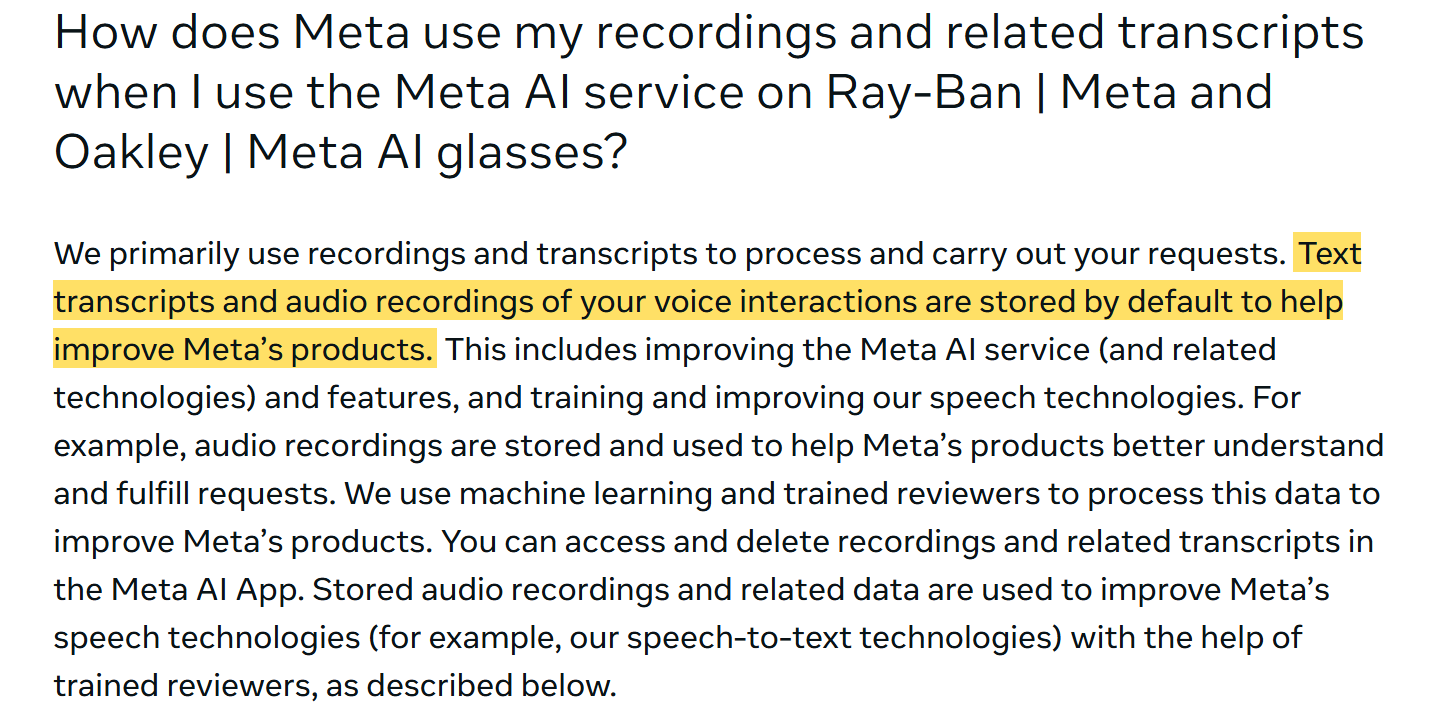
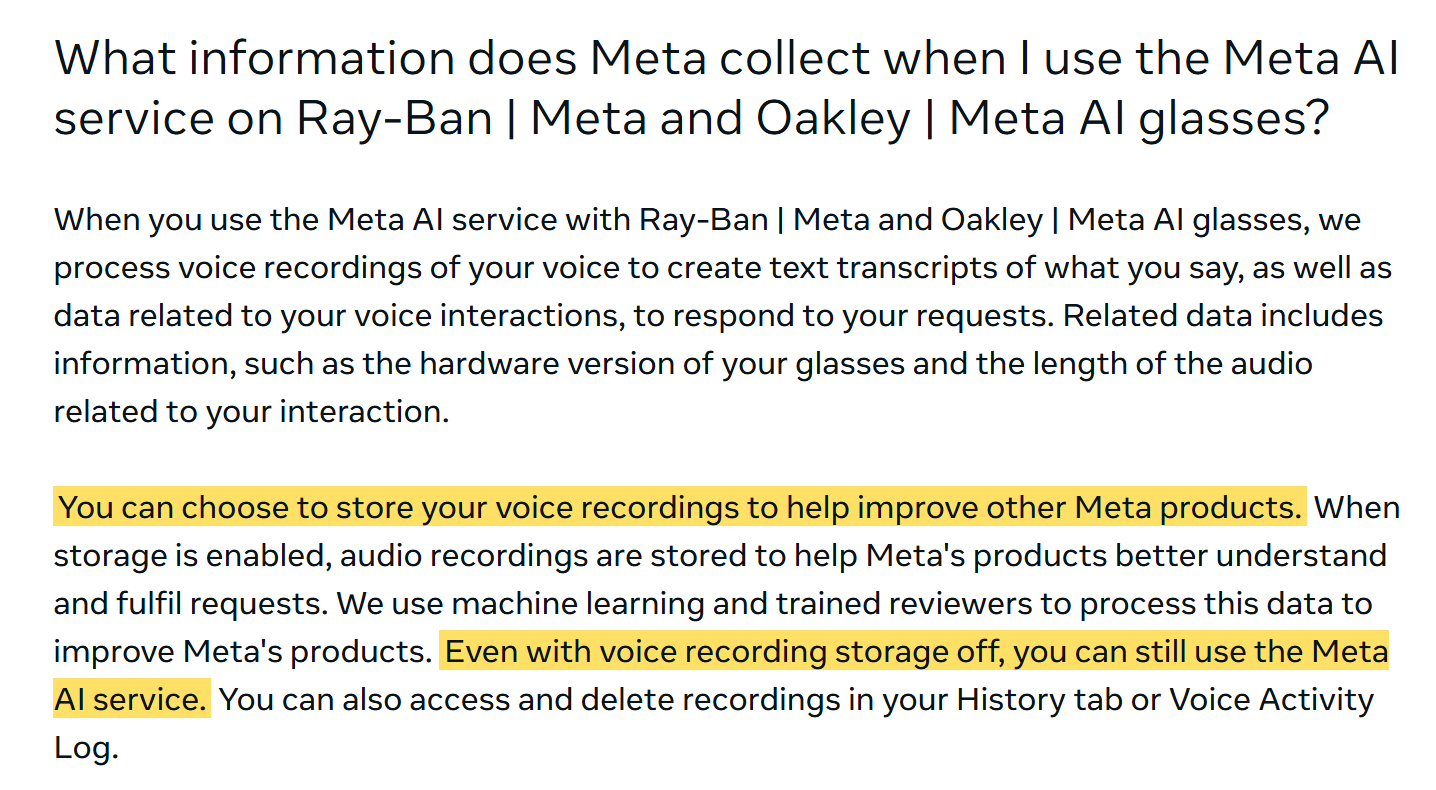
The second sentence of that statement is the one whose meaning depends on the country. Meta publishes its AI Glasses Voice Privacy Notice, effective July 22, 2025, in regional versions, and the versions do not describe the same product. For the Meta AI service on Ray-Ban Meta and Oakley Meta glasses, the United States text reads: "Text transcripts and audio recordings of your voice interactions are stored by default to help improve Meta's products." It offers no setting that turns this off. The only storage switch anywhere in the US notice belongs to Ray-Ban Stories, the 2021 pair that preceded Ray-Ban Meta. The United Kingdom version of the same notice, carrying the same effective date, says instead: "You can choose to store your voice recordings to help improve other Meta products." It follows that with "Even with voice recording storage off, you can still use the Meta AI service." When VR.org compared the regional pages on October 16, the Irish and German versions carried the UK language, and the Canadian and Australian versions carried the US language.
A recording nobody asked for
For a misfire like this one, the retention clause is where the regional difference becomes a practical one. The US notice states: "We will store voice recordings even if you unintentionally activate a voice interaction." If Meta's systems detect that an activation was not intended, the recording is labeled a "false wake" and deleted "within 90 days of detection." Otherwise, voice transcripts and stored audio are kept "for up to one year." The UK version opens the same clause with a condition, "When storage has been enabled," and says that with storage off, recordings are deleted "immediately after processing." Set side by side, the two texts describe different outcomes for the same misfire. On a pair in London with storage switched off, an unprompted activation produces audio that is processed and discarded. On a pair in Los Angeles it produces a stored recording, kept for up to 90 days if Meta's systems flag the mistake and for up to a year if they do not.
Which of those clocks applied to the recordings in the Reddit report is not public. Android Authority said it had asked Meta what happens to audio captured through an unintended activation, and the statement it published does not address the question. The US notice also says stored recordings help improve Meta's speech technologies "with the help of trained reviewers," who hear them with the pitch altered. It does not say whether recordings labeled as false wakes are kept out of that review before deletion. Owners can delete entries sooner through the glasses' privacy settings in the Meta AI app, where the voice activity log lives, as TechRadar set out. Deletion, however, depends on the owner finding the entry first.
The switch US owners had until April 2025
US owners did have a storage setting for the Meta AI service. It went away on April 29, 2025, when Meta emailed owners that "The option to disable voice recordings storage is no longer available, but you can delete recordings anytime in settings," as The Verge reported the following day. The same email said "Meta AI with camera use is always enabled on your glasses unless you turn off 'Hey Meta.'" This week's statement repeats that offer in different words. A US owner is left with two controls: delete after the fact, or turn off voice activation entirely, which TechRadar reports some affected owners have done at the cost of hands-free access to Meta AI. The UK notice describes a third control, and it is the only one of the three that takes effect before a recording exists.
Meta's safeguards were built for the camera
The privacy safeguards Meta has publicized for its glasses this year have centered on the camera and its capture LED. In July a mandatory update disabled the camera on glasses whose LED had been tampered with, and in August Meta extended that check to the full length of a recording. Lawmakers have been reaching further than that. California's SB 1130, which would have required a recording indicator on smart glasses, was drafted broadly enough to cover a camera-free pair with microphones, and it was vetoed on September 30. The broadest of the three device definitions Norway is weighing for its proposed temporary ban would, read literally, reach one as well. Neither is law. The light in this week's report was the internal notification LED, which faces the wearer, and none of Meta's LED safeguards governs what the microphones keep.
Meta's newest hardware puts more weight on the microphones. Its Connect announcement on September 23 gave Ray-Ban Meta (Gen 3) "a new 6-mic array" for calls and voice commands. The same post introduced Ray-Ban Meta Audio, a $349 pair with no camera at all, scheduled to ship on October 13, the day the Android Authority report appeared. On that pair, the capture LED safeguards have nothing to attach to.
For a company or institution deciding whether to put these glasses on staff, a purchase Meta handles through an AI glasses bulk order inquiry linked from its US store, the regional text is the material difference. A UK buyer can set voice recording storage off as a matter of policy and still use the assistant. A US buyer, under the notice as currently published, cannot, and anything an unprompted activation captures sits on Meta's deletion schedule unless someone audits the voice activity log on every pair. Workplace and venue rules written around the capture LED, including New York's July ban on smart glasses in its courthouses, address the camera. This week's fix may well have ended the specific misfire. It did not change the US default that decides what is kept the next time one happens.