
The Official Report of a Westminster Hall debate held on the morning of November 4 contains the most specific statement the UK government has yet made about camera glasses. Answering MPs, Satvir Kaur, Parliamentary Under-Secretary of State at the Home Office, said that "the benefits of smart glasses must be weighed against the harms that they can cause," and then set out where the work stands: "The Government are already looking into options to restrict smart glasses in certain settings and restricting the sale to certain users. That work is happening at pace."
ArNovember 5, 2026
The UK Government Is Looking at Restricting Who Can Buy Smart Glasses, a Home Office Minister Told MPs
By Sam Whitfield
Contributing Writer, VR.org
Advertisement

That is a statement of direction rather than a policy. Kaur did not name a product category, a retailer obligation or a timetable, and she did not say who the "certain users" would be. The most concrete candidate came from the Liberal Democrat benches, where Marie Goldman, the party's spokesperson in the debate, asked the government to "expand the scope of sexual harm prevention orders to prohibit completely the purchase or use of smart glasses by sex offenders, where appropriate, including as a condition of release." She also called for the government to "ban modifications that disable or remove the recording indicator, as well as those that might cover it up," noting that "a bit of electrical tape might do the job." Both proposals are aimed at the person holding the glasses rather than at the device itself, which may make them simpler to legislate than anything that would touch products Meta and its rivals sell openly on UK high streets.
Anna Sabine, the Liberal Democrat MP for Frome and East Somerset who secured the debate, built her case around that recording light. "The only indication anyone has that they are being filmed is a small LED in the corner of the glasses, but that is quickly disappearing," she told MPs, describing shops that offer to remove it. She also pointed to Meta's terms of use, under which, she said, content captured by the glasses can be used to train Meta AI, with the burden of consent placed on the wearer rather than on the person being filmed. Her party, she added, is "not calling for a total ban on this technology," a point worth holding onto given how much of the coverage since has been framed around bans.

What already applies
Much of the minister's answer described rules that exist today. Courts and tribunals already prohibit the glasses, since recording is barred there anyway; Engadget reported in August that HM Courts and Tribunals Service now confiscates them at the door across criminal, civil and family courts in England and Wales. Kaur said healthcare and education settings have safeguarding and professional policies that already cover recording, and that NHS England and the Department for Education "are currently looking into wearable technology in certain settings as well." She cited the Protection from Sex-based Harassment in Public Act 2023, which she said was brought into force earlier this year and can cover filming someone without consent, and the Online Safety Act 2023, which requires platforms to remove non-consensual intimate images. On the parliamentary estate itself, where Sabine's party has called for a ban, the minister said "appropriate next steps are currently being considered," subject to decisions by the Commission and the Speakers of both Houses.
The Conservative frontbench argued for caution in the other direction. Blake Stephenson, the MP for Mid Bedfordshire, cited a Counterpoint Research estimate that global sales of AI glasses rose by 263% in the first half of 2026 and pointed to beneficial uses, among them CrossSense, which makes AI smart glasses for people living with dementia and recently won the £1 million Longitude Prize on Dementia. He asked the government "to consider those beneficial uses before introducing any blanket bans." Kaur accepted part of that argument, describing smart glasses as "a game changer for those who are visually impaired," while placing the design burden on manufacturers: "We need to design out the issues so that it does not happen in the first place."
The petition the government still has to answer
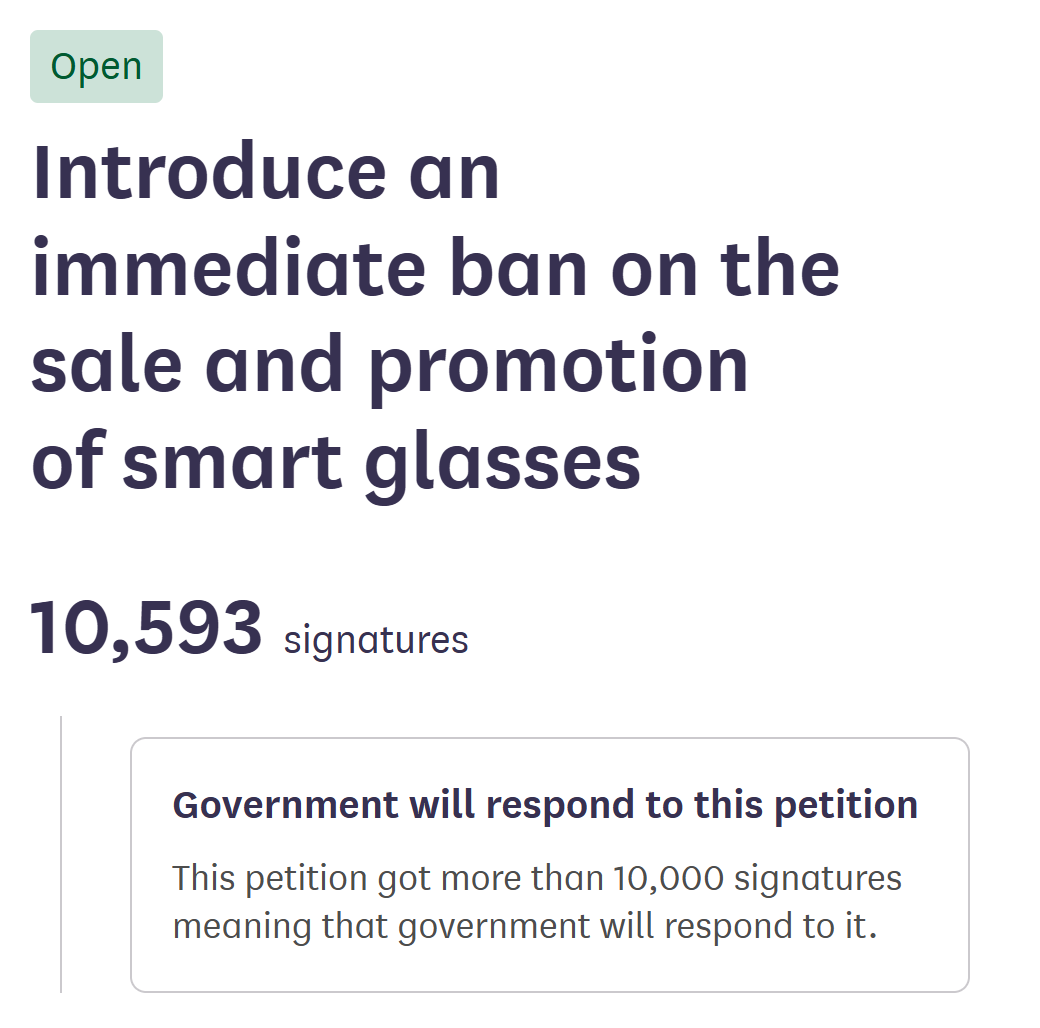
Outside the chamber, the pressure has a number attached. A parliamentary petition calling for "an immediate ban on the sale and promotion of smart glasses" passed 10,000 signatures on October 5, the threshold at which the government commits to a written response. It stood at 10,593 signatures on November 5, with that response not yet published. An earlier petition to ban recording-capable glasses in public spaces closed in April with 765 signatures, which gives some sense of how quickly public interest has grown over the course of the year.
The UK is also not acting alone. UK venues moved first, with Wetherspoons, Soho House and ATG theatres writing the glasses out of their house rules over the summer. Victoria has put smart glasses under its school phone rule from January 2027, Norway is preparing a temporary ban on use in parks, schools, gyms and clinics, and two Dutch retailers, Wehkamp and Hans Anders, stopped selling Meta's glasses outright. In the United States, Senators Wyden and Markey have given Meta until November 25 to answer nine questions about its camera glasses. VR.org keeps a running list of every restriction it has verified, from courtrooms to exam halls, in its smart glasses bans tracker.
For manufacturers and UK retailers, the practical question is which of the two routes the minister described reaches law first. Restrictions by setting would largely formalise what courts, venues and employers are already doing, and the commercial impact would be modest. Restrictions by buyer are newer territory, because they would make a court order, or possibly a retailer, responsible for who leaves a shop with a pair, and nothing said in the debate indicated how that would be checked at the point of sale. Kaur described the debate as "not the end of the journey; it is very much the beginning." The next concrete marker is the government's written response to the sales-ban petition, which will have to set out in writing what the minister described on November 4 only in outline.
Correction, November 5, 2026: This article listed Wetherspoon among UK venues that wrote the glasses out of their house rules. A Wetherspoon spokesperson told UC Today on August 11 that it "did not say that Meta glasses are banned" and has no company policy specifically for smart glasses; its existing rule against filming customers or staff without their permission applies to them the same way it applies to phones. Soho House and ATG Theatres have asked wearers to remove them, and UK Comic-Con has barred recording devices at its events.
Advertisement