
Victoria's Minister for Education, Gabrielle Williams, signed Ministerial Order No. 1515 on October 18. The government announced it in a release dated October 21. The four-page order commences on January 28, 2027, and applies to every school in the state, government, Catholic and independent alike. From that date, students must keep smart glasses turned off during school hours and stored "in a way that restricts their access to them." Clause 8, the glasses rule, repeats clause 7, the phone rule, almost word for word. A separate ministerial policy for government schools, effective January 27, goes much further. It bars anyone from wearing or using smart glasses on government school premises or at school-organized events, covering "students, staff, parents, carers, contractors, volunteers and other visitors." "Smart glasses have no place in our classrooms or on school grounds," Williams said in the release.
Victoria's Ministerial Order Puts Smart Glasses Under the Phone Rule in Every School From January 28, 2027
A definition with no camera in it
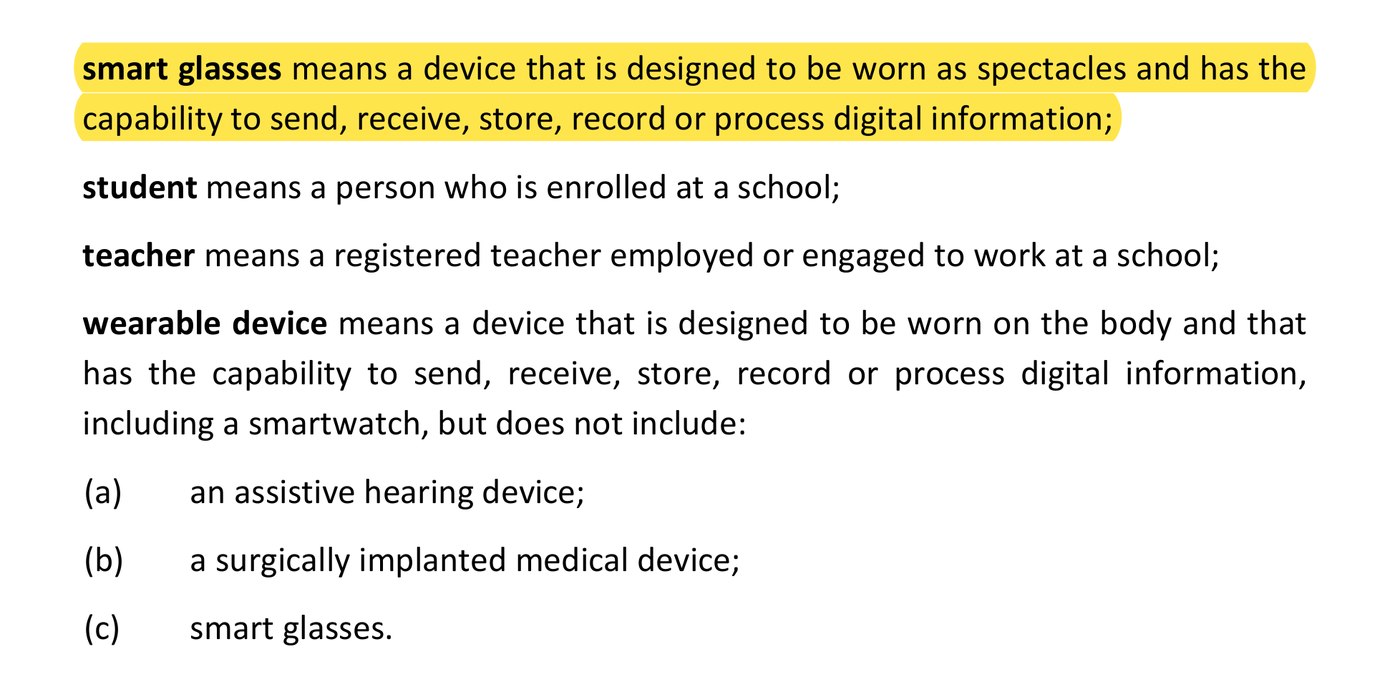
The order defines smart glasses in one sentence: "a device that is designed to be worn as spectacles and has the capability to send, receive, store, record or process digital information." It requires no camera, no microphone and no AI assistant, even though the department's own rationale is about filming, warning that the glasses "can film people and their surroundings without their knowledge or consent." Norway's proposed restriction, announced October 5, floated candidate definitions without choosing one, each built around a camera, audio recording or AI, as Jordan Kuo pointed out at the time. Victoria's turns on computation alone, which makes it wider than any of them. Read as signed, it reaches Meta's $349 Ray-Ban Meta Audio, a pair with no camera at all, and the camera-free category on which Even Realities raised money at a $1 billion valuation in July. The department has not said whether that reach was intended. The text does not lend itself to a narrower reading.
The neighboring definition creates a second problem. The order's wearable device category, which covers smartwatches and only requires notifications, cellular connection and recording to be switched off, expressly excludes "an assistive hearing device" and "a surgically implanted medical device." The smart glasses definition has no matching exclusion. On the order's wording, a hearing aid built into a pair of frames counts as smart glasses. EssilorLuxottica sells exactly that product as Nuance Audio, and Luxottica cleared its software with the FDA in January 2025. The only route back onto a student's face is clause 11(2), which permits an exemption solely as "a reasonable adjustment for a student with disability," and only "where the adjustment cannot be reasonably provided for by another device or approach." A conventional hearing aid is another device. The department says its guidance on exemptions will be published during Term 4, the last term of the 2026 school year. How it tells principals to weigh that second condition is the most consequential thing it has left to write.
Six months from the smartwatch rule to the phone rule
The order is tighter than the plan the government described in April. Its April 1 announcement extended the 2020 government-school phone ban to every school from January 28, 2027. It covered "wearable devices like smart watches and wireless earbuds," set the softer switch-off rule for wearables, and did not mention glasses at all. The order now separates glasses from smartwatches by name and gives them the storage obligation written for phones. A pair that has been switched off still cannot be worn as eyewear. For most students that costs nothing. It costs more for a student whose corrective lenses sit in a smart frame, and Meta released two Ray-Ban models in April, the Blayzer Optics and Scriber Optics, built for prescription wearers. That student needs a second, ordinary pair for school hours. The government-school policy's one example of a qualifying disability is vision impairment, but correction alone does not appear to meet the test, since an ordinary pair provides the same adjustment.
Adults, at all hours, in government schools
For adults, the reach depends on who runs the school. The government-school policy applies at all times, and its list of school-organized events runs from camps and concerts to formals, fetes and school council meetings, "regardless of whether or not it takes place on or off school premises, during or outside the school day or school term." A parent wearing Ray-Ban Meta glasses to a Saturday fete is covered. Staff who find someone in a pair must ask how long it was worn and whether anything was recorded, and must report it to the department's incident center if students or staff may have been recorded in a way that compromises their privacy or safety. A visitor who refuses to remove and store the glasses can be asked to leave. Groups that hire school buildings on weekends inherit the ban and enforce it themselves.
None of that yet applies to adults at Catholic and independent schools. According to the release, a re-elected government "will extend the adult ban on smart glasses to non-government schools, which will be done through legislation." Victoria votes on November 28, per the Victorian Electoral Commission. For non-government schools, the adult half of the policy is a campaign commitment made about five weeks before polling day. The student half is already signed.

From house rules to a drafted standard
Restrictions on these glasses have so far arrived one venue at a time. Wetherspoons and Soho House in Britain wrote them out of their house rules in August, and ICE classified them as body-worn cameras for its own staff. In Florida, Polk County Public Schools told parents in an August 13 notice that students "may not possess or wear Meta/Ray-Ban smart glasses." Each of those rules was written by one operator for its own premises, and the Florida notice names a brand rather than defining a device. The Victorian order hands other education departments a one-sentence definition they can adopt as written.
For an education buyer, that definition draws its line at form factor. A Quest 3 is not designed to be worn as spectacles, so a government school's VR program falls outside the definition, while a glasses-form AR device in the same classroom would need the disability exemption, since the government-school policy describes no exception for hardware the school owns. For Meta and EssilorLuxottica, the most exposed buyers are the two groups both have been building for, prescription wearers and hearing-aid users, whose smart pair is the pair they wear all day. For them, the Term 4 guidance, more than the order itself, will settle what January 28 means in practice.