
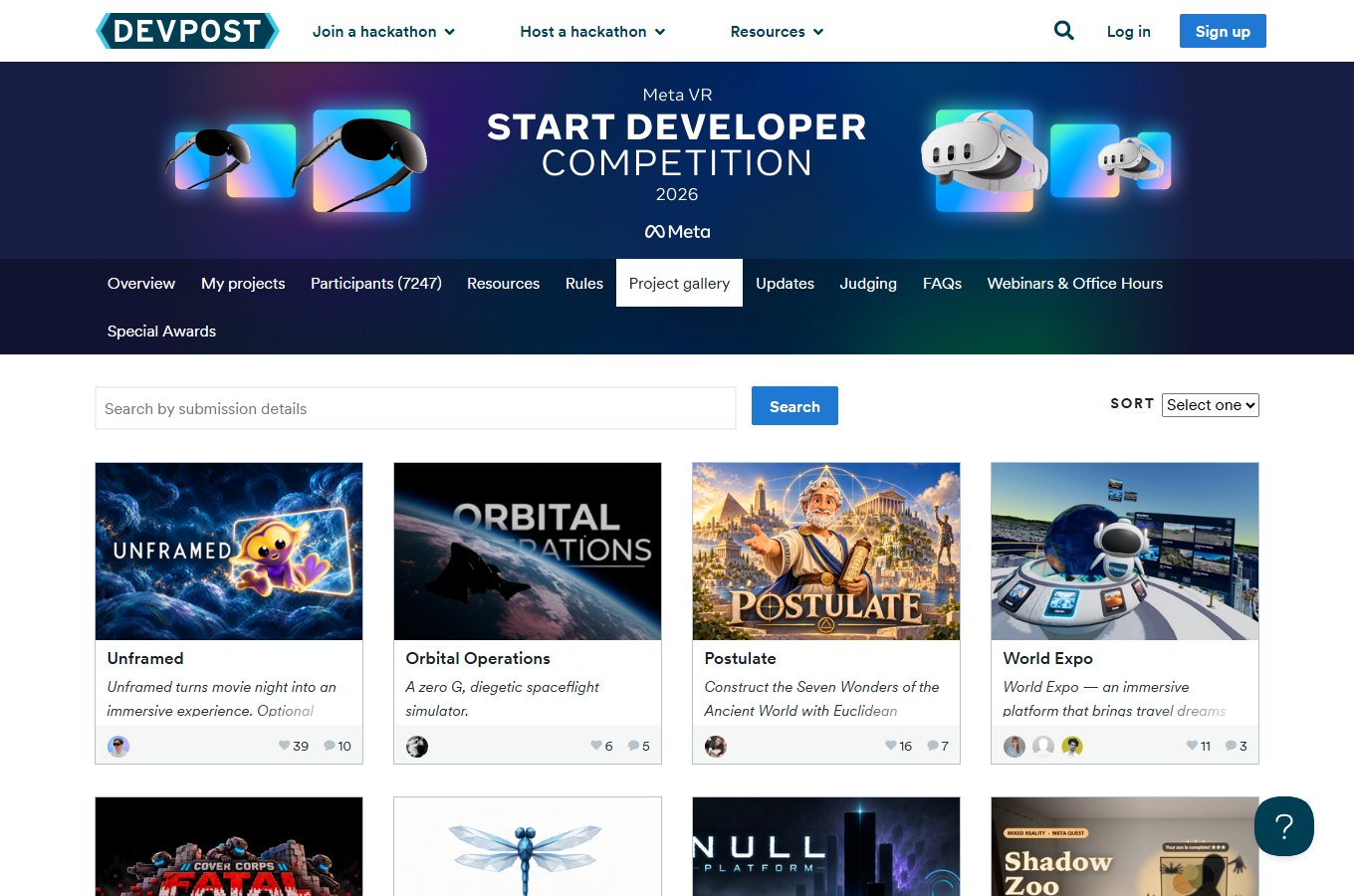
Platform holders announce developer contests loudly and count them quietly, which is why the turnout for Meta's second VR Start Developer Competition has to be read off a pager at the bottom of a third-party web page. Entries closed on November 18 at noon Pacific, Meta has not said how many arrived, and the public project gallery on Devpost answered the question on Monday morning anyway: 2,105 projects, from 7,247 registered participants. Last year's gallery stops at 655 projects and 2,860 participants. Antony Vitillo, who writes as Skarredghost, noted in his weekly roundup that his feeds had been full of entrants showing off their submissions for a couple of days. The gallery puts a number on that impression, and VR.org read every project page in it to see what the field is made of.
Meta's $1 Million Hands-First Competition Drew 2,105 Entries, and One in Three Was Built on the Web
Three times the field, two thirds of the money
The rules changed more than the turnout suggests. In 2025 the competition ran for five weeks and, by Meta's own account of the winners, paid $1.5 million across 32 awards. This year it ran for eight weeks and the official rules list 20 prizes adding up to $1 million, with the top prize unchanged at $100,000 and a limit of one prize per entry. Put the two years side by side and an entrant's chance of winning anything went from roughly 1 in 20 to 1 in 105. Spread evenly, the pool works out to about $475 per entry, against about $2,290 a year ago.
Not all 2,105 will be scored. The rules describe a first stage that decides, pass or fail, whether a project "reasonably fits the theme," and only survivors reach the four equally weighted criteria. Membership in Meta's Start program is also a condition of entry, one the organizers repeated in a notice to entrants in the closing days. How many entries clear both hurdles is a figure Meta is under no obligation to publish.
What the entries say they were built with
Last year's submission form asked every entrant to pick a build path, and the 2025 gallery still filters on the answer: 446 chose Unity, 76 Immersive Web or WebXR, 71 Unreal, 23 Android or native and 17 Spatial SDK. This year's gallery exposes no such filter. What each project page does carry is a "Built With" list the entrant typed in, so VR.org collected those lists from 2,104 pages on November 23 and grouped them. The two methods are not identical, since a free-text list is voluntary and a form field is not, and the comparison should be held with that much slack.
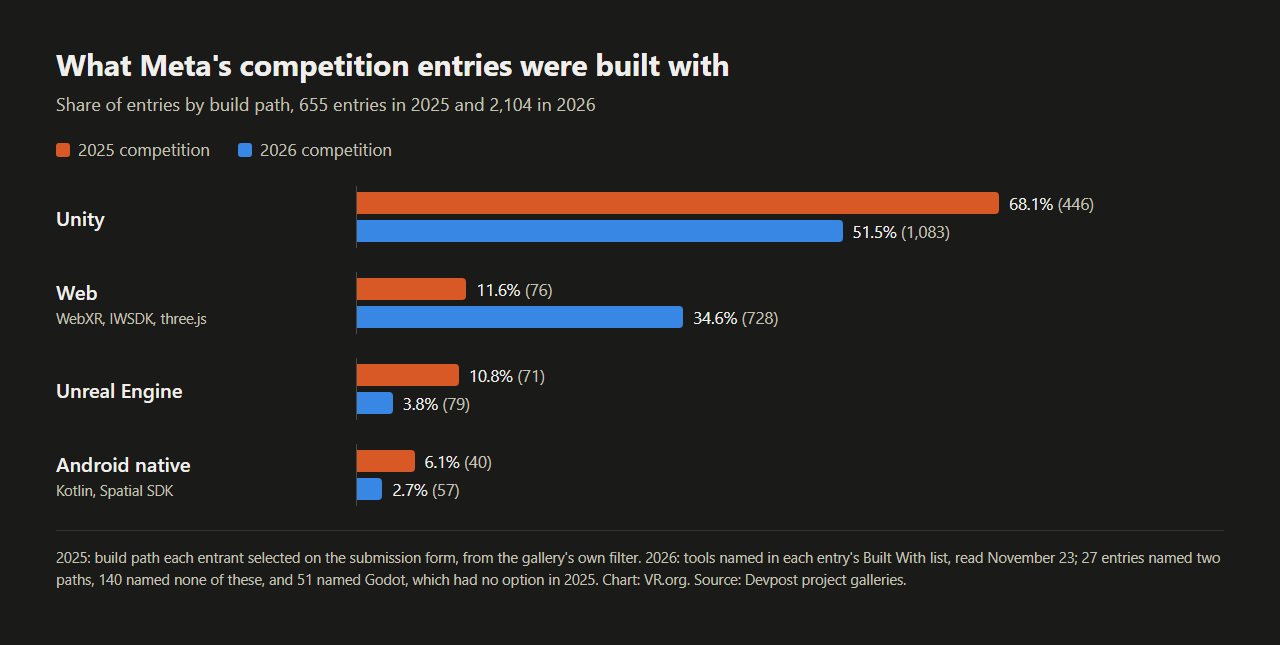
Even with slack, the shift is large. Unity is named on 1,083 entries, or 51.5%, down from 68.1% of last year's field. A web stack (WebXR, Meta's Immersive Web SDK, three.js or a close relative) appears on 728 entries, or 34.6%, where the 2025 form counted 11.6%. In absolute terms that is 76 browser projects becoming 728. Unreal barely moved, from 71 entries to 79, while the field around it tripled, which leaves it at 3.8%. Godot, which had no option on last year's form, is named on 51.
The web's growth came without a bounty. Eight of the 32 awards in 2025, worth $260,000 together, were reserved for particular build paths: two for the Immersive Web SDK, two for Spatial SDK, one for React Native and three for Android apps. None of this year's 20 prizes is tied to a toolchain. Several things did change in the web's favour, and the data cannot rank them. The Immersive Web SDK reached 1.0 at Connect, as Nina Castillo reported in September, and 416 entries name it. A web entry is submitted as a hosted link, where every other path has to upload an APK to a release channel on Meta's developer dashboard. And the competition FAQ confirms that an entrant does not need to own a headset at all.
Mostly one name per project
A single creator is listed on 1,769 of the 2,104 pages, or 84%. Another 209 list two people, and just 51 list four or more. Last year's form recorded 320 entries from individuals, 125 from teams and 210 from organizations, which is a different measure, because a studio can file under one account. The direction still looks clear enough: the field grew mostly by adding people working alone.
Meta's launch post told entrants to connect a coding agent and hand it the QA pass, and some said they did. Claude, Codex, Cursor or another coding assistant is named in the tool list of 355 entries, about one in six, with Claude alone on 282. Treat that as a floor, because nobody is required to list one. The Meta VR CLI, the tool that post promoted for the purpose, is named on 43. Agent tags are also more common on Unity entries (21.6%) than on web entries (12.6%), so the tidy story in which agents explain the browser's rise does not survive the count.
A contest ahead of its hardware
Anyone who shipped on Android early will recognize the shape. Google's first Android Developer Challenge closed on April 14, 2008, six months before a phone running the platform went on sale, and drew 1,788 entries written against an emulator. Fifty of them received $25,000 each. Google later wrote that it recruited about 125 judges to get every submission reviewed by at least three people.
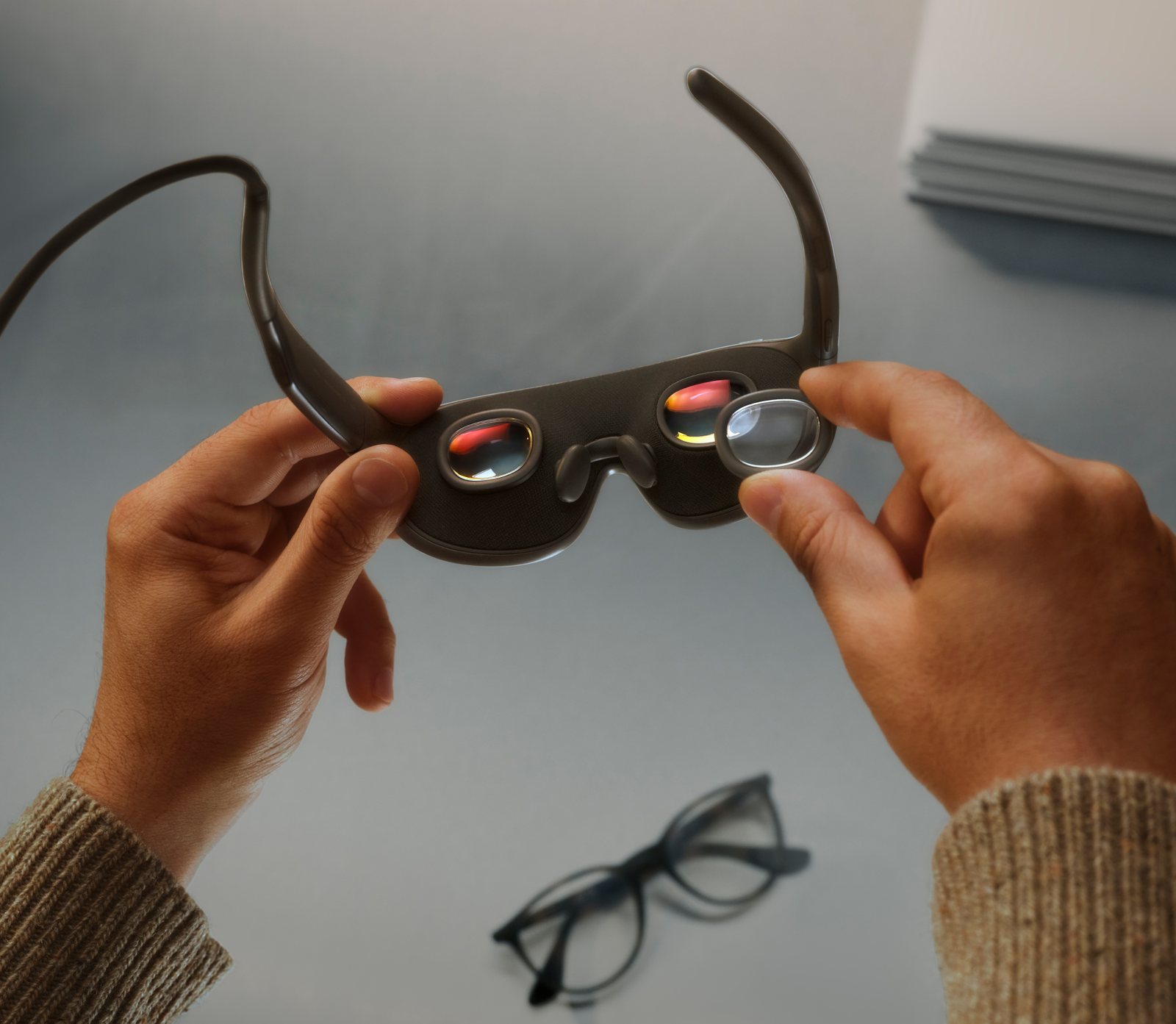
Meta's version is a hybrid. The glasses it is meant to stock do not ship until spring 2027, but the FAQ requires that every build be playable on a Quest 3 or 3S, hardware that is already on shelves. That has a visible cost in the data. The technical criterion in the rules lists gaze interactions first among the features that define a hands-first app, yet only 23 entries tag eye tracking or gaze, and neither Quest 3 model can track eyes. One entry, Staredown, describes itself as "built for eye tracking, playable with head aim on every Quest," which is about as honest a summary of the situation as a tagline allows. The hands half of Meta's eyes-and-hands input model got 2,105 rehearsals this autumn. The eyes half mostly waits for the device.
The judging period ends on or around December 9 and winners are due on or around December 11. Each entry includes a demo video of up to three minutes, so the videos alone could run to 105 hours, and the rules allow that "AI tools may also be used to assist in the judging, but final decisions will be made by human judges." For a developer scoping a hands-only project for next spring, the more useful artifact is already public. The gallery is 2,105 attempts at the same brief, seated, controller-free and satisfying inside ten minutes, and browsing a few pages of it is cheaper than discovering in March which ideas a thousand other people also had.