XR platform holders spent 2026 teaching their SDKs to talk to coding agents. Google connected Gemini to its XR Blocks framework in March, Meta gave its WebXR SDK an agentic workflow in April, and ByteDance's PICO has published an Apache-2.0 plugin marketplace for coding assistants since June, one that has covered ten assistant hosts since late September. Meta's $1 million VR Start competition, which closed on the day this one opened, told entrants to speed up development with its AI tooling and had no prize category for the agent workflow itself. PICO's version has one, inside a $50,000 pool with a February deadline and an entry path that starts by pasting a prompt into whichever agent a developer already has open.
SoftwareNovember 21, 2026
PICO's $50,000 Build With AI Competition Pays Its Kotlin Winner Double Its Unity Winner
By Jordan Kuo
Staff Writer, VR.org
Advertisement
The sponsor is a German training company
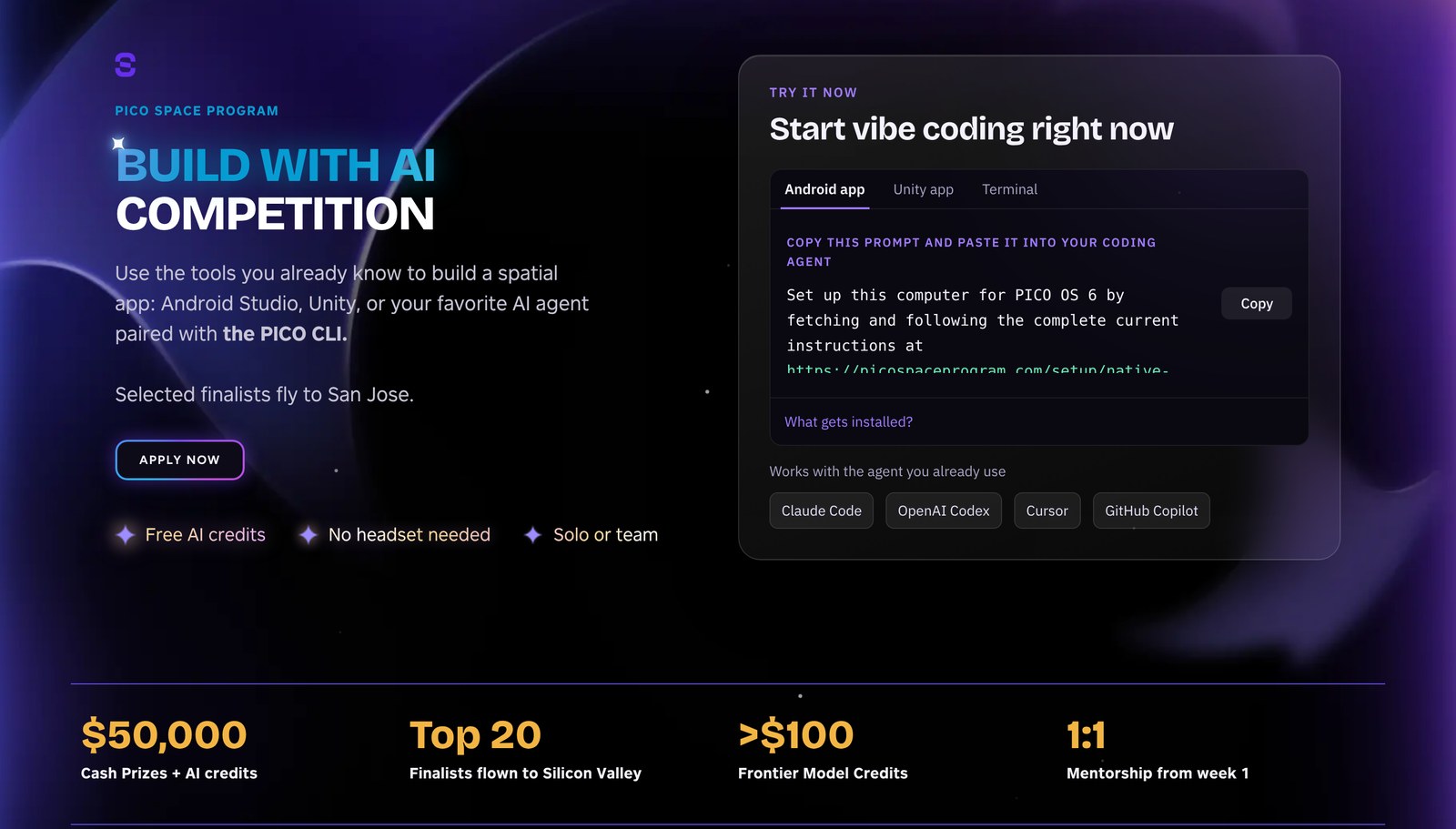
Registration opened on November 18 at 6:00 am Pacific and closes on February 1, 2027 at noon Pacific, with $50,000 spread across 32 cash prizes. PICO's name is on the logo, the hero and the domain, and Auganix reported it on November 19 under a headline that begins "PICO Announces PICO Space Program." The legal line at the foot of the landing page is narrower than that: "XR Bootcamp GmbH is the sole sponsor of the competition." The official rules on Devpost name XR Bootcamp GmbH of Potsdam as both sponsor and administrator, and describe Pico Immersive Pte. Ltd. as "the brand and hardware/software partner of the PICO Space Program" which "is not a sponsor or administrator of the Hackathon, including judging and prize fulfillment."
XR Bootcamp describes itself as a global online academy for XR development courses, and the site's terms of use say all prizes "are awarded and paid by XR Bootcamp GmbH" and that program partners "support the Program with prizes, tools, mentoring or promotion" without naming which partner supplies what. On paper, then, this is a training company running a developer drive under a vendor's brand rather than a vendor running one itself. That is a weaker commitment than the branding implies, and it is the kind of detail worth knowing before treating a competition as evidence of a roadmap. PICO supplies the brand, the toolchain and the hardware at the finale. Somebody else answers for the purse and the judging, even with two ByteDance employees among the six judges Devpost lists.
First place in Kotlin pays double
Track A is native Android work, Kotlin in Android Studio against the PICO Spatial SDK. Track B is Unity and C#. Best Android Track Submission pays $10,000 with a $5,000 runner-up, Best Unity Track Submission pays $5,000 with a $2,000 runner-up, and third through tenth place in each track pays $1,000, eight prizes a side. The two tracks are identical from third place down and diverge entirely at the top.
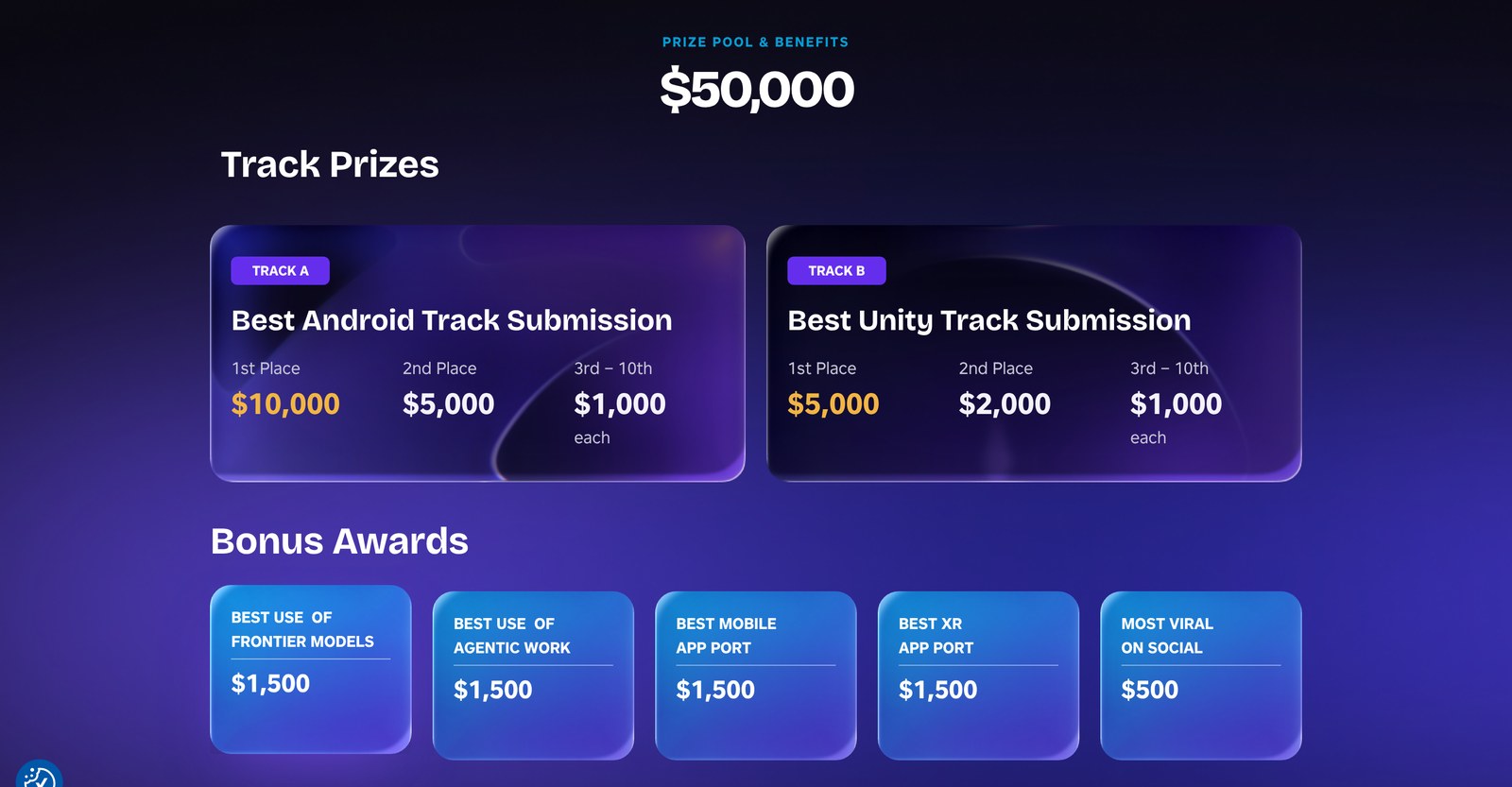
Four bonus categories pay $1,500 to a winner and $1,000 to a runner-up: Best Use of Frontier Models, Best Use of Agentic Workflow, Best Mobile App Port and Best XR App Port. Most Viral on Social pays $500 to each of four winners, which requires a public post tagging PICO with the program hashtag.
A two-to-one split at the top of a prize table is the plainest statement of platform direction anywhere in the program, and it tracks what the repositories already showed. When this site read PICO's agentic tooling in October, the spatial half was Apache-2.0, aimed squarely at PICO OS 6 and the Spatial SDK, and small enough to read in an evening. The Unity half was a 0.1.1 package leaning on a Unity AI Assistant release that Unity has only ever shipped as a preview. The prize table has now put a number on that gap.
What the paste actually does
The default prompt on the landing page, under a tab labelled Android app with a Unity prompt one tab over, tells an agent to fetch picospaceprogram.com/setup/native-kotlin.md and follow it, and that document, revision 2026-10-08, is where the real specification lives. It instructs the agent to query public npm metadata for the newest stable @picoxr/pico-cli rather than pin a version, to install a Node LTS build if the host has none, to resolve Android Studio against the current Spatial plugin's documented compatibility range, to install whatever Android platforms and sources the current template requires (the previous one needed platform and sources 35), to provision a dedicated PICO Emulator device, and to finish with an interactive solar system visibly running on that emulator as a smoke test. It also tells the agent to record the source URL, retrieval time, revision and a SHA-256 checksum, and to "Never invent missing text."
Advertisement
Today that instruction resolves to version 0.7.0 of the CLI, published on November 11, a week before registration opened. The package first appeared on npm on June 19. Snap published the first real version of its own npm CLI for Lens builds two days later, on November 13, which is starting to look less like coincidence than like the shape the 2027 onboarding funnel takes across the whole category.
No headset is needed to enter. Everything is built and tested in the emulator, a submission is a GitHub repository plus an installable APK, testing instructions and a demo video under three minutes, and the rules let that video show the project running on either the PICO Platform or the official PICO emulator.
The Windows path is written down and untested
The setup document is unusually candid about the limits of its own coverage. It writes host-specific guidance for macOS and Windows both, down to PowerShell quoting and running the Gradle wrapper as gradlew.bat, and then states that the reference workflow was verified on macOS and that "Windows remains untested until a Windows run completes the same smoke test." It tells the agent to record the actual host and results rather than imply cross-platform verification. The sibling Unity setup document concedes more: "This Unity installer and game have not yet been executed as an end-to-end run."
The candour is welcome and the gap is still a gap. The larger purse sits on native Android development, a discipline whose practitioners are not reliably on a Mac, and the automated setup for that track ships with an explicit note that nobody has driven it to completion on Windows. Seventy-five days is a generous window right up until the first of them goes on working out which part of a hypervisor configuration an agent cannot resolve by itself.
Where the hardware comes in
Entrants must be 18 or older and legal residents of the United States, Canada excluding Quebec, an EU or EEA member state, the United Kingdom, Switzerland or Türkiye. Mainland China is not on that list, and the setup document tells the agent to "Default to Global outside mainland China" when it picks a download channel, so this one runs entirely outside ByteDance's home market.
Hardware arrives at the end rather than the beginning, apart from a limited pool of demo devices that the rules say will be offered in person at select program events. Up to 20 finalists fly to San Jose for a finale that Devpost dates to February 2027 and the landing page puts in Q1, where they present live and get hands on what the site calls PICO's newest hardware, with travel offered to finalists based in North America and Europe. The rules bar anything built with "Unreleased PICO tools or features," which reads differently next to the hardware the setup document is written around: its title is "Set up PICO Space Pro for the Space Program," and its opening instruction names "PICO Space Pro (Project Swan)." Space Pro is reported for December 2 after a Q4 slip and a cancelled Beijing launch event, which would put its launch roughly two weeks into a submission window that nobody has to own one for.

Dates, judges, and the decision
Live sessions start November 24. Judging runs from February 1 to February 15 and winners are announced on or around February 25, per the rules, with every submission scored on four equally weighted criteria: innovation and creativity, spatial experience design, technical implementation, and polish and presentation. Devpost lists judges from Unity, NVIDIA, AMD and ByteDance, among them Neil Trevett, who is also president of Khronos, the body that maintains OpenXR. Seating the Khronos president on the panel for a competition whose headline track targets a vendor SDK, on a platform whose own Unity agent tooling states that PICO ships no plane detection feature for OpenXR, makes for an interesting room.
For anyone planning to ship on PICO in six months, the purse is the least informative part of this. What matters is that a competition carrying PICO's name has now priced the platform's two developer paths differently in a public document, and has made the native Kotlin one the default tab on the prompt that greets a coding agent. The Unity track is still there, has a setup prompt of its own, and still pays. It simply is not the one with the most money on it.
Advertisement