
Pico Space Pro: Release Date, Price, Specs, and Everything We Know
Last updated: November 10, 2026
See also: every upcoming VR headset, the release dates tracker, our best VR headsets guide for what you can buy today, and all VR hardware news.
Pico Space Pro is the flagship mixed reality headset from Pico, the ByteDance-owned maker of the Pico 4 line, and the company's answer to Apple Vision Pro. Pico previewed it in March 2026 under the codename Project Swan, with MicroOLED displays near 4,000 PPI, a custom XR chip and a new operating system, PICO OS 6. Pico has not announced a date or a price. A Chinese outlet reported on November 9 that it launches on December 2, 2026, and a US reseller says the release is targeted for December. This page covers the release date, price, confirmed specs, the two-piece design, US availability and every development we have tracked.
- LaunchDecember 2026December 2 reported, not confirmed by Pico
- PriceNot announcedA US reseller briefly listed $2,899
- Display4K MicroOLEDNearly 4,000 PPI, per Pico
- DesignTwo piecesBattery and radios sit in a tethered main unit
- SoftwarePICO OS 6Android apps side by side with 3D
- US salesBusiness firstReseller Knoxlabs says it will carry it

Official PICO pages only. We will switch the button to the store page the day orders open and add the price when Pico publishes one.
Image: PICO
Release date: December 2 reported, not confirmed by Pico
Pico has never put a day on Space Pro. Its March 2 preview said the headset was "targeting a global launch in late 2026," and its developer FAQ still reads: "PICO Space Pro will launch globally in 2026," adding that "the specific hardware release date has not yet been announced."
The closest thing to a date arrived on November 9, when Chinese XR outlet VRAR World posted that "PICO Space Pro is set to launch on December 2." The Ghost Howls reports that the outlet got the date from Pico, and advises taking it with a pinch of salt, for a reason worth remembering: Pico has announced a launch day for this headset once before and withdrawn it.
That was September 2. Pico booked a launch event in Beijing, then cancelled it on August 24, nine days out. In a notice Road to VR published in translation, the company said it had decided "to adjust the product release date to the fourth quarter of this year" in order to "spend more time on a major upgrade to the software experience." We covered the cancellation at the time.
A second source now points at the same month. US reseller Knoxlabs, which will stock the enterprise model, wrote on October 24 that "release is targeted for December 2026." Three weeks earlier its product page had said the first week of February 2027. We will add the confirmed date to the release dates tracker the day Pico gives one.
Price: not announced
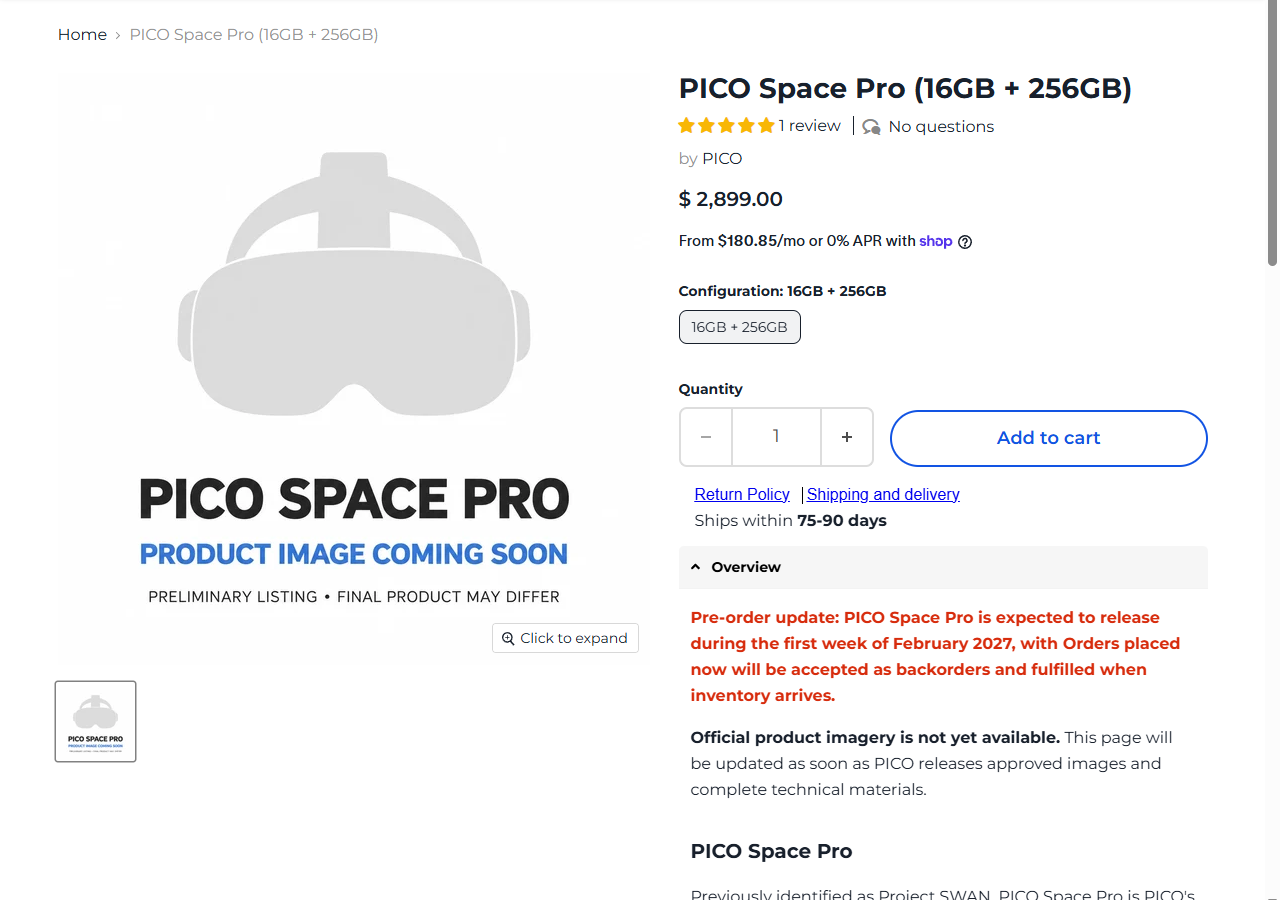
Pico has not named a price in any currency. The only dollar figure to appear came from Knoxlabs, whose product page listed a 16GB and 256GB enterprise configuration at $2,899 in early October, with an Add to cart button. We reported the listing on October 7, and an Internet Archive capture preserves it.
That page is gone. Knoxlabs now says it "is temporarily offline at PICO's request until public listing is allowed at release," and its replacement post carries no price. So $2,899 is a number a reseller published and then withdrew, for a business configuration, and Pico never confirmed it. The Ghost Howls expects an expensive headset and guesses around $2,500.
For scale, the headsets it will be measured against are Apple Vision Pro at $3,699, Samsung's Galaxy XR at $1,799.99 and Valve's Steam Frame from $1,059. Pico's own most expensive US product today is the PICO 4 Ultra Enterprise at $1,199 on its business price list.
Confirmed specs
| Spec | Pico Space Pro |
|---|---|
| Made by | Pico, owned by ByteDance |
| Codename | Project Swan |
| Display | MicroOLED, nearly 4,000 PPI; "dual-eye 4K" per Pico's FAQ |
| Sharpness | 40 pixels per degree on average, more than 45 at the center |
| Chips | A custom XR chip for perception and imaging, plus a flagship processor |
| Latency | 12 milliseconds, mixed reality end to end |
| Performance | More than double the CPU and GPU of Snapdragon XR2 Gen 2 |
| Design | Headset plus a tethered main unit (FCC) |
| Battery | 7,000 mAh in the main unit, per the FCC label; runtime not announced |
| Wireless | Wi-Fi, including 5 and 6 GHz, and Bluetooth, all in the main unit (FCC) |
| Input | Eyes, hands, PICO XR controllers, Motion Trackers, keyboard and mouse |
| Software | PICO OS 6 |
| Weight | Not announced |
| Field of view | Not announced |
| Memory and storage | Not announced by Pico; a reseller lists 16GB and 256GB |
| Price | Not announced |
| Availability | "Will launch globally in 2026," per Pico; December 2 reported |
From Pico's March 2, 2026 preview and its developer FAQ, plus FCC grants dated September 1, 2026. Last checked November 10, 2026. Anything Pico or a regulator has not stated is marked not announced.
The display and chip figures are Pico's own. Its March release describes "a new generation of MicroOLED displays with a pixel density of nearly 4000 PPI," "an average PPD (Pixels Per Degree) of 40, with a center sweet spot exceeding 45 PPD," a custom XR chip that builds its picture of the room "with just 12 milliseconds of latency," and a flagship processor with "more than double the increase in CPU and GPU performance over the current XR2 Gen 2." Nobody outside Pico has published a measurement of any of it.
Weight is the number to be careful with. A figure of 270 grams for the headset alone has circulated since the spring, but it appears in neither Pico's release nor its FAQ, so it stays off the table. The same goes for field of view, refresh rate and battery life.
Design: a headset and a main unit
Space Pro is a two-piece machine, and the evidence for that is regulatory rather than promotional. Two FCC grants dated September 1 cover it: one for the part you wear and one for a separate box. UploadVR read the labels and reports that they call the two parts a Mixed Reality Headset and a Mixed Reality Main Unit, share the model number B3110, and list a 7,000 mAh battery rated at 54.32 Wh on the main unit.
The radio split tells you how much lives in that box. The head-mounted unit is authorized for a single band, 2402 to 2480 MHz. The main unit carries 5 GHz and 6 GHz Wi-Fi and Bluetooth. In other words the networking, the battery and very likely the main processor ride on your hip, which is how the part on your face can be light. Our read of the two grants goes through the filings line by line.
Pico has not shown the hardware, and the FCC's photos stay confidential until February 28, 2027. Japan's did not. UploadVR found the headset in Japanese certification records on October 11, with external and teardown images showing a front camera, a sensor array, the optical modules and a central cooling fan.
PICO OS 6: the part Pico rebuilt
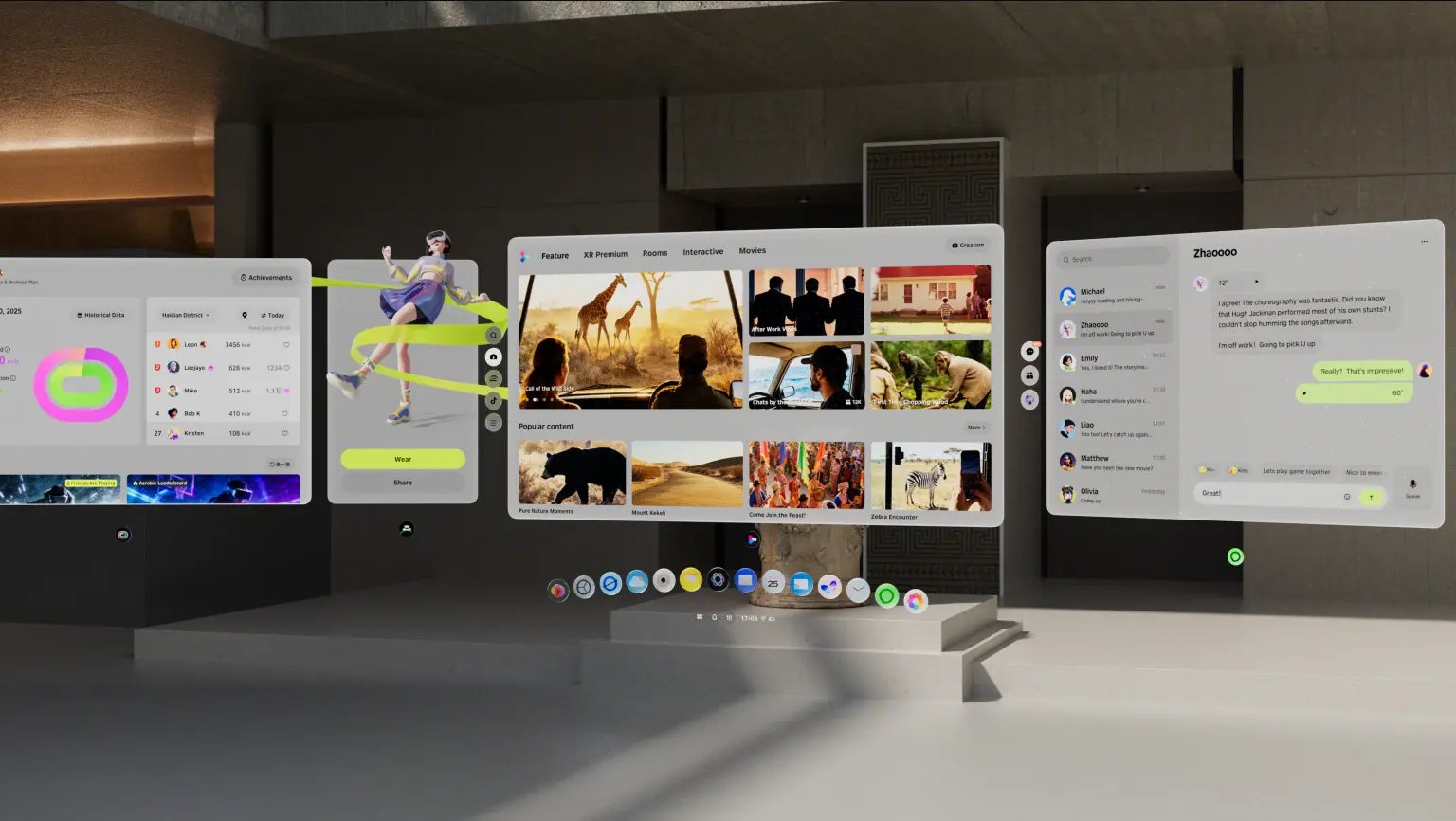
The software is the stated reason for the delay, and the bigger bet. Pico calls PICO OS 6 "a fundamental reconstruction of the spatial operating system," built around what it names the PICO Spatial Engine, which moves rendering from each app into the operating system. The practical result, in the FAQ's words: "You can anchor a 2D utility app (like a browser) next to a 3D immersive experience." That is the trick that makes Apple's visionOS feel like a computer, and Pico is claiming it.
Two details matter for buyers. Existing Android apps "can run directly on PICO OS 6," and the system "only runs on PICO Space Pro and the new PICO Emulator," so no current Pico headset gets it as an update. For input Pico lists eye tracking, gaze and pinch, hand tracking, PICO XR controllers, PICO Motion Trackers, and keyboards, mice and game controllers.
Developers can build for it today with the Kotlin-based PICO Spatial SDK, Unity, Unreal or WebSpatial, Pico's open-source web framework. Since October the SDK also plugs into AI coding assistants, which we covered here.

How it compares with Vision Pro, Galaxy XR and Steam Frame
| Pico Space Pro | Apple Vision Pro | Samsung Galaxy XR | Valve Steam Frame | |
|---|---|---|---|---|
| Price (US) | Not announced | $3,699 | $1,799.99 | From $1,059 |
| Display | MicroOLED, nearly 4,000 PPI | Micro-OLED | Micro-OLED | LCD |
| Software | PICO OS 6 | visionOS | Android XR | SteamOS |
| Status | December 2 reported | On sale | On sale | On sale, by reservation |
Space Pro figures are Pico's claims. Galaxy XR price from samsung.com on November 10, 2026; Vision Pro and Steam Frame prices as listed in VR.org's best VR headsets guide.
On paper Space Pro belongs with Vision Pro and Galaxy XR: micro-OLED panels, a pack on a cable, and an operating system built for windows as much as for games. Steam Frame is the outlier, a gaming headset with LCD panels at under a third of what Apple charges. What separates Pico from the other two is that every figure above is a claim, and the one number that decides the comparison, the price, is missing. Our best VR headsets guide ranks what you can buy now.
Can you buy it in the US?
Probably, if you are a business. Pico does not sell consumer headsets in the US; its American site is PICO Business. But the paper trail is American too: the FCC grants name Pico's US subsidiary, and Knoxlabs says plainly that it "will carry it in the US when PICO releases it," describing a 16GB and 256GB "enterprise headset." The reseller is taking private interest from companies in the meantime, not public orders.
Nothing so far describes a consumer model, a US retail price or a list of launch countries. Pico's phrase is that Space Pro "will launch globally," and its home market is China. If you are shopping for yourself in the US this year, the realistic shortlist is still on our upcoming headsets page.
Every Pico Space Pro development, dated
- Apr 30, 2026Pico's Project Swan preview puts MicroOLED panels near 4,000 PPI, a dual-chip design and PICO OS 6 on the record.
- Jul 28, 2026ByteDance hands Pico to Li Xiaokai, the engineer who has run its displays, chips and perception work.
- Aug 20, 2026Project Swan becomes Pico Space Pro, with a launch event booked for September 2 in Beijing.
- Aug 26, 2026Pico cancels the Beijing event nine days out and moves Space Pro to the fourth quarter, citing a software upgrade.
- Sep 8, 2026Two FCC grants show a headset with a single 2.4 GHz link and a tethered main unit that carries the Wi-Fi and Bluetooth radios.
- Oct 7, 2026US reseller Knoxlabs lists an enterprise Space Pro at $2,899 and dates it February 2027. Pico has confirmed neither.
- Nov 10, 2026LatestVRAR World reports a December 2 launch, and Knoxlabs takes its listing offline at the request of Pico while moving its own estimate to December.
Official PICO pages only. We will switch the button to the store page the day orders open and add the price when Pico publishes one.
Image: PICO
Frequently asked questions
When does the Pico Space Pro come out?
Pico has not announced a date. Its developer FAQ says only that Space Pro will launch globally in 2026, and in August it moved the launch to the fourth quarter after cancelling a September 2 event in Beijing. On November 9 the Chinese outlet VRAR World posted that Space Pro is set to launch on December 2, and US reseller Knoxlabs says the release is targeted for December 2026. Treat December 2 as reported until Pico confirms it.
How much will the Pico Space Pro cost?
No price has been announced. In early October US reseller Knoxlabs listed a 16GB and 256GB enterprise configuration at $2,899, then took the listing offline at Pico's request. That figure was never confirmed by Pico. For context, Apple Vision Pro costs $3,699 and Samsung's Galaxy XR costs $1,799.99.
What are the Pico Space Pro's specs?
Pico has confirmed MicroOLED displays with a pixel density of nearly 4,000 PPI, which its developer FAQ describes as a dual-eye 4K display, an average of 40 pixels per degree with more than 45 at the center, a custom XR chip for perception with 12 milliseconds of latency, and a flagship processor with more than double the CPU and GPU performance of the Snapdragon XR2 Gen 2. Weight, battery life, field of view, memory and storage have not been announced by Pico.
Is the Pico Space Pro a standalone headset?
It is a two-piece design. FCC grants dated September 1, 2026 cover a head-mounted unit and a separate tethered box, which the labels call a Mixed Reality Headset and a Mixed Reality Main Unit. The main unit carries the Wi-Fi and Bluetooth radios and, according to UploadVR's reading of the label, a 7,000 mAh battery. Pico has not described the design itself.
Is Pico Space Pro the same as Project Swan?
Yes. Pico previewed the headset in March 2026 under the internal codename Project Swan, and its developer documentation now uses the name PICO Space Pro for the same device and the same PICO OS 6 software.
Will the Pico Space Pro be sold in the US?
Pico's US presence is a business one, and the signs point to an enterprise launch there. The headset has FCC certification, and US reseller Knoxlabs says it will carry Space Pro when Pico releases it. Pico has not announced countries or a consumer model for the US.
What is PICO OS 6?
PICO OS 6 is the operating system built for Space Pro. Pico says it runs multiple apps at once in a shared space, so a 2D window can sit beside a 3D experience, and that existing Android apps run on it directly. It only runs on Space Pro and the new PICO Emulator; older Pico headsets stay on PICO OS 5.
Does the Pico Space Pro have controllers?
Pico lists eye tracking, gaze and pinch, hand tracking, PICO XR controllers and PICO Motion Trackers as supported inputs, along with keyboards, mice and game controllers. It has not said what comes in the box.
How does the Pico Space Pro compare with Apple Vision Pro?
Both use micro-OLED displays, a tethered pack and an operating system that places 2D windows alongside 3D apps. Pico claims a pixel density of nearly 4,000 PPI and has not announced a price; Vision Pro costs $3,699 and is on sale now. Nobody outside Pico has published measurements of Space Pro's display or latency.