
Five assignments recorded at the United States Patent and Trademark Office carry Sony patents to Meta, and the same seller is typed on every cover sheet: Sony Group Corporation. Sony Interactive Entertainment, the subsidiary that designs and sells PlayStation VR2, is named on none of them. That distinction did not survive the trip from the patent office to the week's coverage, where Push Square's headline read "Sony Seemingly Ends VR Ambitions by Selling Patents to Meta."
HardwareOctober 7, 2026
All Five Sony Patent Transfers Recorded to Meta Name Sony Group as the Seller, Not PlayStation
By Sam Whitfield
Contributing Writer, VR.org
Advertisement
The transfers were first reported on October 5 by ZDNet Korea, which counted 43 US patents recorded to Meta between June and September and 419 patents worldwide in the agreement behind them. Road to VR relayed the report on October 7 and noted that neither company has issued a statement. VR.org pulled the same five recordations from the USPTO Assignment Center, read the 13-page filing attached to each, and counted the patent schedule row by row. The totals hold. Several of the details repeated around them do not.
Effective in December, signed in April
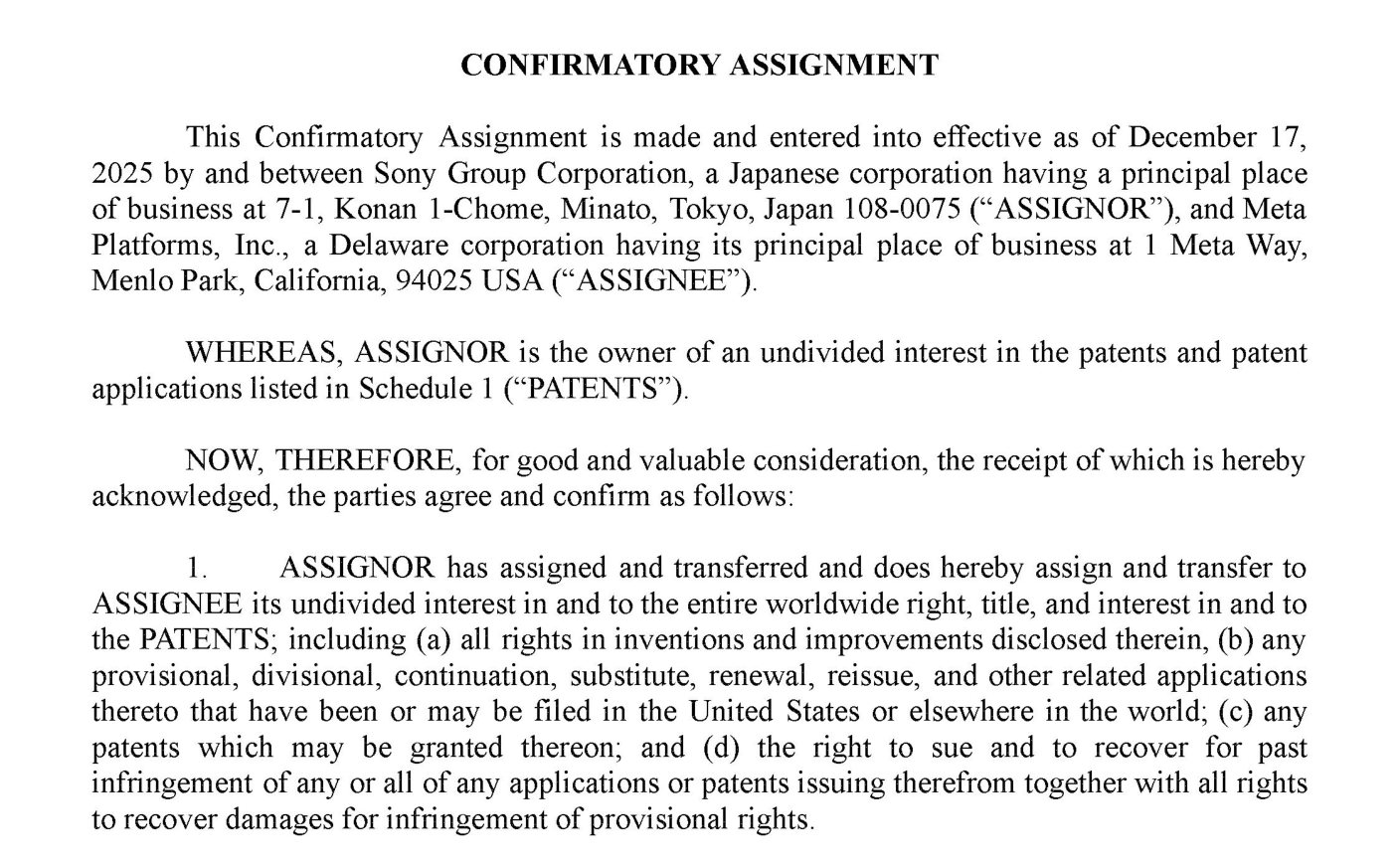
Each filing attaches the same instrument, a one-page Confirmatory Assignment (PDF, 23 MB) followed by a ten-page Schedule 1. It is "made and entered into effective as of December 17, 2025" between Sony Group Corporation, of Konan, Minato, Tokyo, and Meta Platforms, Inc., of 1 Meta Way, Menlo Park. A confirmatory assignment is the short form that parties record so the purchase agreement itself, with its price and warranties, can stay private, and this one discloses no price. The consideration is described only as "good and valuable." What Meta receives is spelled out more fully: "the entire worldwide right, title, and interest" in the scheduled patents, any continuations and related applications, and "the right to sue and to recover for past infringement."
The effective date is why the deal has been described as signed in December 2025. The signature blocks carry later dates. Jeremiah Chan, whose title is given as Director and Associate General Counsel, Patents, signed for Meta on April 29, 2026. Asashi Shimodaira of Sony's Intellectual Property and Standards Division signed on April 30. Whatever the two companies agreed in December, the paper on the public record was executed more than four months afterward, and the first recordation did not follow until June 30.
The buyer is a parent company as well. A name search for Sony as assignor and Meta Platforms as assignee returns nine records. Five are the Sony Group filings, each naming Meta Platforms, Inc. itself. The other four match only because an inventor on each has the first name Sony; they assign employee inventions to Meta Platforms Technologies, LLC, the subsidiary once known as Oculus VR.
Which Sony sold
VR.org ran the recorded ownership history of all 43 properties. Each of the 41 genuine Sony entries was assigned by its inventors to Sony Corporation or, after the parent changed its name in 2021, to Sony Group Corporation, and from there to Meta. None passes through Sony Interactive Entertainment or its predecessor, Sony Computer Entertainment, and searches for either as assignor to Meta return nothing. Thirty-one of those 41 share a single change-of-name filing, Sony Corporation to Sony Group Corporation, that was recorded on December 17, 2025, the day the assignment takes effect.
The titles point the same way. Twelve name a head-mounted display outright, among them "Head-Mounted Display and Glasses" and "Head-Mounted Display Capable of Preventing Damage of an Image Display Apparatus." The rest cover display control, image processing for virtual objects, content distribution and a "Heat Conduction Mechanism." Hiroshi Mukawa and Akihiro Komori are the inventors on four of the display patents, and Takeshi Iwatsu and Hirotaka Ishikawa on five. Filing dates run from 2010 to 2022. These came from Sony's corporate parent, the company behind the HMZ personal viewers and SmartEyeglass. PlayStation's patents are filed and held separately, under Sony Interactive Entertainment's name.
None of this shows what Sony intends for PlayStation VR2. PlayStation Direct's US store listed the headset as unavailable on September 18 and still showed it out of stock on October 7, and Sony has not explained that either. On PS VR2 the patent record is simply silent. Nothing recorded so far came from the business that makes it.
Advertisement
A water repellent and a mass spectrometer
The count of 43 needs a footnote. The July 29 recordation, filed by Freestone IP Law of Redmond, Washington, lists four properties, two by patent number and two by application number. The application numbers given are 10816814 and 10893212. In the patent office's index those belong to a 2004 Jintex Corporation application titled "Solvent-based fluorinated water and oil repellent and process for producing the same" and a 2004 application assigned to Micromass UK Limited titled "Method of mass spectrometer." Neither has any other recorded connection to Sony.
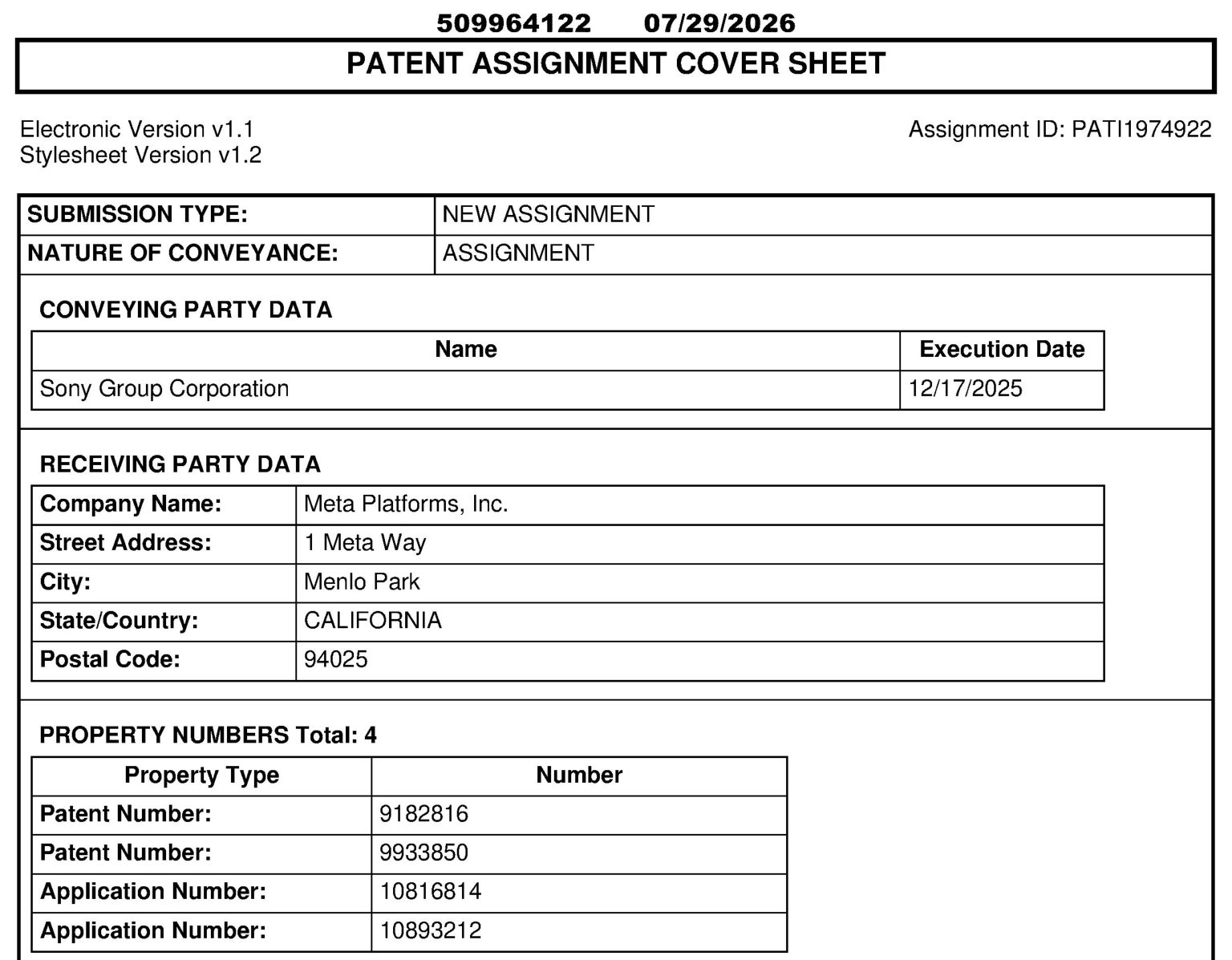
Read as patent numbers, the two match Sony entries on Schedule 1: US 10,816,814, "Imaging Device," invented by Junichi Rekimoto, and US 10,893,212, a spherical camera array by Tooru Masuda. The likeliest explanation is a patent number entered in an application number field, and the usual remedy is a corrective filing. Until one is recorded, the public index shows Meta holding an interest in a water repellent application and Sony Group still owning two patents it has sold.
Four more of the 43 are relatives. The July 23 recordation by McDermott Will & Schulte lists 16 properties, and four of them do not appear as rows on the schedule. They are parents and continuations of scheduled patents, which the assignment reaches through its clause on related applications. Net of both adjustments, 37 of the schedule's US rows currently show Meta as the owner of record.
419 rows, and two thirds of the US ones run past 2035
Schedule 1 runs to 419 rows by VR.org's count, and 180 of them are US patents or applications. That matches the figures ZDNet Korea now carries, which is worth stating plainly because 418, 118 and 119 are also in circulation from earlier versions and relays of the report. Japan accounts for 96 rows, China for 81 and Germany for 27. The other 35 are spread across the United Kingdom, France, South Korea, the Netherlands, India and Italy, plus one pending European application.
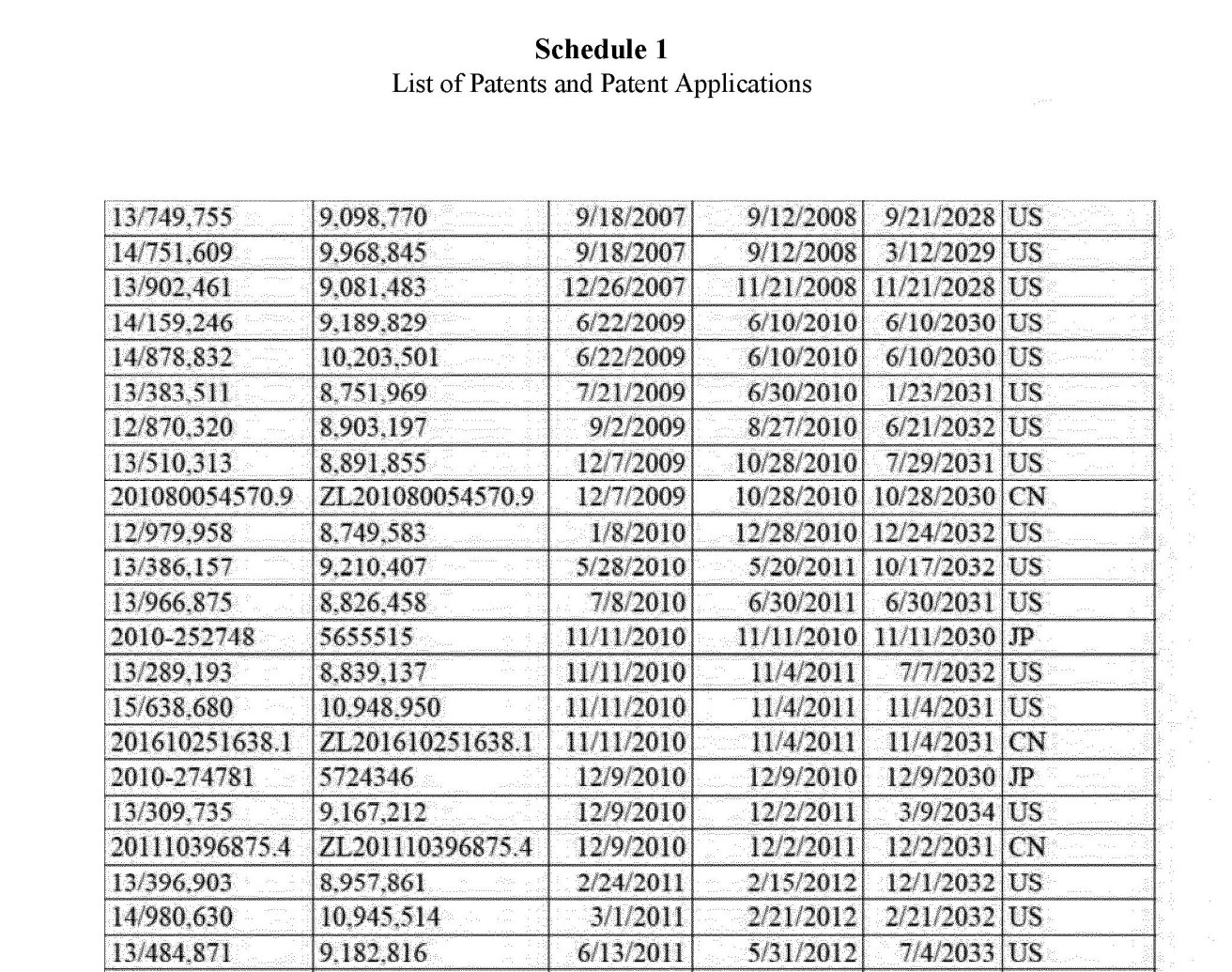
The schedule gives an expiration date for all but one of the US rows, a pending application. The earliest lapses on September 21, 2028 and the latest on August 10, 2041. Five expire by the end of 2030. One hundred twenty-two, a little more than two thirds, run to 2036 or later. The last three rows show five-digit spreadsheet serial numbers where the dates should be, a small sign of how the list was assembled.
Why the count will keep moving
Four law firms filed the five recordations. Seyfarth Shaw recorded one patent in each of two filings on June 30, McDermott Will & Schulte recorded 16 properties on July 23, Freestone IP Law recorded four on July 29, and Potomac Law Group recorded 21 on September 18. That pattern reads less like a transfer closing in stages than like a single executed agreement being recorded piecemeal by the outside firms taking over each group of patents, and the remaining US rows will probably arrive the same way. Nothing obliges anyone to hurry. Under 35 U.S.C. 261, an assignment binds the parties whether or not it is recorded; recording protects the buyer against a later purchaser who had no notice of the sale.
For a developer or a buyer deciding what this week's news means for PlayStation VR2, the record supports a narrow reading. Sony's parent company sold a block of display, augmented reality and immersive media patents, two thirds of the US ones running to 2036 or later, to a company that will put its own $1,299.99 Meta VR Glasses on sale next spring. Meta has not said what it paid, and Sony has not said why it sold. The entry that would change the PlayStation picture is a recordation naming Sony Interactive Entertainment as the conveying party. As of October 7, the database does not contain one.
Advertisement