
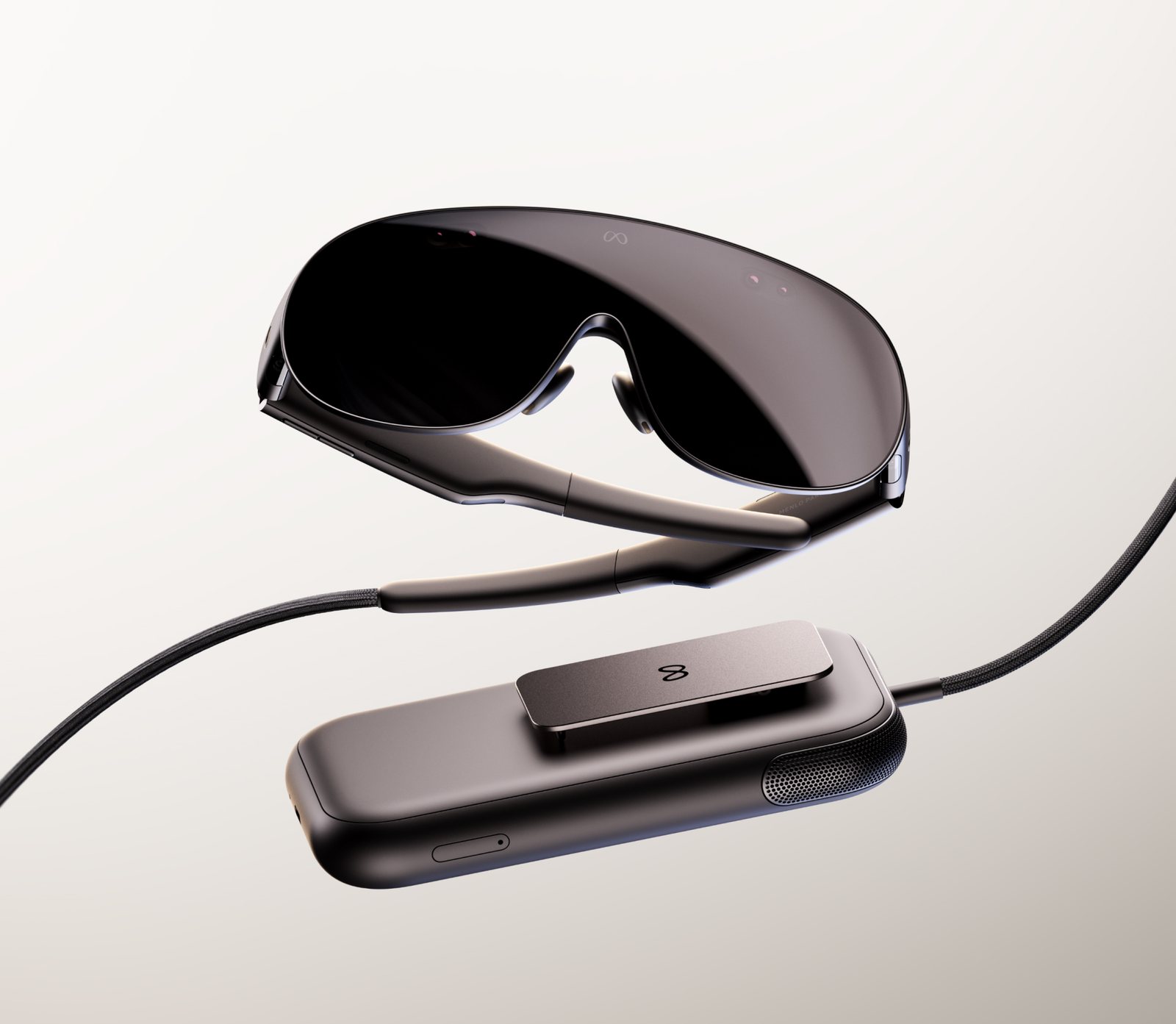
Apple's Vision team is now working on "a completely revamped headset under the code name N224," Bloomberg's Mark Gurman wrote in Sunday's Power On newsletter. The next sentence is the one Meta will read closely: "Company engineers are exploring about four concepts for the device, including designs that offload internal components in the same way as Meta's new product." The newsletter landed four days after Meta priced Meta VR Glasses at $1,299.99 for spring 2027, a frame of about 100 grams that hands its compute and battery to a puck on a cable. Gurman was less generous about the project's health than about its ambitions. He described N224 as on "life support" while Apple weighs a new direction, and he does not expect a device before late 2028 or early 2029, if one ships at all.
Apple's N224 Headset Is Testing a Meta-Style Puck That Some of Its Own Executives Oppose

Weight is the thread running through every concept described so far. Accounts of the newsletter describe one design that keeps the current Vision Pro's egg-shaped form while engineers test plastic, titanium and other materials to take mass out of it, and another that moves both the computer and the battery into a separate puck. Apple wants any successor to be lighter and less expensive than the model it sells today. Some senior decision-makers, according to the report, regard the external puck as a poor user experience and would rather keep everything in the headset. An all-in-one design that is also lighter and cheaper is the harder engineering problem of the two, and nothing in the report suggests Apple has solved it.
Apple already sends 353 grams down a cable
The objection to a puck is harder to sustain than it sounds, because Vision Pro has been a tethered device since launch. Apple's published specifications put the M5 headset at 750 to 800 grams and list its battery as a separate 353-gram pack, rated for up to 2.5 hours of general use, that connects by a braided cable. Meta's puck, which Road to VR's hands-on puts at roughly 300 grams, carries the Snapdragon Reality Elite chip and the storage along with the battery. Every Vision Pro owner already carries a pack at the hip. The open question is whether the M-series silicon, and the fan and heat that come with it, should follow the battery down the cable.

Meta made that call, and the arithmetic shows why Apple is testing it. Meta says its glasses weigh about 100 grams on the face. Vision Pro weighs 650 to 700 grams more. Titanium can shave a housing. It cannot take a chip and its cooling system off the front of someone's head, and that is where much of the difference sits. Gurman titled Sunday's newsletter "Meta's VR Glasses Are Exactly What the Apple Vision Pro Should Have Been," which is close to the verdict Road to VR reached in that September 23 hands-on. Two outlets arriving at the same comparison in four days is a fair measure of how the product landed.
Two reporting tracks, one disputed roadmap
N224 also reopens a question that the year's most categorical reporting had treated as settled. On June 3, TF International Securities analyst Ming-Chi Kuo reported that John Ternus had approved an overhaul leaving only two smart glasses products on Apple's XR roadmap, with every Vision Pro successor removed. "I think removing the Vision Pro line was the right call, as Apple shifts resources toward smart glasses with greater mass-market potential," Kuo wrote, in a note relayed by MacRumors. VR.org's June 5 analysis relayed that account and told procurement teams there was no next headset to wait for.
Gurman's reporting has never gone as far as Kuo's. In May he put a successor at least two years out and described N100, the lighter Vision Air, as shelved. On August 21, reporting roughly 100 job cuts in the Vision Products Group, he wrote that a new model remained under consideration for as early as the end of 2028. Sunday's newsletter puts a codename and a timing window on that consideration. The two accounts can be partly reconciled, since a project on life support is not a product on a roadmap and Kuo's claim concerned the roadmap. They cannot be fully reconciled. Kuo described the line as removed, while Gurman describes engineers actively testing designs for its next model. Apple has commented on neither.
Where the people and the parts have gone
Organizational signals in the same newsletter point toward lower priority rather than higher. Fletcher Rothkopf, who oversees Vision hardware after Paul Meade left for OpenAI this summer, now reports to vice president Tom Marieb rather than directly to Apple's top leadership, according to accounts of the report. For now, Gurman writes, the company's attention is on displayless smart glasses, which Apple aims to release in some form by the end of 2027. That is consistent with his July report placing the first pair's unveiling at WWDC 2027.
The component side has moved in the same direction. Samsung Display's G-VR program, a glass-substrate micro-OLED panel at roughly half the pixel density of the current headset's displays, was scheduled to be formally wound down by September. It was the most plausible route to a less expensive Apple headset, since the displays are widely estimated to be the costliest components in Vision Pro. The accounts of the newsletter do not say which display N224 would use. Lighter materials and a puck can take weight out of the design, but neither brings down a $3,699 price.
What changes for buyers
For the hospitals and training operations running Vision Pro today, the practical guidance barely moves. The depreciation schedule VR.org set out in June, one that treats the M5 model as the device in service through the end of the decade, holds up against a successor that is on life support and at least two years away even if it survives. What the report changes is the signal worth watching. A procurement office does not need to know whether N224 ships in late 2028. It needs to know whether Apple commits to it. The first public evidence of that is more likely to come from the supply chain, in the form of a display maker taking on a panel program like the one Samsung Display is closing this month, than from any newsletter.