
The $650 Andromeda now carries 2160x2160 panels per eye. It launched on Kickstarter at 1600x1600 on October 17. The upgrade came October 20. The battery went from 45Wh to 85Wh in the same revision, the price did not move, and Walker Industries says anyone who already pledged at the old specification is upgraded automatically.
HardwareOctober 24, 2026
Vector Gear's $650 Andromeda Got 2160x2160 Panels and an 85Wh Cell Three Days Into Its Kickstarter
By Alex Reeves
Staff Writer, VR.org
Advertisement
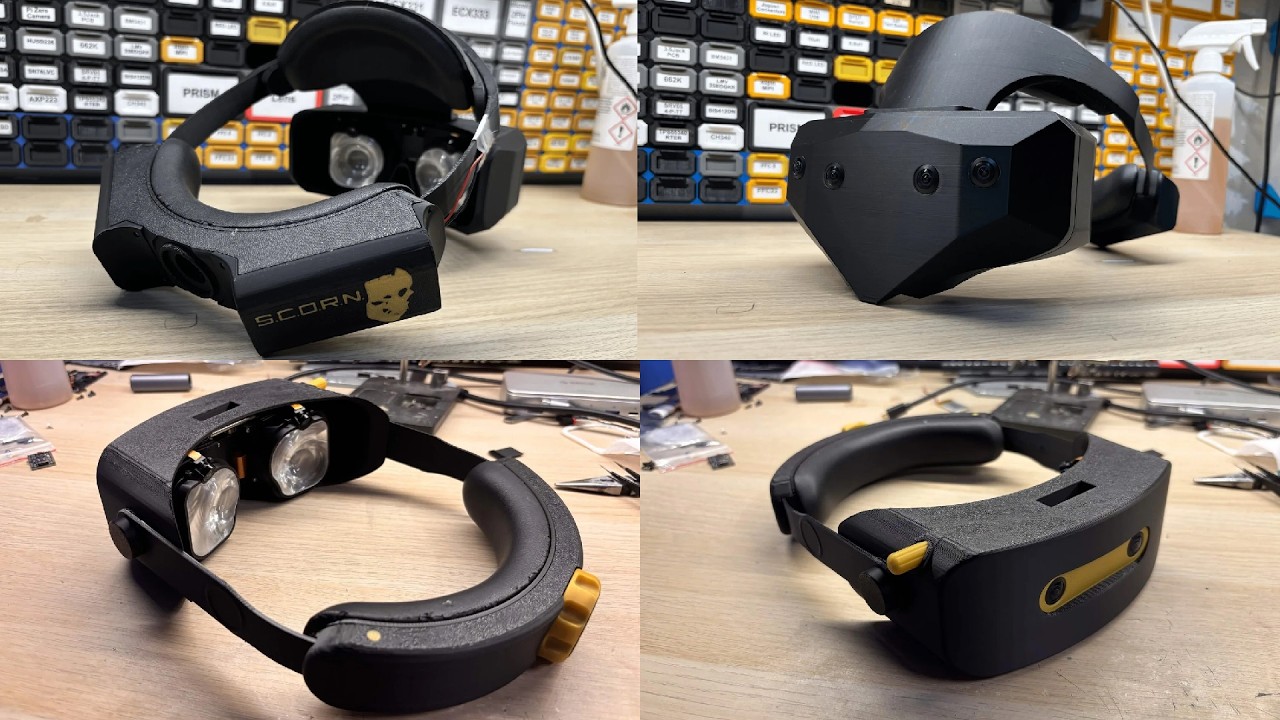
Walker Industries is a small team of VR makers in Japan. It is building three configurations on one platform. The Vector Gear sits at $980, standalone and PC VR. The Andromeda is the $650 LCD version, PC VR only. An OLED Andromeda runs $1,250 with 2560x2560 pancake panels, native at 75Hz or 1920x1920 upscaled at 90Hz. All of them are meant to be opened, modified and repaired by whoever bought them.
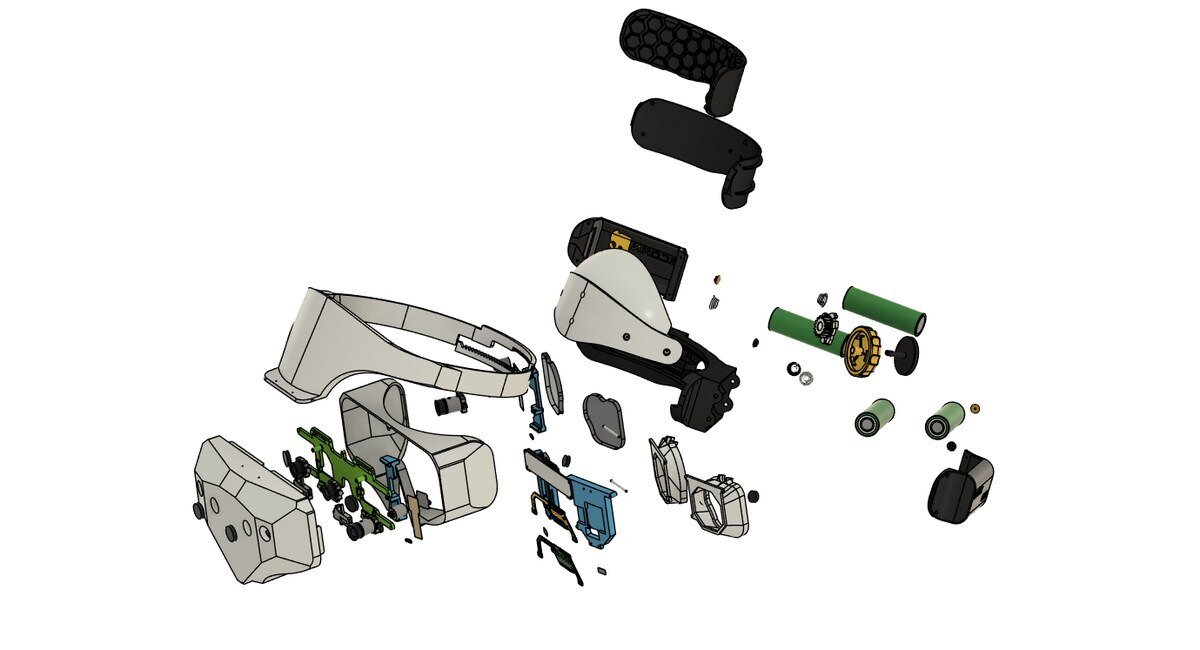
The Vector Gear reads as a parts list, which is the intent. Dual 2160x2160 LCD panels at 90Hz, behind combined Fresnel optics the company calls pseudo-pancake. Automatic IPD. A Snapdragon 8cx Gen 3 with 8GB of RAM as the main processor, plus an RK3588S co-processor with another 8GB handling SLAM, sensor fusion and wireless PC VR streaming. Seven cameras: two monochrome for SLAM, two global-shutter color for passthrough, two inside for the eyes, one inside for the mouth. An 85Wh Amprius silicon cell charged over USB-C Power Delivery. A 500GB or 1TB NVMe drive. Each controller runs its own RK3576 and is tracked inside out.
Weight is not published; the team "can't really determine a weight yet," per an October 19 Kickstarter update. Field of view is on the campaign chart: 105 degrees for the Vector Gear and LCD Andromeda, 95 for the OLED, with a 58 to 70mm IPD range. Neither appears on the company's own specification page, which otherwise lists everything down to the controller silicon.
Open to what degree
The company says the platform will be "either source-available or fully open source," opened in stages after release: more software first, then parts of the hardware, then most of the headset. The site and campaign name no license. Its GitHub organization is public already.
The stack is almost entirely homegrown. YuukOS is an Arch-based XR distribution. XRUIOS is the spatial layer on top of it. AstroSLAM does the tracking. Shinra Meisin handles faces and streams over OSC into VRChat, which is better timing than the team could have planned for, since VRChat just moved face tracking into its own SDK in open beta, and the new system still takes OSC feeds. FEX covers x86 emulation and Proton covers Windows games. The credits list a developer on Monado work, and a SteamVR driver, MilkyWay, already runs.
Most parts can be bought individually and used commercially, per the same page.
The funding math
Kickstarter listed the campaign at $35,820 from 45 backers on October 24, just under 24 percent of its $150,000 goal. The deadline is December 16. The term is 60 days and all or nothing. Every headset tier lists May 2027 delivery.
Five months from the December 16 close to delivery is a short runway for a first Kickstarter. Update #3 lists what is left: injection-molded shells instead of 3D prints, finalized boards instead of test PCBs. Antony Vitillo wrote the project up at The Ghost Howls on October 22 and named Lynx and Tilt Five as the cautionary cases, which is the right reference class. The other side of the ledger exists too: URXR One closed at $1,288,712 in September against a mid-October ship date, and in August those glasses were out-raising a crowdfunded Job Simulator spin-off fifty-four times over.
The upgrade went out as Kickstarter Update #4 on October 20. The reward tier still reads 1600x1600 and 45Wh, because "Kickstarter doesn't let us rename a reward once someone has backed it." Vitillo's spec list, two days later, still carries the old figures.
Against the Steam Frame
The comparison is unavoidable. Valve's Steam Frame launched at $1,059, runs a Snapdragon 8 Gen 3 rather than the laptop-class 8cx Gen 3, uses the same 2160x2160 per eye, and Valve published CAD files and a 44-pin front-port pinout for people who want to build hardware onto it. That is unusually generous. Valve licensed them for non-commercial use only. That is not open source.
What Walker Industries is selling is the part Valve will not: hardware documentation after release, eventually the lens design, and commercial use of most parts. For now it is a promise; the Shinra Meisin repository still reads "All rights reserved."
For a buyer, the Andromeda is the line item worth watching. 2160x2160 per eye at $650 is market rate: Meta's Quest 3 is $599.99 at 2064x2208 and also runs standalone, which the Andromeda does not. The 85Wh cell is the outlier, roughly four times the Steam Frame's 21.6Wh, though the campaign chart still marks it a work in progress. The upgrade also landed on existing pledges rather than as a new tier. The cost is a May 2027 date on a campaign under a quarter funded. All or nothing means nobody is charged if it misses. If it funds, Kickstarter's own page warns that rewards are not guaranteed, and Lynx is the example.
Advertisement