
You make a hologram with your phone. Open the Meta AI app, turn your head up, down and to each side, smile, then answer a few open-ended questions out loud, and after a few minutes of server-side processing there is a photorealistic copy of your face waiting for your next WhatsApp call. Dress for it. UploadVR reports that the capture keeps whatever you were wearing and whatever was behind you, and both appear on every call until you capture again, which Meta told Road to VR you can do up to ten times a day. No headset is involved.
SoftwareSeptember 28, 2026
On Ray-Ban Display, Your Hologram Is Animated by Your Voice Alone
By Nina Castillo
Staff Writer, VR.org
Advertisement
Connect turned that from a research demo into a schedule. Meta's Ray-Ban Display update puts Hologram in Early Access on WhatsApp for US owners of Meta Ray-Ban Display later this fall, and UploadVR says that version is shoulders-up. A full-body version ships with Meta VR Glasses in spring 2027, and Quest 3 gets it eventually, with no date. Meta has worked on photoreal avatars under the Codec Avatars name since 2015, and the keynote demo was reported a week early. Whether it ships is settled. What it is, less so.
Your face is not in the loop
Ray-Ban Display has no camera pointed at the wearer. Meta explains what fills that gap in one sentence: "Your hologram is driven entirely by your voice, and the hologram model infers your expression from what you're saying and how you're saying it."
Infer is the operative verb. Nothing is measuring your eyebrows. According to UploadVR, a diffusion model on Meta's servers (the kind of image generator that works by stripping noise away step by step) takes the microphone audio and produces a 2D video of your face, which is what the person you called receives. Words count. So does delivery. Years of avatar research assumed inward-facing cameras watching a real face, and skipping them is why this can ship on glasses at all. The glasses never render you. They send audio, and a server does the rest.
The person you call gets told
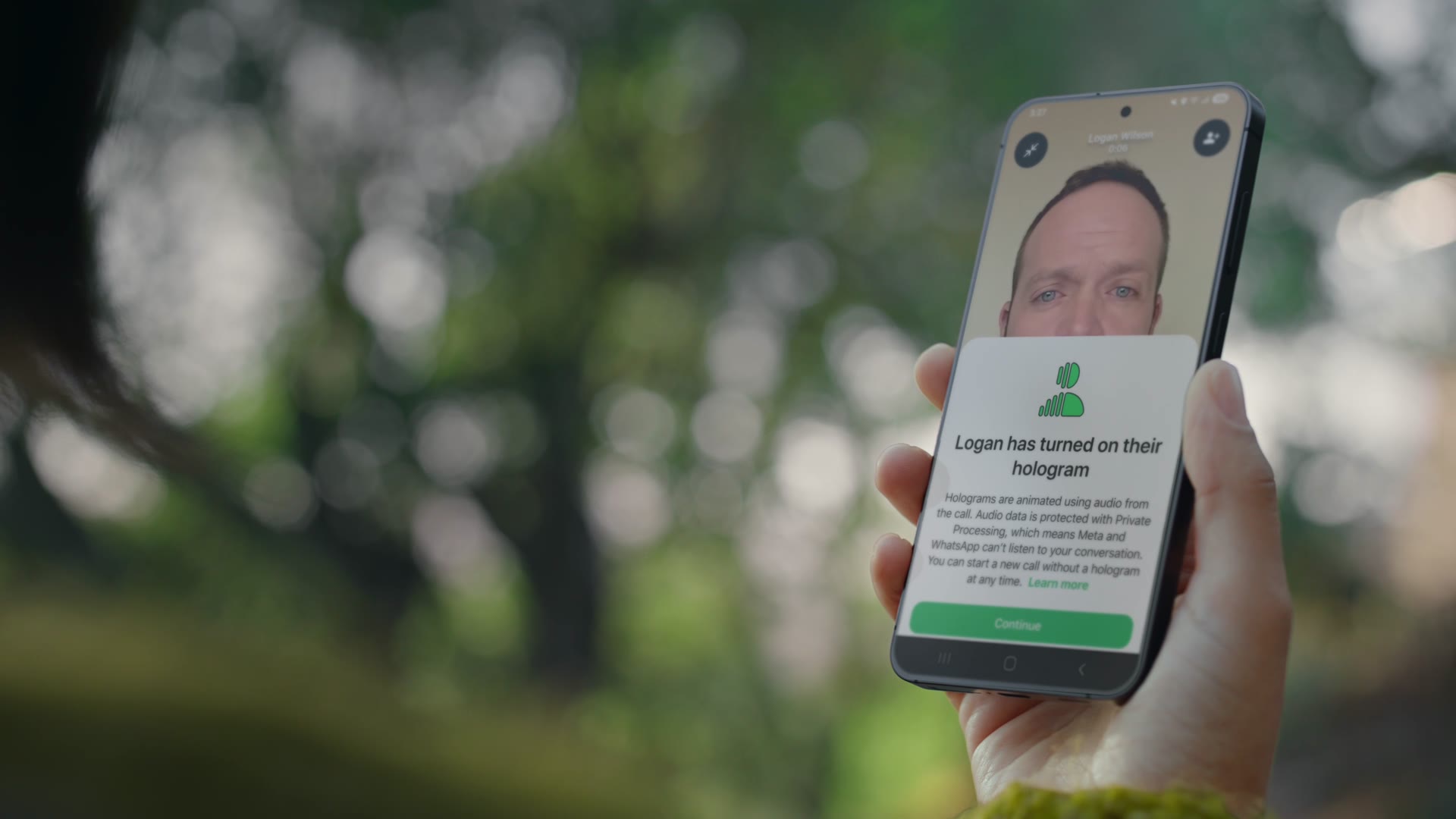
Look at the card in the frame above, taken from the video Meta posted with the announcement. It is more specific than most consent screens. "Logan has turned on their hologram," it reads. "Holograms are animated using audio from the call. Audio data is protected with Private Processing, which means Meta and WhatsApp can't listen to your conversation. You can start a new call without a hologram at any time." Road to VR adds that a small ghost-shaped icon stays in the lower left of the call.
Private Processing is the system WhatsApp described in April 2025 for running AI requests inside a trusted execution environment, a sealed-off area of a server that Meta says it cannot read into. Take that as stated, not verified. The visible part is the product decision: the person receiving the call is told, has to tap Continue, and is offered a way out. Apple's Personas never needed a card like that, because a Persona is driven by sensors on the headset the speaker is wearing. An avatar animated from audio is a different thing to be on the other end of.
It is video, not volume
Last week's hands-ons are where the ceiling shows. UploadVR tried the full-body version on Meta VR Glasses and describes it as "a stereoscopic 3D video pixel stream, masked out to exclude any kind of background," the same server-side approach in stereo. Stereoscopic means one slightly offset image per eye, which reads as depth when you look straight at it. Road to VR calls the result 2.5D. Step off that axis and it shows: when UploadVR's reporter leaned or walked toward the avatar, it turned to keep facing the viewer, "exactly like a billboard sprite in an old video game," and the eyes went blocky like a low-bandwidth video call.
Advertisement
On Ray-Ban Display there is no stereo at all. The output is flat, shoulders-up video, usually watched on a phone. Road to VR, calling another Display wearer, found the picture so small in the right-eye screen that it called the feature more for smartphone users than Display users. It also spells Hologram with a capital H, to keep it apart from the real thing.

From WhatsApp to Zoom, eventually
Meta's VR Glasses announcement promises more. "It works with whichever calling app you're using, from WhatsApp to Zoom," it says of Hologram, and people joining from a phone or computer see your hologram on their screen. The one dated launch is WhatsApp only. Jordan Kuo noted last week that Mixed Reality Link now lists a Meta avatar camera beside the webcam on Windows, cartoon avatar for now, which is the easy way into any video app with a camera dropdown. Meta has not said how Hologram reaches Zoom, or when.
Nothing to build against yet
If you write software, the practical summary is short. Hologram is a first-party feature inside WhatsApp, on glasses whose developer toolkit still cannot publish to the public, and the Hologram Calling frameworks that turned up in Horizon OS builds in August still have no documented API.
Meta did give UploadVR a direction. A later, truly volumetric version, with no timeline, is the one Meta says developers will be able to put in their own VR apps, replacing the cartoon Meta Avatars SDK, which UploadVR says is no longer being developed. Before that, the spring 2027 version on Meta VR Glasses adds face tracking from downward-facing sensors, confirmed in Road to VR's demo rather than the keynote. On that hardware, your voice stops being the only input.
Until then, the shipping answer to photorealistic presence is a flat video of your face, generated on a server from a guess about what your voice means, inside one messaging app, in one country. That is a real product. It is just much smaller than the eleven years behind it.
Advertisement