
The smart glasses category has spent two years refusing to answer a fairly basic question about itself, which is whether the product being sold is a display or an assistant. Most of the hardware that has shipped since 2024 has tried to be both at once, and the results have been predictable: frames heavy enough that you notice them by lunch, batteries measured in hours rather than days, and a display good enough for notifications but nowhere near good enough for a film. RayNeo announced its answer on August 21, ahead of IFA in Berlin, and the answer is that you cannot have both, so here are two.
ArAugust 23, 2026
33 Grams and 78 Grams: RayNeo Is Selling Both Halves of the Glasses Argument on September 4
By Jordan Kuo
Staff Writer, VR.org
Advertisement
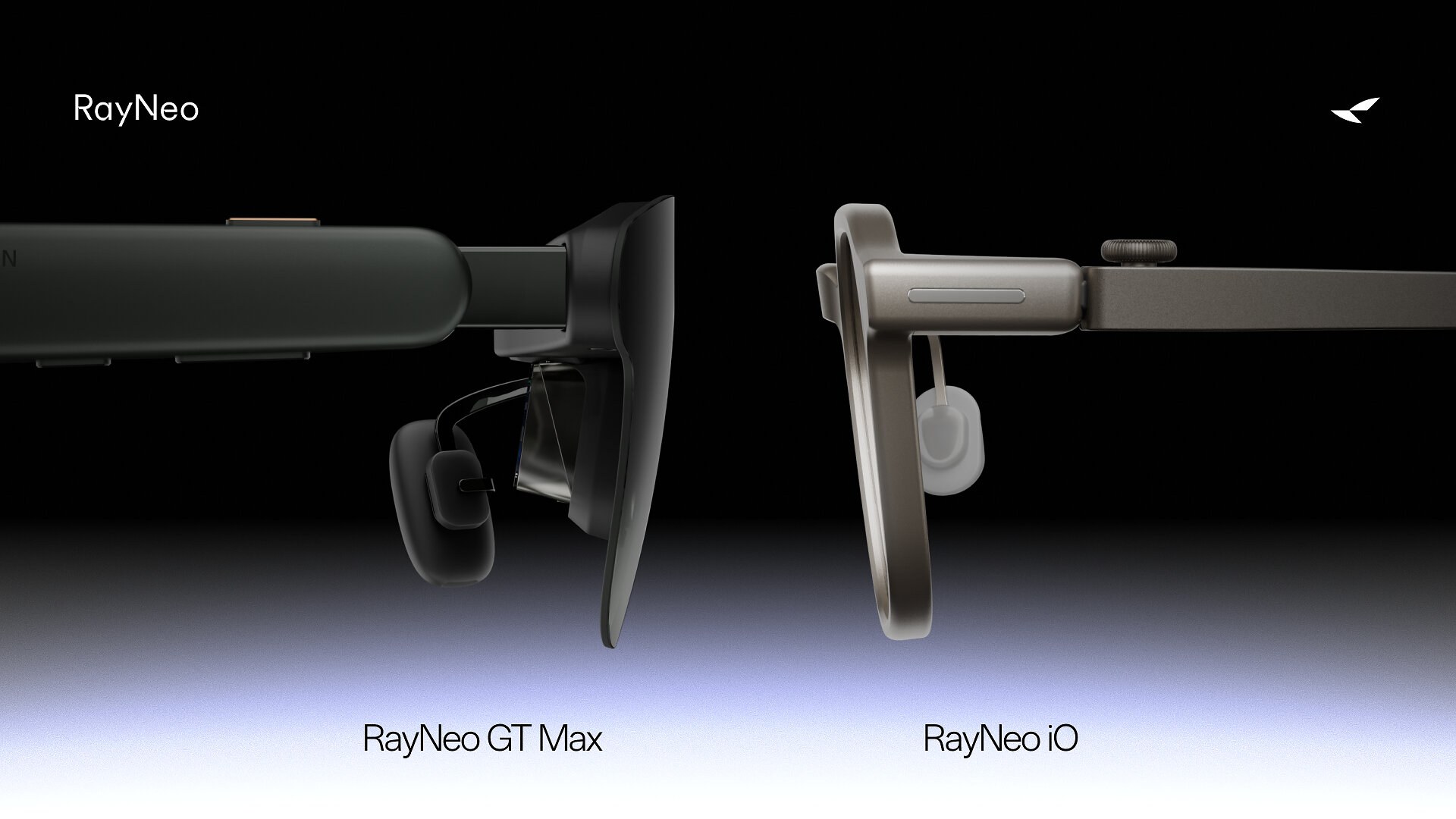
Both lines go on sale on the same day, September 4, through RayNeo's own store and Amazon, with live demos at IFA in Hall 21A. RayNeo is worth taking seriously here in a way it would not have been three years ago: incubated by TCL Electronics and since spun out as its own company, it says it held 23.7 percent of global consumer AR glasses shipments in the first quarter of 2026 by Counterpoint Research's count, a number it uses to argue it is the largest seller of this class of device anywhere. Founder and CEO Howie Li framed the split as a deliberate rejection of the compromise everyone else is shipping. "Rather than compromising with a single device that tries to do everything, we designed two dedicated experiences," he said.
Twenty-three degrees against fifty-nine
His spec sheets make the argument better than the quote does.
Start with the iO. It weighs 33 grams, which is inside the range where people stop noticing a frame by lunchtime, and it gets there by giving up almost everything that makes a display glasses product a display glasses product. Field of view is 23.5 degrees. The image is monochrome green, generated by a 0.085cc micro-LED engine RayNeo calls Firefly Nano, pushed through a diffractive waveguide the company rates at 97 percent optical transparency and 1,300 nits at eye level. There are no speakers at all, just bone conduction and a four-microphone array. The battery is 240mAh, which sounds tiny until you remember the display is drawing a few lines of green text, and RayNeo claims two days of typical use, 18 hours of continuous recording, or 6.2 hours of continuous translation from it.
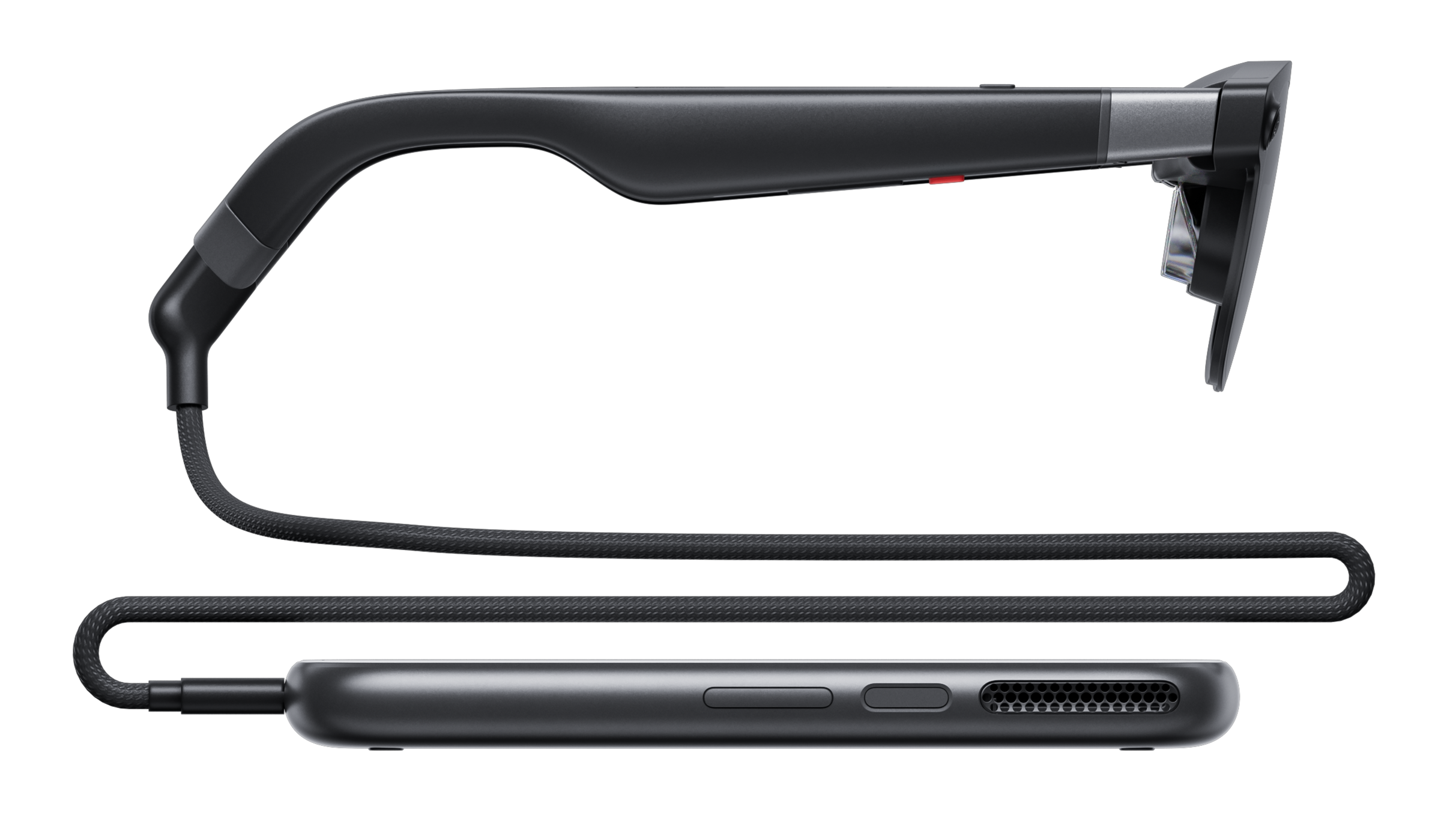
Its opposite number is the GT Max, at 78 grams, and it goes the other way on every axis. Field of view is 59 degrees, the optical stack is a birdbath fed by a 5.5th-generation tandem micro-OLED panel, and the pitch is a virtual screen up to 307 inches with Dolby Vision, quad speakers co-tuned with Bang and Olufsen, and head-tracked spatial audio. The cheaper GT sits at 68 grams and 46 degrees with a 231-inch ceiling. Both carry a native 3DoF tracking chip so the screen can be pinned in space rather than glued to your face, and both come in three IPD sizes.
Those are not two configurations of one product. A diffractive waveguide that passes 97 percent of ambient light physically cannot deliver a 307-inch cinema image, and a birdbath bright enough to hold black levels in a movie physically cannot disappear into a frame you would wear to a meeting. Anyone who has spent time with both optical architectures already knows this, and the interesting thing is not the physics but the willingness to say it out loud in a product line rather than papering over it with one device and a marketing deck.
The camera-shaped hole
There is no camera on the iO. That decision arrives in a month when the pressure on camera glasses has become impossible to ignore: US Immigration and Customs Enforcement classified Meta's glasses as body-worn cameras and banned them outright for employees, and the hardware floor for a pair of camera glasses has fallen to $99.99, which is quietly doing more to shape where those devices turn up than any regulator has.
Advertisement
Camera-free is not a new position, and it did not start out as the cheap one. Even Realities built a company on the G1 at $599 by selling discretion as a premium feature, and for most of the last year that was the shape of this tier: no lens, high price, adult styling.

But camera-free is not recording-free, and this is the part worth being precise about. The iO listens continuously. Its headline feature is an Ambient AI Life Log that captures audio in the background and hands it to a model, alongside Timekettle's BabelOS 3.0 for live translation across 55 languages, an auto-teleprompter, and a multi-LLM selector that lets the wearer route requests to Gemini, ChatGPT, Claude or DeepSeek, with Gemini 3.1 Flash Lite doing the ambient work. There is an indicator LED that lights during recording and translation. There is also a microphone array pointed at whoever happens to be standing in front of you, which is the same structural problem we walked through with XGIMI's MemoMind One this month. A device that takes no pictures can still be the reason a conversation ends up in a transcript.
One quieter detail: the iO carries Apple MFi licensing alongside Bluetooth 5.4, so it is built to work properly with an iPhone rather than tolerating one. For a category where the assistant is the product, being a first-class accessory on both mobile platforms is a bigger strategic decision than the waveguide spec.
Nobody will tell you the price
RayNeo announced three products, a hard on-sale date two weeks out, and a price for none of them. Pricing lands on September 4, on stage at IFA, the same day the products go on sale.
That is now a pattern rather than an oddity. XREAL has taken more than 10,000 reservations for AURA since June, moved through an early-bird tier where $99 converted into $199 of credit, and is currently collecting $199 deposits against a product whose price it still describes only as "under $1,500" before tax. When AURA reservations opened at the end of June, that ceiling read as an aggressive competitive move against Snap. Two months and ten thousand reservations later, the ceiling has not resolved into a number, and the fall launch window has not narrowed.
Two of the largest companies in consumer AR are asking for commitment before disclosure, and both are getting it. That tells you the demand is real. It also means the only genuinely comparable figure across this entire category right now is weight in grams.
What September 4 actually settles
There is no developer story in any of this, and that absence is the thing worth flagging. RayNeo's announcement is a consumer product announcement from start to finish. No SDK, no app platform, no mention of Android XR, which is where every ecosystem argument in glasses is currently being fought. The iO is an appliance with a rotary dial on the temple and four language models behind it. The GT Max is a screen you strap to your head.
Both of those are legitimate products, and shipping a 33-gram frame that runs two days is a harder engineering result than shipping another do-everything pair that runs four hours. The open question is whether a company can hold 23.7 percent of a category on appliances alone while Google, Samsung and Qualcomm spend the next eighteen months trying to turn the same eyewear into a platform with an app store attached. September 4 will not answer that. It will at least tell us what RayNeo thinks the two halves are worth.
Advertisement