
Eleven model numbers. That is the size of Samsung's Intelligent Eyewear line in the Federal Communications Commission's database, where two grants dated September 27 cover SM-O200P plus four variants and SM-O200J plus five. Samsung has shown four frames in public, by The Korea Herald's count at Galaxy Unpacked in July. Droid Life found the filings on September 30. A day later the Korea Herald reported that a Samsung official had confirmed a November launch.
HardwareOctober 1, 2026
Samsung's November Glasses Cleared the FCC With Eleven Frame Models and a 6 GHz Radio
By Alex Reeves
Staff Writer, VR.org
Advertisement

Treat November as a claim. It comes from one unnamed official speaking to one newspaper, and Samsung has announced no date and no price. Three days ago none of this fall's promised glasses had a ship date of any kind, so a month is progress. The filings are firmer. They are Samsung's own paperwork, tested by Element Materials Technology in Columbia, Maryland, and they describe the radio hardware in a way neither Google I/O nor Unpacked did.
Eleven models, two families
The count is less dramatic than it looks. Element's RF exposure report for the P family says "the only difference between the parent and variant models is the design of the front frame." Its emissions report says the circuit board is identical across all five and that the models "differ only in the dimensions of the glasses enclosure." The variants are shapes. Five in one family, six in the other, and within each family no higher or lower tier.
Which family belongs to which brand is not in the public record. Neither Warby Parker nor Gentle Monster is named in the exposure or emissions reports. Droid Life matched SM-O200P to the Warby Parker temple and SM-O200J to the Gentle Monster one from the label drawings, and Road to VR reads the codes the same way. The match is reasonable. Samsung has not confirmed it.
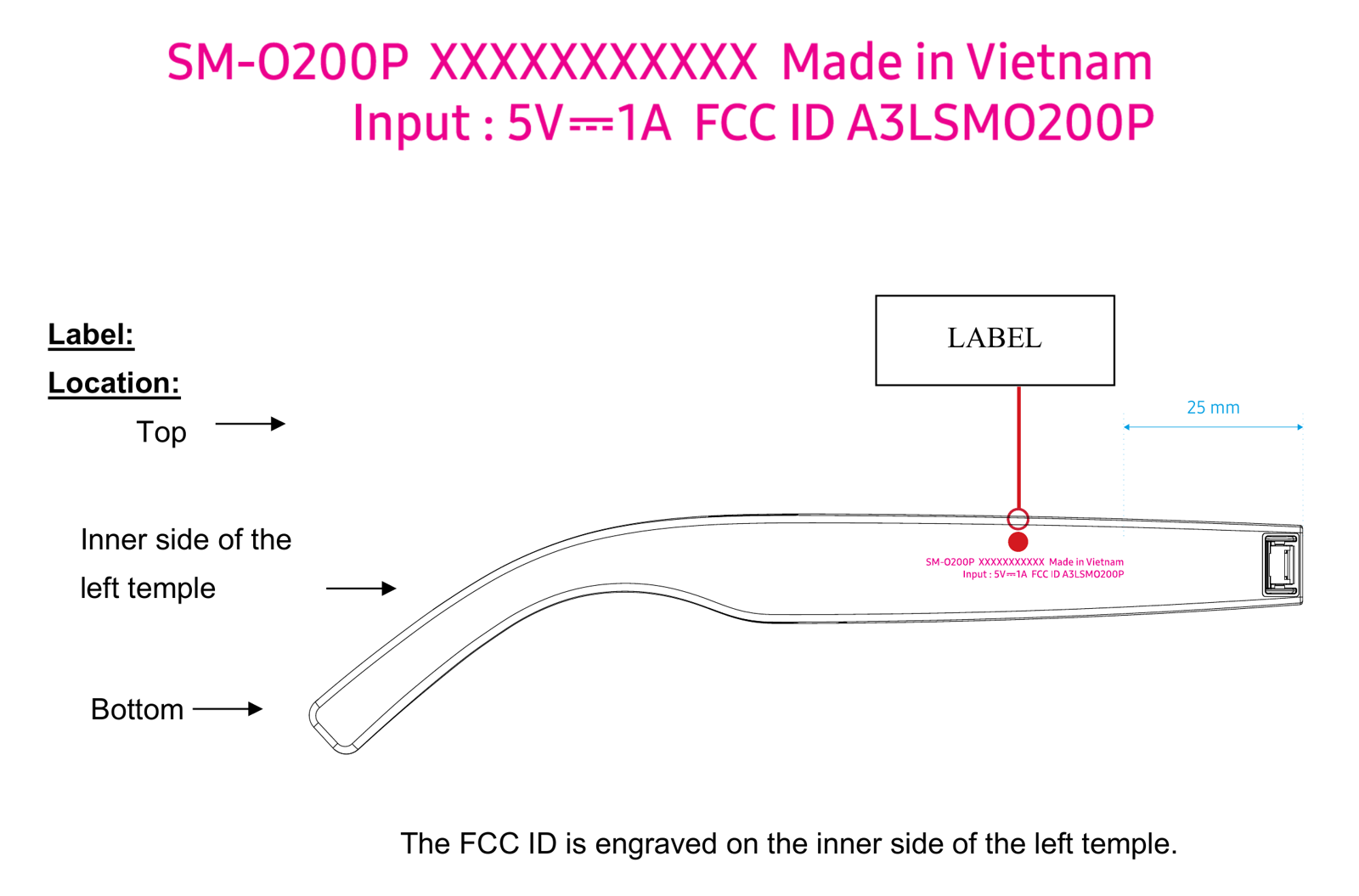
The label exhibit gives up two details. The FCC ID is laser engraved inside the left temple, and the line beside it reads "Made in Vietnam," with a 5-volt, 1-amp input. Testing on the P family ran from February 26 to July 13, nine days before Samsung put the glasses on a stage in London. The rest of the visual record is sealed: Samsung asked for 180 days of confidentiality on the photos and the user manual, and the database lists them as available March 26, 2027.
Advertisement
The radio is the new information
Samsung's July announcement named the Snapdragon AR1 Gen 1 and a nine-hour battery. It did not mention Wi-Fi. The filings do. The glasses carry Bluetooth and Wi-Fi 6E across 2.4, 5 and 6 GHz, with channels up to 160 MHz wide on the upper two bands and a single transmit antenna housed in one temple.
The 6 GHz radio is certified two ways. One is as a normal client of an indoor router. The other is as a very low power device, a class the FCC opened in October 2023, naming "wearable technologies and augmented and virtual reality" among its uses and allowing operation "anywhere, indoors or outdoors." Samsung's attestation letter says that in this mode the glasses "will allow client to client communications." Put plainly, they can talk to another device on 6 GHz with no router in between.
The likely reason is the phone. Samsung calls the design split computing. Choi Jae-in, who heads XR research and development in its mobile division, said at a London briefing the Korea Herald covered that heavier processing runs on the handset and that "the glasses can remain light because they are closely connected to the smartphone." A direct 6 GHz link is the obvious tool for that job, though the filing does not say what sits at the other end. Element tested four conditions: video recording, audio playback, file transfer, and the glasses sitting in their charging case. For two of them the glasses were paired to a phone.
One more part surfaces in the exposure report. A grip sensor on the inner side of the temple detects contact with the wearer. Worn, the radios run at full power. Off the head, they step down.
Exposure figures for the P family sit inside the federal limit. The highest single-band reading at the head is 0.84 watts per kilogram, on 6 GHz. Adding the two bands that can transmit at once gives 1.53, under a ceiling of 1.6.
What a buyer has today
A sign-up form. Both brands' pages take an email address and nothing else. Choi said in July that "the product needs to be in the premium category." Samsung was also considering selling mainly through eyewear stores, where frames get fitted and prescription lenses added, over phone carriers.
Weight is the number to watch. Samsung has advertised the glasses as "lighter than most AI glasses," and the Korea Herald cites local reports of a target up to 5 grams under the 51-gram Ray-Ban Meta. The same article puts Meta's new Ray-Ban Meta Audio at 43 grams, which Meta managed by deleting the camera Samsung is keeping. It also carries the Counterpoint Research figure that explains the hurry: Meta held 94 percent of display-less glasses shipments in the first half of 2026.
Software is the thinner half. Google's distribution page still says Play Store distribution "is only available for immersive app experiences on XR headsets and wired XR glasses devices." These are neither. Unless that changes, third-party apps have no public route onto the frames at launch, which leaves Gemini and whatever Google and Samsung ship themselves.
So the buyer's list is short. A launch month from one official. No price and no weight. And FCC grants that clear eleven frames for sale in the United States whenever Samsung decides to say so.
Advertisement