
$1,099. That is the price of XREAL AURA as of October 28, with 12GB of memory and 256GB of storage. On October 7, XREAL priced the same configuration at $1,279. The 16GB and 512GB model went from $1,499 to $1,299. XREAL calls both a limited-time launch offer, running through December 2026.
HardwareOctober 30, 2026
XREAL Cut AURA to $1,099, and Its Earliest Buyers Get $180 or $200 Back
By Alex Reeves
Staff Writer, VR.org
Advertisement

Some people already paid the old price. A panel on XREAL's AURA page, headed Refund, lists $180 for the 12GB model and $200 for the 16GB model, each "Based on the original prices." The line under it reads: "If you've already purchased AURA, you'll receive a refund for the hardware price difference based on the original prices."
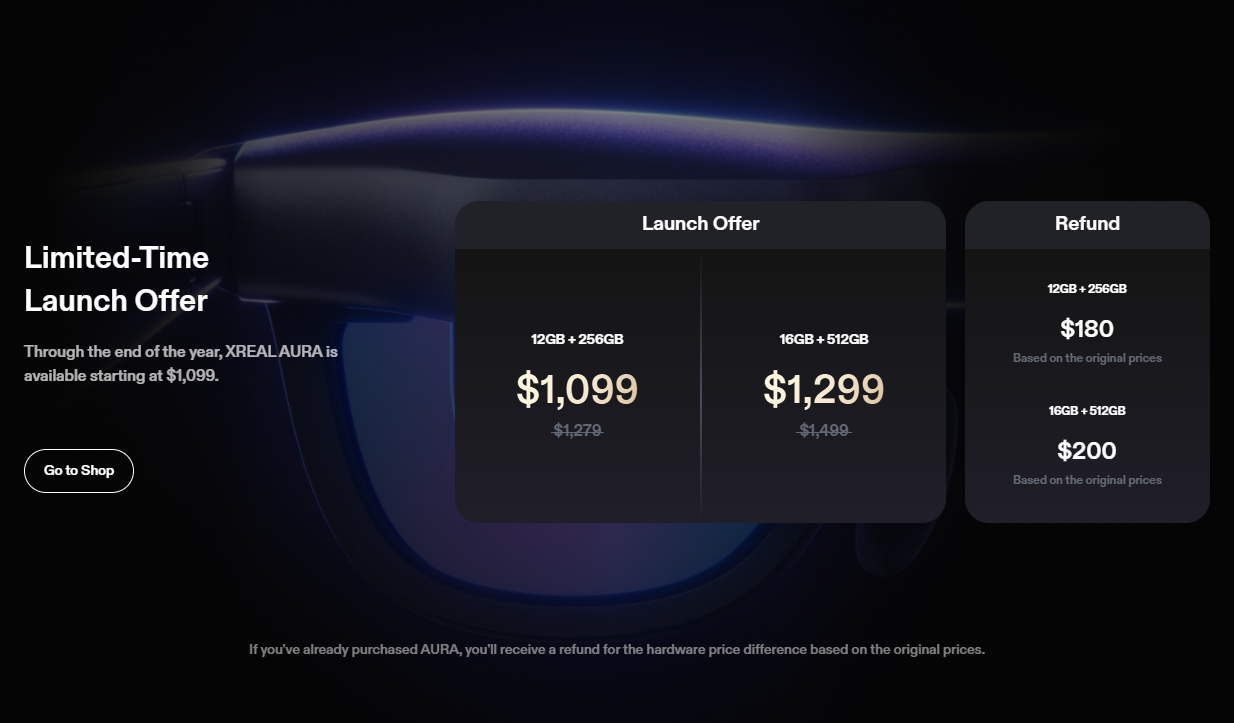
The terms on XREAL's US shop are narrower than the panel. They cover customers "who placed and fully paid for an order at the original price before October 28." XREAL says it will refund "in the order in which purchases were placed," expects to start all refunds within 30 days, and pays them to the original payment method. No claim step is described. In Canada the gap is C$230, from C$1,829 to C$1,599.
Who actually paid $1,279
Only part of the reservation list could. Under XREAL's October 7 release, ordering opened only to people who had reserved AURA before that day. The shop FAQ now says $199 Reservation Pass holders "can pay their remaining balance starting October 28 at 10:00 AM PT," and that the launch offer applies to those payments. That leaves the refunds with whoever paid in full between October 7 and October 27.
XREAL has not said how many orders that is. The largest early group on record is the Founder Priority Pass: 2,000 of them at $299, sold out within 36 hours of reservations opening in June. Founder's Edition orders ship first.
The ceiling, three readings
Reservations opened on June 16 with one commitment: the base model would not exceed US$1,500 before tax. That cap was the first consumer price point for Android XR glasses. On October 7 the base model landed $221 under it. Through December it sits $401 under it.
The FAQ that carried the $1,500 line is gone from the rebuilt page. An Internet Archive capture shows it still there on October 22, next to "XREAL AURA is expected to launch in Fall 2026." The 28-market launch list that promised the United Kingdom and left out Canada went earlier. It was on the page on October 7 and had been cut to the four launch markets by October 13.
Those four are the United States, Canada, Japan and South Korea. Google's launch post says orders opened on October 28 in the US, Canada and Korea, and open on November 2 in Japan. The UK is not on the list. XREAL's October 7 release said more markets would come in 2027.
Advertisement
Mid-November, and a Best Buy listing
XREAL's October 28 release, issued from Sunnyvale and announced on stage at Google's Android Developer Summit, puts first shipments in mid-November. AURA sells through XREAL.com in all four markets and through BestBuy.com in the US. Road to VR reports that select Google Store locations in the US and Japan add it in 2027.
The release counts more than 150 made-for-XR experiences. Two of them cost nothing: Asteroid is free for AURA owners, and Nevatars is free for the first six months. Owlchemy's Hyper Visor is on Google Play at $1.99.
Two sizes, chosen once
AURA comes in two fixed frame sizes. M covers an interpupillary distance of 60 to 66mm. L covers 66 to 72mm. The size is picked at checkout, so two memory tiers against two sizes makes four SKUs.
That range is narrower than on XREAL's cheaper glasses. One Pro comes in 57 to 66mm and 66 to 75mm, which XREAL says covers 95 percent of consumers. AURA gives up 3mm at each end. The IPD page the AURA shop links to, written for One Pro, offers an optometrist, an online camera tool, or a ruler held level against the forehead in front of a mirror. A ruler and a mirror is an odd instruction to find attached to a $1,099 computer for your face. It is also the one most likely to be right.
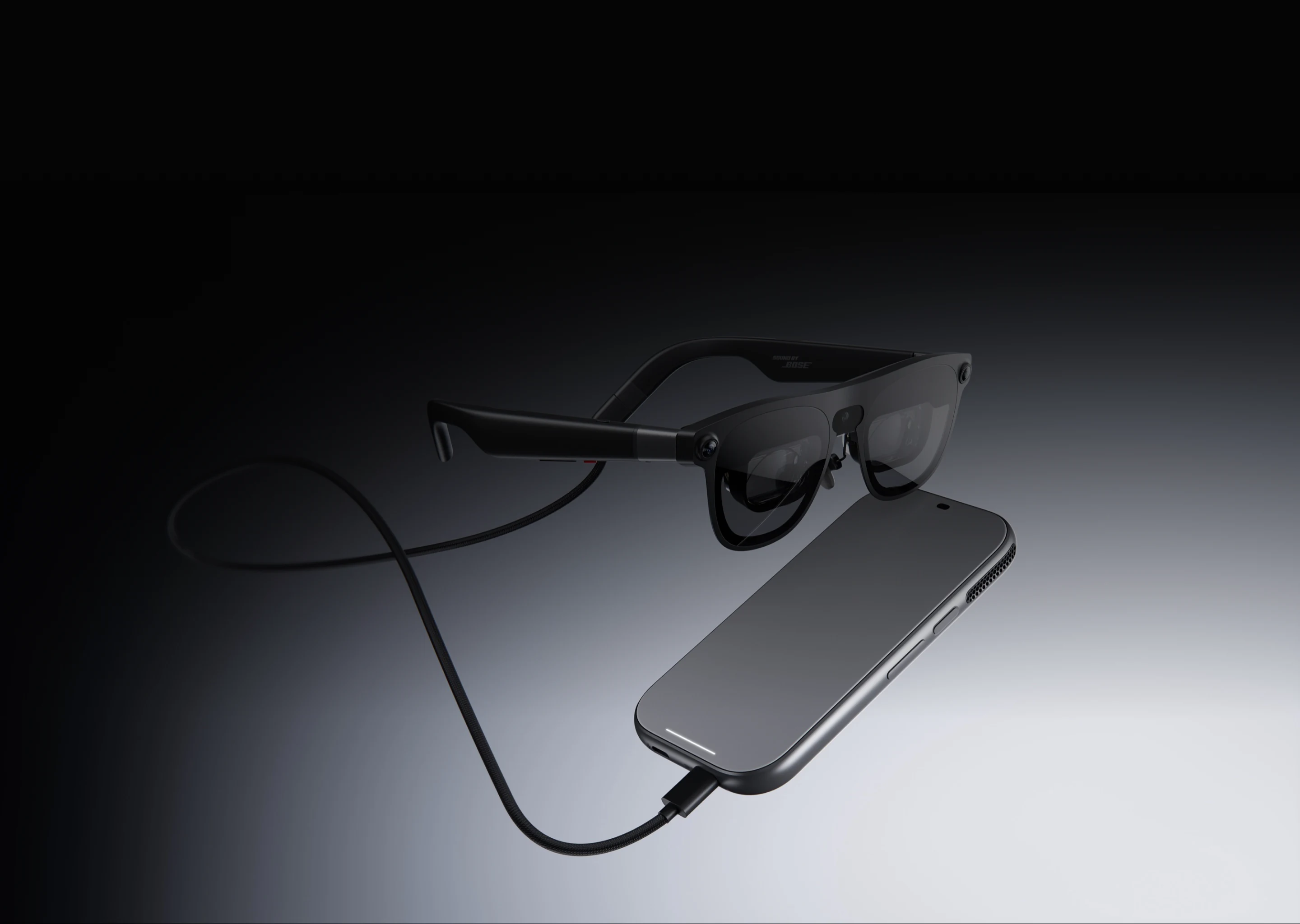
The spec sheet: glasses at 95 grams, and a 265-gram puck with a 4,455 mAh, 34.84Wh battery, a fingerprint button, a touchpad and Snapdragon Reality Elite. An X1S coprocessor sits on the frame, quoted at 3ms motion to photon. X Prism optics give a 70 degree field of view over Sony micro-OLED panels at 1920 by 1200 per eye, up to 120Hz.
What the cut buys
Meta VR Glasses are $1,299.99 and go on sale in spring 2027, with a puck of roughly 300 grams. AURA's base model is now $200.99 under that, not $20.99. A rounding difference became a real one. The calendar matters more. XREAL bills AURA as the first wired XR glasses on Android XR, and Meta's answer is a spring product.
A $199 Reservation Pass holder has nothing to claim: the balance window opened at the launch price. Anyone who paid in full before October 28 should see the difference go back to the card they paid with, starting within 30 days by XREAL's estimate. Watch the statement and confirm that it does.
Advertisement