
Setup graphics for Meta's unreleased ultralight headset turned up inside Quest firmware this week. Dataminers pulled them out, Road to VR and UploadVR wrote up what they show, and the codename is Phoenix. The images are low resolution and there is no spec sheet attached.
HardwareJuly 29, 2026
Meta's Phoenix Has to Match a 107-Gram Headset and Add Cameras to It
By Alex Reeves
Staff Writer, VR.org
Advertisement
One detail in them is worth more than the rest. Phoenix has no face gasket. It rests on nose pads, and a firmware string walks the user through adjusting those pads for comfort.
That single design choice is what makes the long-reported weight target interesting. Phoenix is supposed to come in under 110 grams. VR.org has been logging that number across the devices that shipped or leaked this year, and the ledger says something the leak coverage has mostly skipped. 110 grams is not, on its own, an ambitious target. It is a weight that currently belongs to devices doing almost nothing.

The ledger
Here is roughly where the market sits, by weight on the head.
Rokid Glasses land at 49 grams. Ray-Ban Meta is around 50. XREAL's $299 display glasses are 62, and they get there by having no camera and no battery in the frames at all. Raven Prism comes in under 70. Meta lists its own Ray-Ban Display at 87. XREAL Aura is under 95, with the compute moved to a puck in your pocket. The Bigscreen Beyond 2 is 107. Snap's Specs, fully standalone with the computer and battery in the frames, weigh 132.
Then the actual headsets. Steam Frame is 440 grams with strap and battery, 185 for the frontbox alone. Quest 3 is 515 with the stock strap. Vision Pro is 600 to 650, and that is after Apple moved a 353-gram battery off the head and into your pocket.

Read down that list and the rule is hard to miss. Nothing under about 130 grams carries a processor, a battery, and a camera array at the same time. The devices at the bottom of the list are display panels with temples. The devices doing real spatial computing start around four times heavier.
Bigscreen is the closest thing to a proof
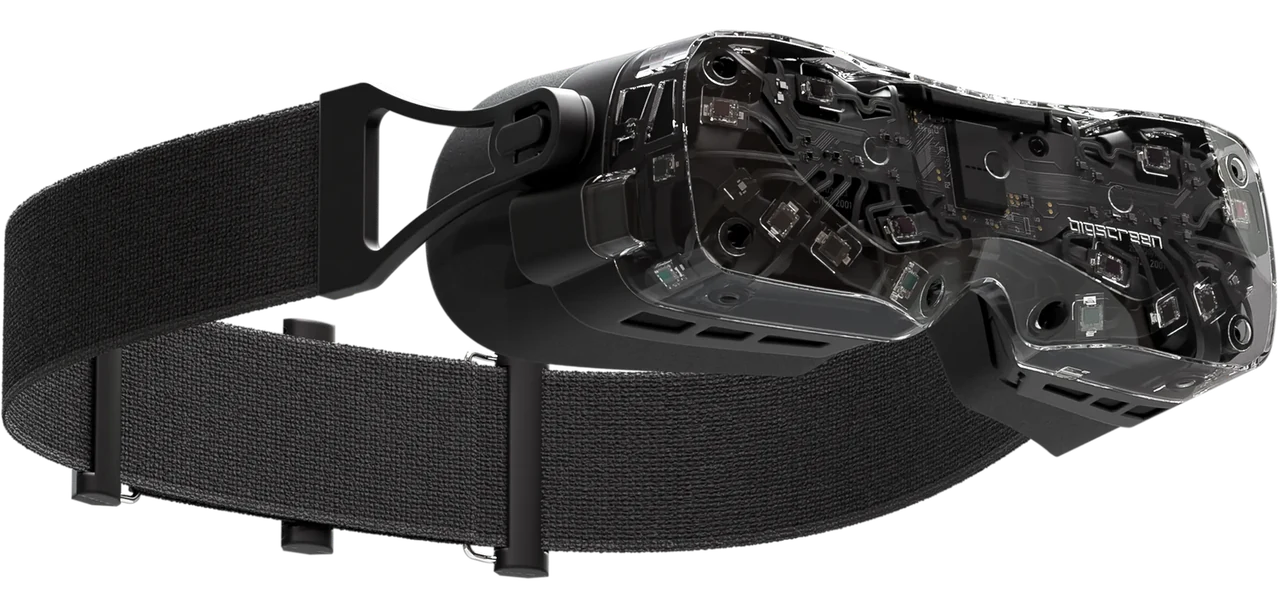
The Beyond 2 is the one device that proves part of Meta's case. It pushes 2560 by 2560 per eye through micro-OLED panels and pancake optics, and Bigscreen lists it at 107 grams. It costs $1,019.
Two caveats belong on that number, and both matter here.
One concerns the measurement. Bigscreen quotes 107 grams without the strap or the facial interface. Nobody has said whether Meta's sub-110 figure is measured the same way, so the two numbers may not describe the same thing at all.
The other concerns the hardware. A Beyond 2 has no onboard computing, no battery, no cameras, and no inside-out tracking. It needs a PC with a serious graphics card, external controllers, and at least one SteamVR base station bolted to a wall. It is a pair of very good displays on a cable.
What Phoenix has to add
Now line the two up. Both offload compute and power, Bigscreen to a desktop PC and Phoenix to a tethered puck running Horizon OS. Both use micro-OLED panels in the same size class. Meta's reported panel order, split between BOE and Seeya, is for roughly 2560 by 2560 micro-OLEDs at about 0.9 inches. That is the Beyond 2's resolution, on a panel of about the same size.
Advertisement
So the display half of the problem is solved, and somebody has already shipped the answer.
Eye tracking is not the problem either, which is the part most people get wrong. Bigscreen sells an eye-tracked variant, the Beyond 2e, and says the entire tracking suite adds 1.05 grams. A gram. Whatever is difficult about Phoenix, it is not the eye sensors.
The difficulty is everything Bigscreen never had to carry. Passthrough cameras. Inside-out tracking cameras, because there are no base stations in a Meta living room. Hand tracking off those same cameras. Microphones and speakers, presumably, since a media and social device without audio is not a product. And a fit system that works on every face Meta sells to, rather than one molded from a scan of a single buyer's head.
That last one is the quiet cost. Bigscreen's custom facial interface is not a luxury feature, it is load-bearing engineering. Molding the contact surface to one specific face is how 107 grams stays comfortable. Meta cannot do that at Quest volumes, so it has to solve the same problem with removable nose clips and adjustable lens spacing, both of which appear in the leaked setup flow. Those are not comfort niceties. They are the universal-fit substitute for a custom mold, and they have mass.
110 grams on a nose is not 110 grams on a face
Weight is the number everyone quotes. Distribution is the number that decides whether anyone wears the thing.
The Beyond 2's 107 grams press against a molded interface covering most of the face, spreading the load over a wide surface and resting partly on the forehead and cheeks. Phoenix, if the firmware is read correctly, puts its weight on two nose pads and whatever the back of the device turns out to be.
For scale: an ordinary pair of prescription glasses runs 25 to 40 grams. Ray-Ban Meta is about 50. The heaviest thing Meta currently asks anyone to balance on nose pads is the Ray-Ban Display at 87 grams, and that is a device people wear in bursts.
Phoenix would be carrying roughly 110 grams on those same contact points, for the seated media and productivity sessions the device is reportedly built around. Nobody has shipped that. It is not obviously impossible, and the back of the device is still unknown, so a rear cradle could take a real share of the load. But it is the open question, and no leak answers it.
What the firmware settles
VR.org's Quest 4 explainer filed five circulating claims about this device as rumor back on June 20: a 0.9-inch micro-OLED panel, motorized automatic IPD adjustment, iris scanning, eye tracking, and the nose-pad fit.
Three of those now sit in Meta's own shipping assets rather than in an aggregator's summary. Nose pads, adjustable lens spacing, and eye tracking are first-party as of this week. The 0.9-inch panel figure still rests on XR analyst Brad Lynch, supported indirectly by the BOE and Seeya order. Iris unlock is still unattributed to anyone. That is a real upgrade in confidence for three claims and no movement at all on the other two.
What it means for buyers
Connect runs September 23 and 24 at Menlo Park, and setup assets this far along usually mean a device is ready to be shown. Internal Meta memos from December put Phoenix in the first half of 2027. Being shown and being sold are separated by a year here.
On price, the Wall Street Journal reported an internal hope of landing under $1,000, and that hope was formed in a cheaper year. Qualcomm raises Snapdragon prices by double digits on anything shipping after September 1. DDR5 contract pricing has more than doubled year over year. Micro-OLED is the expensive display technology. And Phoenix is two pieces of hardware, because the puck arrives with its own silicon, battery, and enclosure to pay for. The nearest existing comparison costs $1,019 and still needs a gaming PC.
The practical read is simple. Phoenix is not a Quest 3 replacement. The reported input model is gaze and pinch plus hand tracking, the use cases point at virtual screens and seated mixed reality rather than room-scale games, and the gaming successor is a separate program codenamed Griffin arriving in 2027 at the earliest.
Meta will have a hard time acting surprised in September. When it does take the stage, the weight will be the number in the keynote and it will be the least useful one available. Watch instead for what the fit system looks like, what the puck costs, and whether Meta quotes that 110 grams with the strap on or off.
Advertisement