
Valve's own kernel source describes a Steam Frame display with 3,552 by 3,840 pixels per eye. The one mode its driver switches on sends the panel a quarter of that.
HardwareOctober 15, 2026
Valve's OLED Steam Frame Code Sends the Panel a Quarter of Its Pixels
By Alex Reeves
Staff Writer, VR.org
Advertisement
The panel is codenamed Plano. Steam Frame Hub found it on October 14 in deckard-linux, a public GitHub mirror of the Linux kernel that runs SteamOS on the Frame. Road to VR picked it up this morning. Most coverage stopped at the resolution. The driver says more than that, mostly in its own comments.
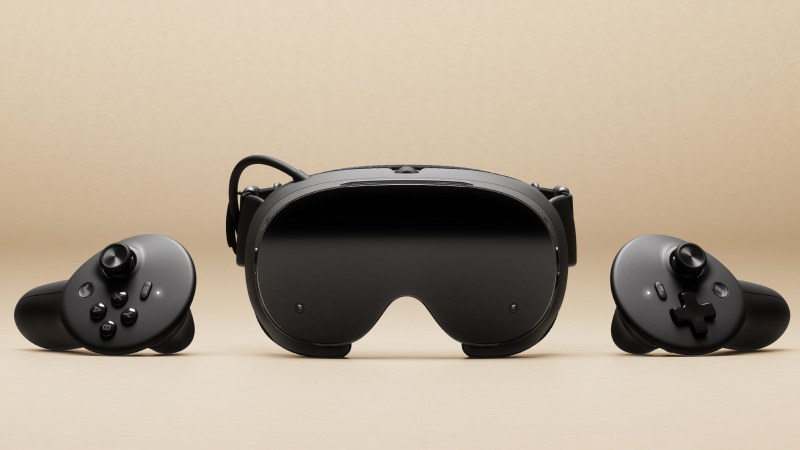
One mode on, and it is the small one
Plano's driver lives in panel-deckard-plano.c, and it calls itself the "Plano DSI Panel Driver." Two constants define the glass: 3552 across, 3840 down. Below them sits a list of display modes, each with its own on or off switch. The newest copy sits on a work-in-progress branch updated at the start of October.
One group is on. Valve calls it Global 2x. The headset sends 1,776 by 1,920 pixels per eye at 72, 80 or 90Hz, and a chip on the panel scales the image up by two in each direction to fill it. The comment beside the switch reads "Working for dphy & cphy," the two kinds of display link Valve has tried.
Now the Frame on sale today. Its LCD panels take 2,160 by 2,160 per eye, about 4.7 million pixels. Plano's working mode takes about 3.4 million. That is 27 percent less image per eye, going into the newer panel.
Each OLED pixel is smaller, and there are far more of them, 13.6 million per eye. The picture is still built from the 3.4 million that arrive.
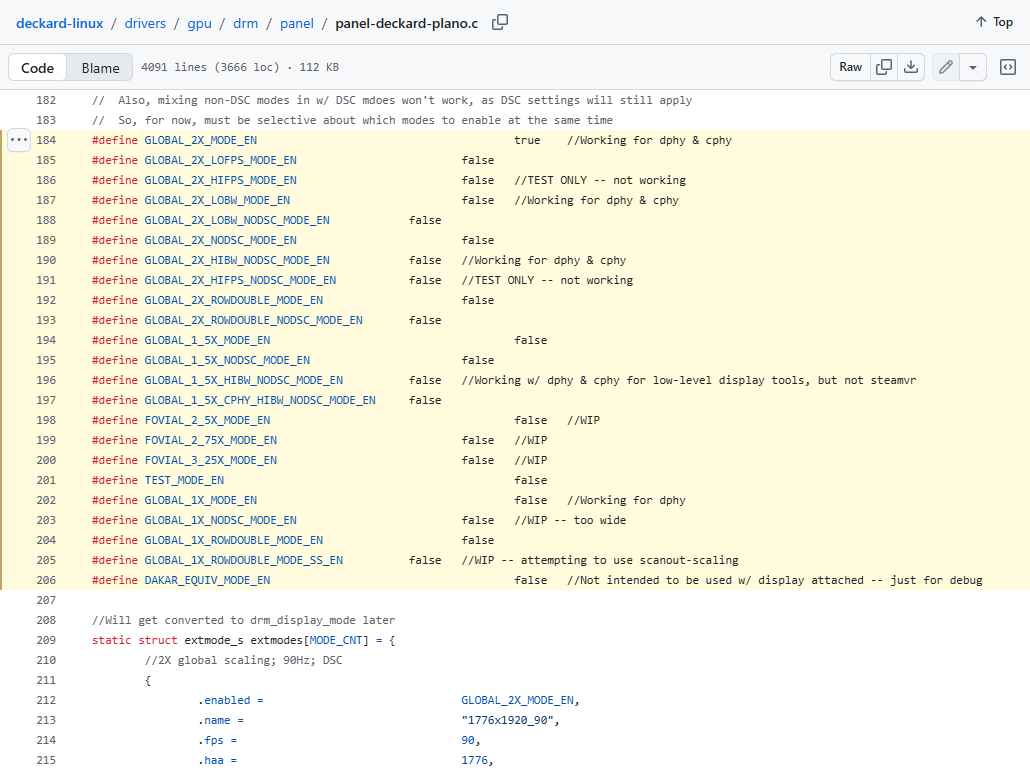
Everything above that is flagged
The other switches are off. Most carry a note.
High refresh at the 2x size covers entries for 100, 110 and 120Hz. Each is marked "TEST ONLY" and "not working." The Frame on sale today runs up to 120Hz, with 144Hz labelled experimental.
A 1.5x mode, 2,368 by 2,560 per eye, is "Working w/ dphy & cphy for low-level display tools, but not steamvr." A July 20 commit describes what happens under SteamVR. It "only displays left eye and system bogs down."
Full resolution is "Working for dphy." The same commit adds the condition: "requires MIPI overclocking." MIPI DSI is the link that carries pixels from the processor to the panel. Running it past its rated speed works on a bench. Products do not normally ship that way.
Last come three foveated transport modes, all marked "WIP." They appear to pack a sharp patch for wherever the eye is looking and a low-resolution background into one frame, and leave the panel to put the two together. The Frame already has eye tracking, which it uses for foveated streaming from a PC. The plumbing to send a patch like that to the panel is not done.
The wire is the bottleneck
Plano's device tree files are built for SM8650, Qualcomm's part number for the Snapdragon 8 Gen 3 inside the current Frame. Same chip, same display outputs. Full resolution on both eyes at 90Hz is about 2.5 billion pixels a second. The LCD Frame at 90Hz moves about 840 million. Roughly three times the traffic.
Advertisement
Everything in the driver reads as a way around that number. DSC, for Display Stream Compression, shows up across the mode list. Global scaling sends fewer pixels and lets the panel enlarge them. The foveal modes would spend full detail only where the eye points, and they are the least finished. The plainest trick is the only one switched on.
That July note also records where the testing ran: on "modded-DPHY panels on a EV2 DPHY MB, and a CPHY 'bench-test' panel on a DV2 CPHY MB." EV2 and DV2 are the names Valve's device tree files give to development builds of the current Frame's main board. So far Plano has been tested on hardware from the existing Frame program.
What the code does not say
The word OLED never appears in Plano's driver. The label rests on two things. Valve started a separate driver on December 17, 2025, in a commit titled "create new deckard-panel for oled display," and that driver also runs at 1,776 by 1,920. Plano support followed on March 5. And 3,552 by 3,840 is the per-eye resolution of the micro-OLED panels in Samsung's $1,799 Galaxy XR, as GSMArena listed it at launch, and of the Sony panels Pimax specifies for the Dream Air.
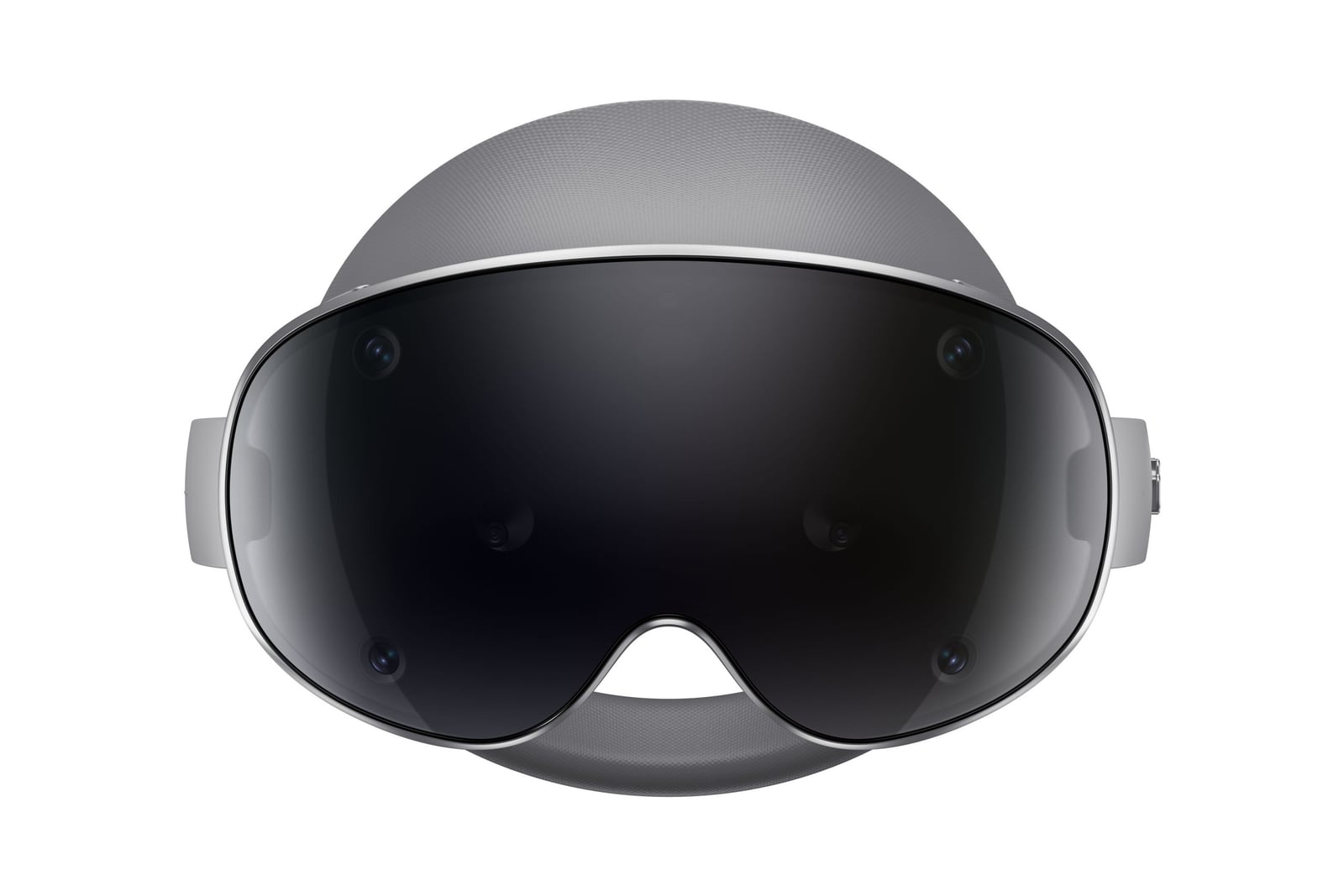
Nothing in the repository names a product or a date. Valve has not commented. Road to VR points out that Deckard, the Frame's own codename, surfaced in code the same way in 2021. The Frame shipped this September. Steam Frame Hub's own guess for Plano is late 2027 at the earliest.
The part Valve has confirmed
The week's other Frame hardware story is a month old. Road to VR reported today, via Skarred Ghost, that Valve is building a strap with hot-swappable batteries. The confirmation itself ran in PC Gamer's September 14 review: Valve "confirmed to us it is working on a new strap with hot-swappable batteries and BMR drivers to match the excellent speakers on the Valve Index." PC Gamer called it "a swap-in upgrade for the modular Frame" with "no launch information."
BMR drivers are what the Index's off-ear speakers used. Valve is clearing out the last Index stock this week. The battery half matters more. The current pack is rated 21.6 watt-hours by Valve and 20.9 on the cells iFixit opened. Valve has given no capacity for the new pack and no price or ship date for the strap.
What it means if you are waiting
Valve's October 9 update told reservation holders their order email arrives "either by December, or in 2027." That is a shipping product on a stated clock, and the Steam Frame hub tracks every date Valve has given. Plano, as of its last commit, is one working mode at a quarter of its pixels, tested on development boards from the current Frame.
The driver spells foveal correctly in fewer than a third of its attempts.
Anyone deciding between a queue spot and an OLED wait is choosing between a headset with a date and a driver with one switch set to true.
Advertisement